




West Coast bid for new flood protection funds
From local democracy reporter Brendon McMahon:
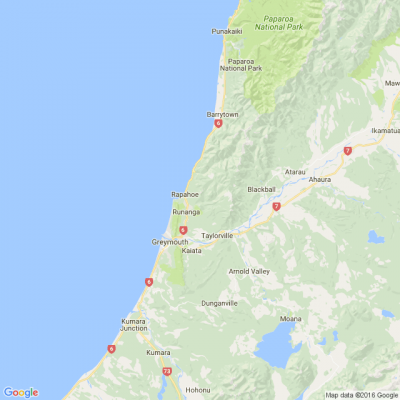
As pressure mounts on the Government's purse strings in the wake of Cyclone Gabrielle, the West Coast Regional Council is pushing the case for a further $23 million of flood protection.
However, the council's Infrastructure Governance Committee heard on Tuesday the North Island experience now strengthened the case for co-funding to protect communities from climate-driven events.
Chief executive Heather Mabin noted in a report, a national initiative had already been tabled with the Government for immediate and ongoing investment in flood protection in the regions.
In response to Cyclone Gabrielle, Te Uru Kahika which represents regional and unitary councils, sent a memorandum to Kanoa, the infrastructure division of MBIE setting out the case for co-investment.
It endorsed the regional councils' request for funding for the 2024 year, including on the West Coast.
This was for:
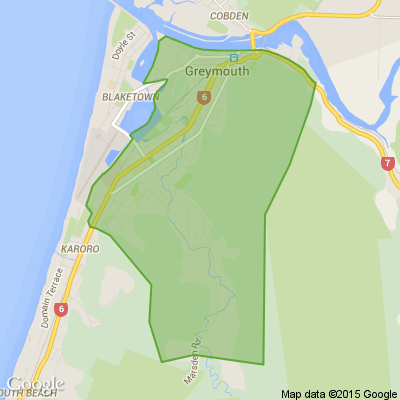
* $4m Cobden seawall, in 2024;
* $2m Hokitika River stopbanks, in 2024;
* $7m Wanganui River scheme, in 2024-25;
* $10m stage two of the Waiho (Waiau) River scheme, in 2024.
Infrastructure Governance Committee chairperson Frank Dooley said the council had been undertaking an "enormous" amount of activity already around infrastructure, including for a Westport scheme.
It had been struggling with capacity, as had been seen with the delay to fix the breach in the Wanganui River northern stopbank. As a result, farmland had flooded last week and there were "lessons to be learned".
"On the face of it we didn't act with the urgency that was required."
At the same time, the council was ready a month ahead of time with its own $10.2m flood protection scheme for Westport, outside what the Government may decide around co-funding the larger $56m proposal.
"That creates some momentum," he said.
Dooley paid tribute to chief executive Heather Mabin for her work on that, "on behalf of the people of Buller".
He also noted from the Te Uru Kahika reports, "that there is a requirement for co-funded adaptation to climate change".
Mabin said the reports showed the impetus for co-investment "has not gone away as a result of Cyclone Gabrielle".
It was also vital to demonstrate to the community the council was still working to reinforce the co-funding argument.
Dooley referred to the Canterbury earthquakes and the implementation of red zones, with future implications for the Coast.
"From the point of view of our communities, some are going to be faced with red zoning."
However, budget day in May would the important indicator for the West Coast.
"Once it's delivered and there is a platform for co-funding we can move a hell of a lot quicker," Dooley said.
Councillor Peter Haddock said the regional council was "ahead of the game" and well prepared in light of the natural events it had dealt with, and a lot of ground work done now for new protection investment.
"It's lucky this council has invested in that professional knowledge."
Dooley said if the council were to get co-funding for the four projects outlined in the report, "then we're going to be pretty busy" in the next few years.
Haddock also noted a call in recent times to "re-wild" rivers and to retreat communities, but he said that was not possible in some communities.
Westport was a good example and if retreat were the option then it would have to be an "intergenerational" shift given the capital values involved.
The Greymouth protection scheme 30 years ago was a good example of enabling community confidence, with new development now happening on the back of planned improvements to the existing floodwall scheme.
Dooley said a recent Sunday television programme on Westport adaptation had portrayed an "outdated and sad" view which was not realistic.
"It's a nonsense."

Don't overthink this riddle...
I have a silver sole
but no feet,
I make my living by bringing the heat.
What am I?
Do you think you know the answer? Simply 'Like' this post if you know the answer and the big reveal will be posted in the comments at 2pm on the day!
Want to stop seeing these in your newsfeed?
Head here and hover on the Following button on the top right of the page (and it will show Unfollow) and then click it. If it is giving you the option to Follow, then you've successfully unfollowed the Riddles page.


Poll: Does a savoury scone require cheese on top, or folded inside?
Help settle the great kiwi debate ... cheese on top, or folded inside?

-
76.5% Inside!
-
23.5% On top!

A reminder this hunting season
As thousands of hunters are making their plans for autumn – the Roar – recreational firearms groups are urging hunters to always be 100% sure of their targets.
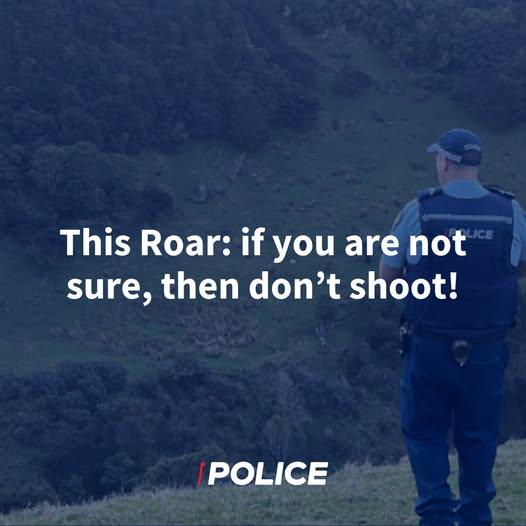
Te Tari Pureke - Firearms Safety Authority NZ, which chairs the Recreational Firearms Users Group, has begun a public information campaign reminding hunters everywhere of Rule #4 of the Firearms Safety Code: to identify their target beyond all doubt.
Director Communities and Corporate, Mike McIlraith, says there is an estimated 50,000-60,000 New Zealanders involved in big game animal hunting each year, and the Roar is the key event for many hunters each year.
“The Roar is a fantastic time of year for hunters to get out into the hills after a trophy animal but hunting safely and making sure everyone gets home in one piece, still must be the most important goal of every trip,” says Mike McIlraith.
“The consequences of not fully identifying your target beyond all doubt can be catastrophic. Our message to hunters is a really simple one: If you are not sure, then don’t shoot.”
Mike McIlraith says while hunting fatalities are thankfully rare, research has shown that misidentification of the target is the largest firearms related risk to New Zealand deer hunters, and 80% of the time this involves members of the same hunting group.
The Authority says hunters should not feel pressured to take a shot: “Instead, hunters should take the time to analyse their target, wait and see if it is a hind or stag, how old is the animal, how many points does its antlers have? Identifying your target means never firing at sound, shape, colour or movement alone.”
Mike McIlraith says good hunters will slow down, and run through some simple mental checks:
- Can I see the whole animal, or could this be another hunter?
- Where are my hunting companions – could this be them or someone else?
- How much of the animal can you see, if it is a hind or stag, how old is the animal, how - many points does its antlers have?
“Taking a little extra time to identify your target and check the firing zone is the key to safer hunting. No meat or no trophy is better than no mate,” he says.
 Loading…