






HOW TO SAY GOODBYE TO YOUR OLD MATTRESS
Mattresses usually last 8-10 years before they need to be replaced. Mattresses are one of the most difficult consumer products to get rid of responsibly. Maybe this is one of the main reasons that they end up on the Curb. But have you ever thought what happens to the old mattress when you leave it on the curb? The size and construction of the mattress create a major problem for the authorities.
"300,000 mattresses are sent to landfill every year in New Zealand – if stacked this pile of unwanted mattresses would reach to the edge of space! This 8100 tonnes of waste cost $14.5 million to landfill every year", says 3R Group Chief Executive Adele Rose.
So what’s the best way to get rid of your old mattress? Here are some of the suggested ways to adios your old Mattress:
Sell it:
If your Mattress is not a home to bed bugs and has no major stains or rips. You can consider to sell it for a nominal fee. Trademe or any other social media platform can help you reach potential buyers. This can be one of the most environmentally friendly options.
Donate the Mattress:
You can check with your local non-profits to see if they accept old mattresses or beds in a donation. Organizations like The Salvation Army & Red Cross have centers where you can drop your good quality old beds & Furniture that can be passed to people in need.
Consider Recycling:
If you're not able to sell or donate your mattress, then you should try to send your mattress to a recycling center. Both consumers and businesses can drop off old mattresses at these centers. Businesses can also arrange direct delivery to a local processing centre. The mattresses are dismantled into raw materials, such as steel, foam, plastic, and fabric which are either recycled or reused. The rebound mattress recycling program is a stewardship program designed to provide a simple and accessible solution enabling consumers to responsibly dispose of unwanted mattresses and bed bases.
Break It Yourself:
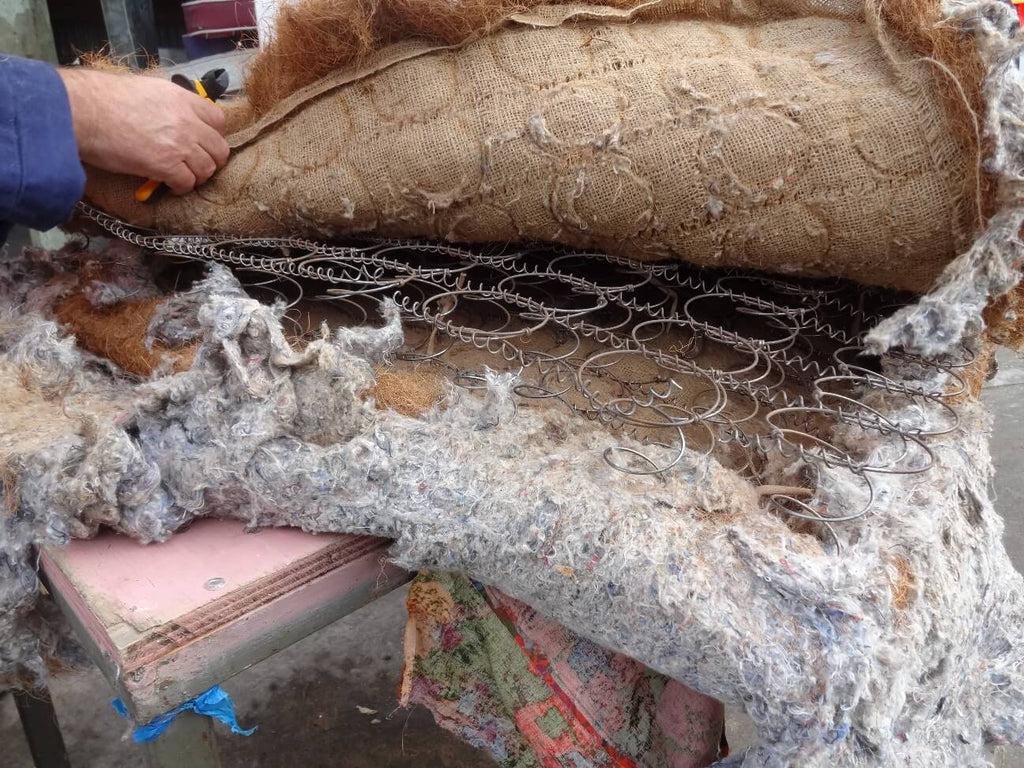
If you have the time, space, and tools, you can easily break a mattress or base yourself. Simply cut around the perimeter of the fabric covering and peel the cloth and foam away from the box springs and wooden frame. You can roll these materials into a compact bundle and put them in your regular trash can. Next, take a saw and cut up the frame you can then burn or turn it into wood chips. Take the box springs to a recycling center or sell them for scrap.
Re-Purposing:
An old mattress can be re-purposed which means putting it to another use. It requires creative imagination to come up with ideas on where to use the old mattress. In Australia, an enterprising group is taking the stuffing out of old mattresses, washing it, and then making punching bags using it as filling. Before you throw away your old mattress consider if you can find a new use for it.
With an estimated 300,000 mattresses and bases sent to landfill every year in New Zealand. That’s the equivalent of twenty-five 20-foot shipping containers filled with these units every single day the community needs to dispose of their old beds responsibly.

Have you got New Zealand's best shed? Show us and win!
Once again, Resene and NZ Gardener are on the hunt for New Zealand’s best shed! Send in the photos and the stories behind your man caves, she sheds, clever upcycled spaces, potty potting sheds and colourful chicken coops. The Resene Shed of the Year 2026 winner receives $1000 Resene ColorShop voucher, a $908 large Vegepod Starter Pack and a one-year subscription to NZ Gardener. To enter, tell us in writing (no more than 500 words) why your garden shed is New Zealand’s best, and send up to five high-quality photos by email to mailbox@nzgardener.co.nz. Entries close February 23, 2026.

Poll: 🤖 What skills do you think give a CV the ultimate edge in a robot-filled workplace?
The Reserve Bank has shared some pretty blunt advice: there’s no such thing as a “safe” job anymore 🛟😑
Robots are stepping into repetitive roles in factories, plants and warehouses. AI is taking care of the admin tasks that once filled many mid-level office jobs.
We want to know: As the world evolves, what skills do you think give a CV the ultimate edge in a robot-filled workplace?
Want to read more? The Press has you covered!

-
52.2% Human-centred experience and communication
-
15% Critical thinking
-
29.9% Resilience and adaptability
-
2.9% Other - I will share below!

The Gospel’s Relevance Today**
The Gospel, meaning ‘good news’, is the cornerstone of the message contained in the Bible’s first four books—Matthew, Mark, Luke, and John. While these records were written approximately 2,000 years ago, a natural question arises: why is this Gospel still relevant and vital for us today? This analysis seeks to explore what the Bible itself defines as the Gospel and to understand its enduring significance.
**Defining the Gospel: Core Biblical References**
The Gospel is not a vague concept; Scripture provides clear descriptions of its content and focus.
* **The Gospel of the Kingdom:** In Matthew 4:23, as Jesus begins his ministry, he is described as “preaching the gospel of the kingdom.” This immediately establishes that the good news is centrally about a kingdom—the Kingdom of God. His accompanying miracles served to validate the authority of this message.
* **The Gospel of Jesus Christ:** Mark 1:1 opens with, “The beginning of the gospel of Jesus Christ, the Son of God.” Here, “Christ” is a title meaning ‘anointed one’. Thus, the good news is intrinsically about Jesus: his identity as the Anointed One and his unique status as the Son of God.
* **The Gospel of God’s Grace:** In Acts 20:24, the Apostle Paul speaks of his mission to “testify the gospel of the grace of God.” Grace signifies an undeserved gift. This reveals that the Gospel involves a gift from God, offered not because it is merited, but out of His benevolence.
* **The Gospel of Salvation and Peace:** Romans 1:16 declares the Gospel is “the power of God to salvation for everyone who believes,” breaking down barriers between Jew and Gentile (Greek). Furthermore, Romans 10:15 calls it the “gospel of peace,” pointing to a future state of peace brought about by this message.
* **The Gospel Summarised:** 1 Corinthians 15:1-4 provides a foundational summary. Paul reminds believers of the gospel he preached, “by which also you are saved.” He then states its core historical facts: “that Christ died for our sins according to the Scriptures, and that He was buried, and that He rose again the third day according to the Scriptures.” The Gospel is therefore rooted in the sacrificial death and resurrection of Jesus.
In synthesis, the Gospel is the good news of **salvation and future peace in the Kingdom of God**, made possible by **the grace of God** and **the obedient sacrifice of His Son, Jesus Christ**, and offered to all who believe.
**Old Testament Foundations: The Gospel Preached to Abraham**
A crucial question is whether the Gospel is confined to the New Testament. Scripture shows its foundations were laid much earlier. Galatians 3:8 states explicitly that “the Scripture, foreseeing that God would justify the Gentiles by faith, preached the gospel to Abraham beforehand, saying, ‘In you all the nations shall be blessed.’”
This reference points back to Genesis 12:1-3, where God made profound promises to Abraham: to make him a great nation, to bless those who blessed him, and that “in you all the families of the earth shall be blessed.” These promises—later reaffirmed to Isaac and Jacob—form the bedrock of the Gospel hope. The good news of salvation through Christ is the fulfillment of how **all nations** would be blessed through Abraham’s “seed.”
**The Gospel’s Personal Relevance: Good News for You Today**
How does this ancient message become “good news for you” today? The application is clearly outlined in Galatians 3.
* **Access through Faith in Christ:** Galatians 3:26 declares, “For you are all sons of God through faith in Christ Jesus.” The promise made to Abraham is now extended to anyone with faith in Jesus.
* **The Role of Baptism:** Verse 27 explains, “For as many of you as were baptized into Christ have put on Christ.” Baptism is the God-appointed act of faith that identifies a believer with Christ’s death and resurrection.
* **Unity and Inheritance:** Verses 28-29 reveal the glorious outcome: “There is neither Jew nor Greek, there is neither slave nor free, there is neither male nor female; for you are all one in Christ Jesus. And if you are Christ’s, then you are Abraham’s seed, and heirs according to the promise.” Through the Gospel, all barriers are removed; believers become spiritual descendants of Abraham and heirs to the promises of the Kingdom.
This Gospel was once a mystery hidden in God’s purpose (Ephesians 3:3-9). Now, it has been revealed: the unsearchable riches of Christ, offering salvation to all who heed the call, believe the message, and are baptised into him.
**Conclusion: An Enduring and Open Invitation**
The Gospel is far more than a historical account; it is the living, powerful good news of God’s plan for salvation. It is rooted in promises to Abraham, accomplished through the death and resurrection of Jesus Christ, and open to all people without distinction. It offers a tangible hope—the hope of resurrection, peace, and an inheritance in the coming Kingdom of God. This is why the Gospel remains profoundly relevant. It is an invitation to listen, believe, and stand firm in this hope, linking our lives today to the eternal purpose of God.
 Loading…