






New multi-billion dollar village planned for Ōwairaka Mt Albert
Plans have been launched for a new multi-billion-dollar Auckland "village within a city, an urban kāinga" of 40 new apartment buildings with more than 3000 units on land within the established suburb of Ōwairaka Mt Albert.
Paul Majurey, Marutūāhu chairman, has announced a scheme with Ockham Residential for the newly-created, newly-named suburb, Maungārongo beside Unitec and the old Carrington Hospital.
The Marutūāhu-Ockham Partnership plans work in the next 20 years within the larger Te Auaunga Precinct: nearly 40ha around the ex-hospital and neighbouring university being developed by three rōpū - Marutūāhu, Waiohua-Tāmaki and Ngāti Whātua Ōrakei.
Majurey said the almost 11ha share of Marutūāhu land would bring new mixed-use buildings to the established Ōwairaka Mt Albert community.
"It's a staged development, a 10 to 15-year project which in time will have over 3000 homes across 40 buildings. It's a village within a city, an urban kāinga," said Majurey, also chairman of Eke Panuku Development Auckland.
Mayor Wayne Brown has called for Majurey and all Eke Panuku board members to resign.
Marutūāhu has master planning under way on the 10.5ha it has been allocated but hasn't released plans for all 40 buildings yet.
To begin, it will work at the Point Chevalier end of the site near the historic brick ex-hospital building, developing four new apartment buildings up to 10 levels high and with around 280 units. Those first four buildings will be developed on around 1ha of the 10.5ha rōpū site.
"Our allocation is nearly 11ha, a strip about 200m wide which begins beside Point Chevalier village and continues for 800m along Carrington Rd up towards Mt Albert/Ōwairaka," Majurey said.
Marutūāhu had given the planned village the name Maungārongo: "There are layers to its meaning of peace. It is an etymological nod to the famous Tūpuna Maunga of Tāmaki Makaurau," Majurey said.
Master planning for other planned projects are for a " metro supermarket, medical centre, creche, 24-hour gym, swimming pool, cafes, restaurants, commercial spaces, co-working offices, playgrounds, recreational spaces, community gardens", Toi's brochure says.
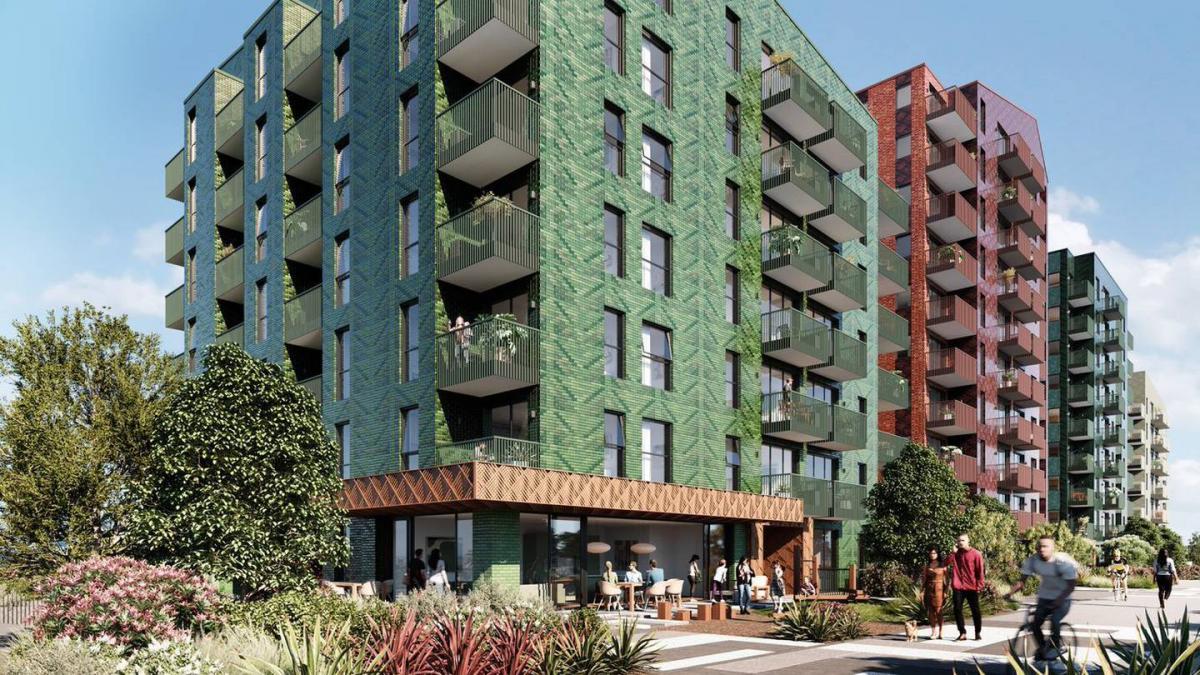
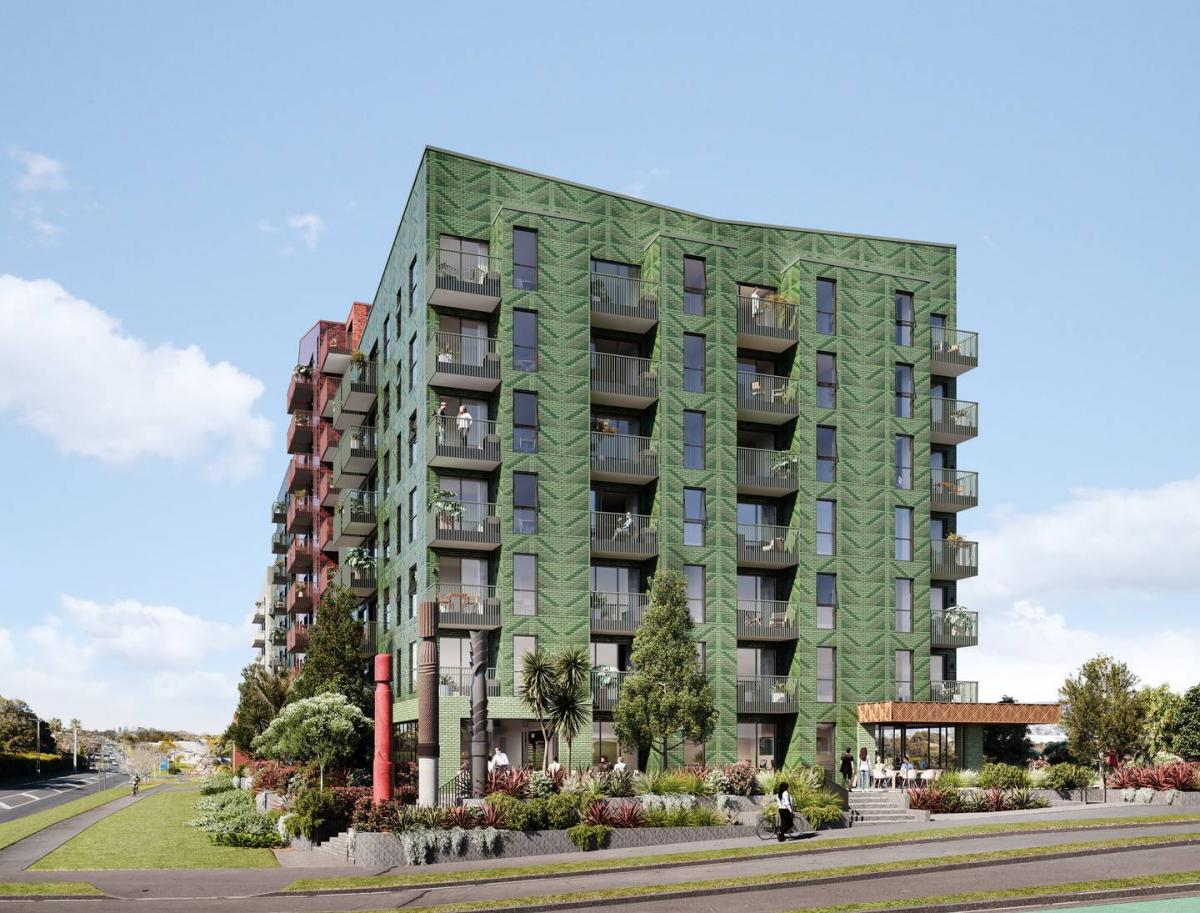
Toi [meaning art and knowledge] is a proposed 65-unit seven-level building with studio, one, two and three-bedroom places with commercial ground-level spaces including for food and beverage operations. The partnership has now begun marketing pre-sales there.
"We appreciate we're launching in a soft market," Majurey said of Auckland residential prices, dropping since the market peaked last November.
Studio units in Toi start at $530,000 and begin at $960,000 for a three-bedroom place but the aim is for them to be affordable, he said. The site will have cycleways and walkways, with some car parking in screened areas. Two-bedrooms start at $730,000.
"We don't want thoroughfares in terms of internal roads," Majurey said.
Ockham's Mark Todd said Toi's construction was scheduled to start next July and be finished 16 months later. That first building was designed by architect Hannah Chiaroni-Clarke and Majurey said the architecture would reflect te ao Māori including art, design and culture.
"This project is our contribution to an Aotearoa aesthetic," Chiaroni-Clarke said, "a reimagining of what multi-density housing can look like."
Majurey said: "The inspiration for Toi was from Hotunui", referring to the great wharenui of Ngāti Mauru/Marutūāhu inside Tāmaki Paenga Hira Auckland War Memorial Museum.
Exterior colours and design features on the four planned apartment buildings pay homage to growth and use phases of the harakeke plant:
• Mid-green new shoot phase for the first apartment block, Toi;
• Dark purple and red for the second 10-level building, representing the kakau and korari, the stalk and flower of the stem of the harakeke;
• Darker green for the more mature growth phase or awhi rito, the parent, in the third nine-level building;
• Silvery green representing the woven phase of the tūpuna or older leaves for the fourth seven-level block.
Housing Minister Megan Woods was at the opening of the partnership's new Waterview building last year.
Kōkihi is a 95-apartment scheme, the second by the Pākehā/Māori collaboration which is developing 541 affordable new units in four blocks, worth $300m and many KiwiBuild properties.
Woods said last year that Kōkihi was delivered ahead of schedule and an example of how to do great development.
"Exemplary developments" from the partnership completed were the already-opened Tuatahi in Mt Albert and now Kōkihi, "instantly recognisable with their brick facades and motifs and the next two will be equally impressive", she said of the under-construction Aroha at 1817 Great North Rd, Avondale and Manaaki at 9 Jordan Ave, Onehunga.
"We've taken seven houses and created 95 new apartments. There are 95 new apartments on land where seven houses once stood and it's 10km from the CBD, on cycleways, bus routes," Woods said last winter, emphasising the new uses of Auckland land with intensive housing models.
Ngāti Whātua Ōrākei's investment arm is also planning its first 38 homes at the Carrington/Unitec site.
Ngāti Whātua Ōrākei Whai Rawa's property general manager Neil Donnelly said last month: "We're weeks away from applying for resource consent for the first 38 on the southern part of the site near Woodward Rd. It will be all terraced housing. We'd plan to start building next year."
The Ministry of Housing and Urban Development says of the 39.7ha site: "The project is a large-scale urban development led by the three Tāmaki Makaurau rōpū of Marutūāhu, Ngāti Whātua and Waiohua-Tāmaki and their project partners. It is being facilitated by the Crown via Te Tūāpapa Kura Kāinga the Ministry of Housing and Urban Development."
In 2018, Prime Minister Jacinda Ardern announced the development at Unitec's Te Noho Kotahitanga Marae in her Mt Albert electorate, saying the mix of affordable and open-market housing would include parks, shops and a new school.
===================================================


Have you got New Zealand's best shed? Show us and win!
Once again, Resene and NZ Gardener are on the hunt for New Zealand’s best shed! Send in the photos and the stories behind your man caves, she sheds, clever upcycled spaces, potty potting sheds and colourful chicken coops. The Resene Shed of the Year 2026 winner receives $1000 Resene ColorShop voucher, a $908 large Vegepod Starter Pack and a one-year subscription to NZ Gardener. To enter, tell us in writing (no more than 500 words) why your garden shed is New Zealand’s best, and send up to five high-quality photos by email to mailbox@nzgardener.co.nz. Entries close February 23, 2026.

Poll: 🤖 What skills do you think give a CV the ultimate edge in a robot-filled workplace?
The Reserve Bank has shared some pretty blunt advice: there’s no such thing as a “safe” job anymore 🛟😑
Robots are stepping into repetitive roles in factories, plants and warehouses. AI is taking care of the admin tasks that once filled many mid-level office jobs.
We want to know: As the world evolves, what skills do you think give a CV the ultimate edge in a robot-filled workplace?
Want to read more? The Press has you covered!

-
52.1% Human-centred experience and communication
-
15.1% Critical thinking
-
30% Resilience and adaptability
-
2.9% Other - I will share below!

The Gospel’s Relevance Today**
The Gospel, meaning ‘good news’, is the cornerstone of the message contained in the Bible’s first four books—Matthew, Mark, Luke, and John. While these records were written approximately 2,000 years ago, a natural question arises: why is this Gospel still relevant and vital for us today? This analysis seeks to explore what the Bible itself defines as the Gospel and to understand its enduring significance.
**Defining the Gospel: Core Biblical References**
The Gospel is not a vague concept; Scripture provides clear descriptions of its content and focus.
* **The Gospel of the Kingdom:** In Matthew 4:23, as Jesus begins his ministry, he is described as “preaching the gospel of the kingdom.” This immediately establishes that the good news is centrally about a kingdom—the Kingdom of God. His accompanying miracles served to validate the authority of this message.
* **The Gospel of Jesus Christ:** Mark 1:1 opens with, “The beginning of the gospel of Jesus Christ, the Son of God.” Here, “Christ” is a title meaning ‘anointed one’. Thus, the good news is intrinsically about Jesus: his identity as the Anointed One and his unique status as the Son of God.
* **The Gospel of God’s Grace:** In Acts 20:24, the Apostle Paul speaks of his mission to “testify the gospel of the grace of God.” Grace signifies an undeserved gift. This reveals that the Gospel involves a gift from God, offered not because it is merited, but out of His benevolence.
* **The Gospel of Salvation and Peace:** Romans 1:16 declares the Gospel is “the power of God to salvation for everyone who believes,” breaking down barriers between Jew and Gentile (Greek). Furthermore, Romans 10:15 calls it the “gospel of peace,” pointing to a future state of peace brought about by this message.
* **The Gospel Summarised:** 1 Corinthians 15:1-4 provides a foundational summary. Paul reminds believers of the gospel he preached, “by which also you are saved.” He then states its core historical facts: “that Christ died for our sins according to the Scriptures, and that He was buried, and that He rose again the third day according to the Scriptures.” The Gospel is therefore rooted in the sacrificial death and resurrection of Jesus.
In synthesis, the Gospel is the good news of **salvation and future peace in the Kingdom of God**, made possible by **the grace of God** and **the obedient sacrifice of His Son, Jesus Christ**, and offered to all who believe.
**Old Testament Foundations: The Gospel Preached to Abraham**
A crucial question is whether the Gospel is confined to the New Testament. Scripture shows its foundations were laid much earlier. Galatians 3:8 states explicitly that “the Scripture, foreseeing that God would justify the Gentiles by faith, preached the gospel to Abraham beforehand, saying, ‘In you all the nations shall be blessed.’”
This reference points back to Genesis 12:1-3, where God made profound promises to Abraham: to make him a great nation, to bless those who blessed him, and that “in you all the families of the earth shall be blessed.” These promises—later reaffirmed to Isaac and Jacob—form the bedrock of the Gospel hope. The good news of salvation through Christ is the fulfillment of how **all nations** would be blessed through Abraham’s “seed.”
**The Gospel’s Personal Relevance: Good News for You Today**
How does this ancient message become “good news for you” today? The application is clearly outlined in Galatians 3.
* **Access through Faith in Christ:** Galatians 3:26 declares, “For you are all sons of God through faith in Christ Jesus.” The promise made to Abraham is now extended to anyone with faith in Jesus.
* **The Role of Baptism:** Verse 27 explains, “For as many of you as were baptized into Christ have put on Christ.” Baptism is the God-appointed act of faith that identifies a believer with Christ’s death and resurrection.
* **Unity and Inheritance:** Verses 28-29 reveal the glorious outcome: “There is neither Jew nor Greek, there is neither slave nor free, there is neither male nor female; for you are all one in Christ Jesus. And if you are Christ’s, then you are Abraham’s seed, and heirs according to the promise.” Through the Gospel, all barriers are removed; believers become spiritual descendants of Abraham and heirs to the promises of the Kingdom.
This Gospel was once a mystery hidden in God’s purpose (Ephesians 3:3-9). Now, it has been revealed: the unsearchable riches of Christ, offering salvation to all who heed the call, believe the message, and are baptised into him.
**Conclusion: An Enduring and Open Invitation**
The Gospel is far more than a historical account; it is the living, powerful good news of God’s plan for salvation. It is rooted in promises to Abraham, accomplished through the death and resurrection of Jesus Christ, and open to all people without distinction. It offers a tangible hope—the hope of resurrection, peace, and an inheritance in the coming Kingdom of God. This is why the Gospel remains profoundly relevant. It is an invitation to listen, believe, and stand firm in this hope, linking our lives today to the eternal purpose of God.
 Loading…