






Poll: How should our kerbside rubbish collection services be paid for?
Kia ora Tāmaki Makaurau.
Auckland Council is looking to scrap bin tags in parts of Auckland.
The bin tags – or a pay as you throw (PAYT) system – were rolled out in West Auckland, Papakura and on the North Shore between 2017 and 2018.
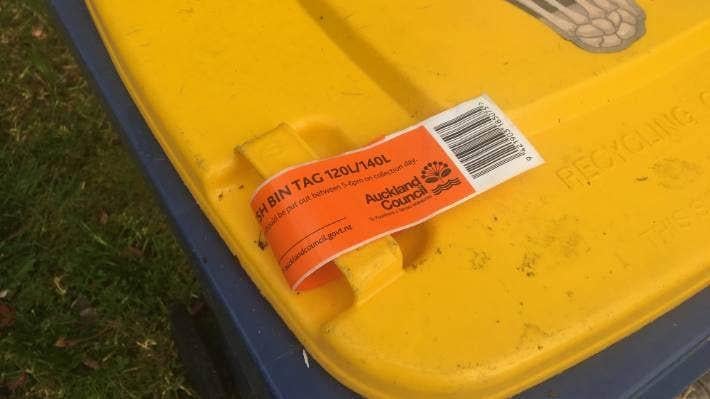
Rather than paying for kerbside rubbish collection as part of their rates, residents in these areas purchase bin tags from supermarkets, council service centres and libraries, and attach them to their bin on rubbish collection day.
The bin tags were part of the council’s strategy to achieve its goal of zero waste to landfill by 2040, with one standard sized bin (120L, bin tag cost $4.25) fitting the equivalent of, and removing the need for, two plastic rubbish bags.
The council had planned on rolling out this system across the entire region, however it now believes it is too expensive to operate and lacks the financial incentive needed to make people reduce their waste.
Now, it is proposing to move the entire region to a rates-funded collection service, with the choice of three rubbish bin sizes to cater to different household needs and costs.
If the proposal to goes ahead, it is estimated Aucklanders will pay $314 per year for their rubbish, recycling and inorganic collection. Including food scraps collection, this will cost $375.
If the entire region moves to a PAYT system, it is expected each household would spend $353 on bin tags each year, or $415 including food scraps collection. This estimate is based on the current average collection rate of a household with a standard 120L bin.
Consultation on the matter will begin on February 28. So, what do you think should happen?
Read more here: www.stuff.co.nz...
-
34.6% Bin tags make me consider what I send to landfill
-
40.2% Rates-funded collection is easier than using bin tags
-
19.9% Rates-funded collection, but bin tags available for those with little waste
-
5.4% Undecided - tell us in the comments

A Neighbourly Riddle! Don’t Overthink It… Or Do?😜
Do you think you know the answer? Simply 'Like' this post if you know the answer and the big reveal will be posted in the comments at 2pm on the day!
If you multiply this number by any other number, the answer will always be the same. What number is this?


Poll: As a customer, what do you think about automation?
The Press investigates the growing reliance on your unpaid labour.
Automation (or the “unpaid shift”) is often described as efficient ... but it tends to benefit employers more than consumers.
We want to know: What do you think about automation?
Are you for, or against?
-
9.5% For. Self-service is less frustrating and convenient.
-
43.5% I want to be able to choose.
-
47.1% Against. I want to deal with people.

Even Australians get it - so why not Kiwis???
“Ten years ago, if a heatwave as intense as last week’s record-breaker had hit the east coast, Australia’s power supply may well have buckled. But this time, the system largely operated as we needed, despite some outages.
On Australia’s main grid last quarter, renewables and energy storage contributed more than 50% of supplied electricity for the first time, while wholesale power prices were more than 40% lower than a year earlier.
[…] shifting demand from gas and coal for power and petrol for cars is likely to deliver significantly lower energy bills for households.
Last quarter, wind generation was up almost 30%, grid solar 15% and grid-scale batteries almost tripled their output. Gas generation fell 27% to its lowest level for a quarter century, while coal fell 4.6% to its lowest quarterly level ever.
Gas has long been the most expensive way to produce power. Gas peaking plants tend to fire up only when supply struggles to meet demand and power prices soar. Less demand for gas has flowed through to lower wholesale prices.”
Full article: www.theguardian.com...
If even Australians see the benefit of solar - then why is NZ actively boycotting solar uptake? The increased line rental for electricity was done to make solar less competitive and prevent cost per kWh to rise even more than it did - and electricity costs are expected to rise even more. Especially as National favours gas - which is the most expensive form of generating electricity. Which in turn will accelerate Climate Change, as if New Zealand didn’t have enough problems with droughts, floods, slips, etc. already.
 Loading…