





Canterbury councils team up to tackle climate change
By David Hill, Local Democracy Reporter
North Canterbury’s three councils have thrown their weight behind a plan to tackle climate change.
The Waimakariri, Hurunui and Kaikōura councils have endorsed the Canterbury Mayoral Forum’s draft climate partnership plan.
Waimakariri mayor Dan Gordon, who chairs the mayoral forum’s climate action reference group, said by working together larger councils could help the smaller councils.
‘‘Climate change doesn’t recognise territorial boundaries, so we need something that works across Canterbury.
‘‘Christchurch is further ahead, which is fantastic, and in Waimakariri we are developing our work programme.’’
The Waimakariri District Council adopted its natural environment strategy at a council meeting last week, after completing its consultation alongside the long-term plan.
The 30-year strategy aims to protect the district’s natural ecosystems and its special indigenous biodiversity.
Gordon said the mayors hoped to officially launch the Canterbury Climate Partnership Plan later this year and he planned to invite Climate Change Minister Simon Watts.
‘‘I have raised with the Minister about attending a public launch to provide some inspiration of what can be done in other regions.’’
The plan sets out 10 climate actions to help the 11 Canterbury councils prepare for ‘‘a sustainable future’’.
The actions included understanding climate risks and improving resilience, reducing emissions, adaptation planning, nature-based solutions, education and advocacy, supporting papatipu rūnanga, integrating climate change considerations into council processes, identifying co-funding opportunities, monitoring and evaluation, and implementation.
Hurunui mayor Marie Black said her council had endorsed the plan in principle.
The Hurunui District Council was represented on the climate action reference group by Councillor Dave Hislop, a dairy farmer.
‘‘Dave brings a pragmatic approach and he is grounded in farming principles,’’ Black said.
Hislop and other rural councillors had questioned aspects of the plan and science behind it, before giving their support, chief executive Hamish Dobbie said.
‘‘I think it has been through a robust process and councillors of all persuasions have been involved.
‘‘We might not 100% agree with everything, but it is important Canterbury stands together and is seen to be working together.
‘‘There is a desire for us to thrive and do well and loom large in the consciousness of the Government and the Canterbury Climate Partnership Plan is just one of those things which we are working on collectively.’’
Kaikōura District Council chief executive Will Doughty said his council had endorsed the plan and budgeted for its contribution over the next three years in its long-term plan.
‘‘We believe it is a great initiative to be looking at the issues from a wider regional perspective.
‘‘We are very keen to see some tangible outcomes from the climate actions.’’
■ LDR is local body journalism co-funded by RNZ and NZ On Air.

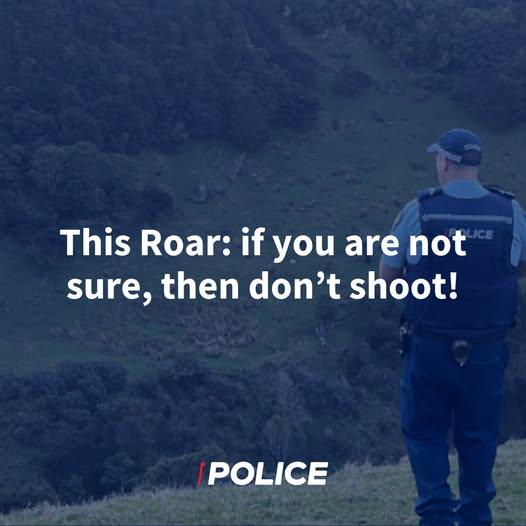
A reminder this hunting season
As thousands of hunters are making their plans for autumn – the Roar – recreational firearms groups are urging hunters to always be 100% sure of their targets.
Te Tari Pureke - Firearms Safety Authority NZ, which chairs the Recreational Firearms Users Group, has begun a public information campaign reminding hunters everywhere of Rule #4 of the Firearms Safety Code: to identify their target beyond all doubt.
Director Communities and Corporate, Mike McIlraith, says there is an estimated 50,000-60,000 New Zealanders involved in big game animal hunting each year, and the Roar is the key event for many hunters each year.
“The Roar is a fantastic time of year for hunters to get out into the hills after a trophy animal but hunting safely and making sure everyone gets home in one piece, still must be the most important goal of every trip,” says Mike McIlraith.
“The consequences of not fully identifying your target beyond all doubt can be catastrophic. Our message to hunters is a really simple one: If you are not sure, then don’t shoot.”
Mike McIlraith says while hunting fatalities are thankfully rare, research has shown that misidentification of the target is the largest firearms related risk to New Zealand deer hunters, and 80% of the time this involves members of the same hunting group.
The Authority says hunters should not feel pressured to take a shot: “Instead, hunters should take the time to analyse their target, wait and see if it is a hind or stag, how old is the animal, how many points does its antlers have? Identifying your target means never firing at sound, shape, colour or movement alone.”
Mike McIlraith says good hunters will slow down, and run through some simple mental checks:
- Can I see the whole animal, or could this be another hunter?
- Where are my hunting companions – could this be them or someone else?
- How much of the animal can you see, if it is a hind or stag, how old is the animal, how - many points does its antlers have?
“Taking a little extra time to identify your target and check the firing zone is the key to safer hunting. No meat or no trophy is better than no mate,” he says.

Autumn Sale on Now
We have slashed the prices of 100s of trees, shrubs, flowering plants, hedging and more.
✅$5 Cupressus Stricta 1.5L and Agapanthus 7cm!
✅5 Beech tree's for $100 🏖🏖!!!
✅3.5M tall London Planes ✈ for $27.50
✅ Instant Hedges of Pitto Small ball - Coprosma Lobster $37.50
✅ $11 Lemon Tree's 🍋🍋🍋!
✅ 50% off Azalea Autumn series $17.50
www.cjsplants.co.nz...


Poll: Does a savoury scone require cheese on top, or folded inside?
Help settle the great kiwi debate ... cheese on top, or folded inside?

-
76.4% Inside!
-
23.6% On top!
 Loading…