




Forest slash on Coast radar
From local democracy reporter Brendon McMahon:
The West Coast Regional Council hired a helicopter to check the forest slash following a cloudburst in December.
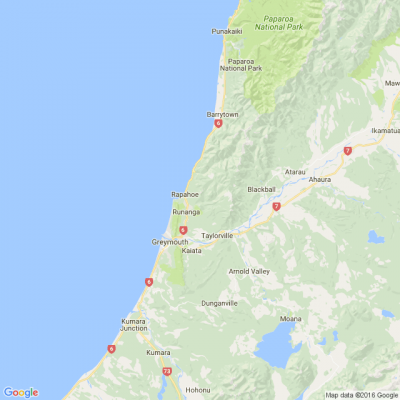
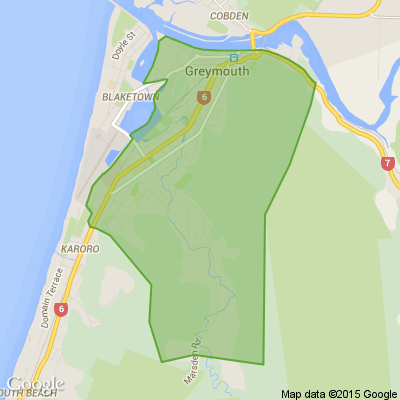
The localised 'cloudburst' in the Grey Valley on December 19 sent a wall of logs down Callaghans Creek at Matai, washing out an approach to a rail bridge on the Stillwater-Westport rail link and closing the line for days.
Councillor Peter Ewen raised the matter at a council meeting this week, in the aftermath of Cyclone Gabrielle.
Acting consents and compliance manager Rachel Clark said that following their investigation into the Matai incident, the council decided that forestry slash "wasn't the total story".
The West Coast experience was that forestry slash was not a particular problem, the meeting heard.
"It is not to the scale here on the Coast that it is there. Certainly what's in the rules allows (foresters) to do what they do with the slash, but that's something going forward that everybody has to reach an agreement as to how the best way to handle it is."
Clark noted there was a requirement which meant "a certain proportion" of cutover material had to be left on the ground after felling to protect the slopes from eroding.
"That's why they do it. There's no doubt there needs to be better ways to (manage) it in the future, but they're not currently doing anything they're not supposed to do."
Following the meeting, Clark said at the time of the Matai incident, the council sent compliance staff up in a helicopter to check the creek catchment above where the damage to the rail corridor occurred.
While they observed "a small amount" of exotic plantation slash, the majority of the contributing problem at Matai was from fallen indigenous trees, following slips in the area as a result of the localised 'cloudburst'.
In her 18 years in the council compliance team, the issue of plantation forest slash had not been remarkable, however that was not to say it would be increasingly evident.
"It's not something that ever comes up as a major problem ... for us it hasn't been what it's like in the North Island. I haven't had too many inquiries."
At this point the regional council did not have a specific rule addressing forest slash, but it could never rule that out.
Forestry operators also had to work to resource consent conditions which were monitored by the council.
The fact some West Coast stream catchments are at a critical erosion point due to the loss of indigenous vegetation killed off by Cyclone Ita eight years ago, is on council's radar.
A case study by council engineer Paulette Birchfield on river and slope stability in the catchment of Lake Stream, a tributary of Mount Rochfort behind Westport, and on hillsides above Barrytown, was presented to the council nearly a year ago.
Her investigation showed the slopes in those locations, and others, were at "a threshold condition" and at a point of "mass movement", ranging from 'soil creep' to landslides.
The effects were being monitored at various sites and becoming critical.

Don't overthink this riddle...
I have a silver sole
but no feet,
I make my living by bringing the heat.
What am I?
Do you think you know the answer? Simply 'Like' this post if you know the answer and the big reveal will be posted in the comments at 2pm on the day!
Want to stop seeing these in your newsfeed?
Head here and hover on the Following button on the top right of the page (and it will show Unfollow) and then click it. If it is giving you the option to Follow, then you've successfully unfollowed the Riddles page.


Poll: Does a savoury scone require cheese on top, or folded inside?
Help settle the great kiwi debate ... cheese on top, or folded inside?

-
76.5% Inside!
-
23.5% On top!

A reminder this hunting season
As thousands of hunters are making their plans for autumn – the Roar – recreational firearms groups are urging hunters to always be 100% sure of their targets.
Te Tari Pureke - Firearms Safety Authority NZ, which chairs the Recreational Firearms Users Group, has begun a public information campaign reminding hunters everywhere of Rule #4 of the Firearms Safety Code: to identify their target beyond all doubt.
Director Communities and Corporate, Mike McIlraith, says there is an estimated 50,000-60,000 New Zealanders involved in big game animal hunting each year, and the Roar is the key event for many hunters each year.
“The Roar is a fantastic time of year for hunters to get out into the hills after a trophy animal but hunting safely and making sure everyone gets home in one piece, still must be the most important goal of every trip,” says Mike McIlraith.
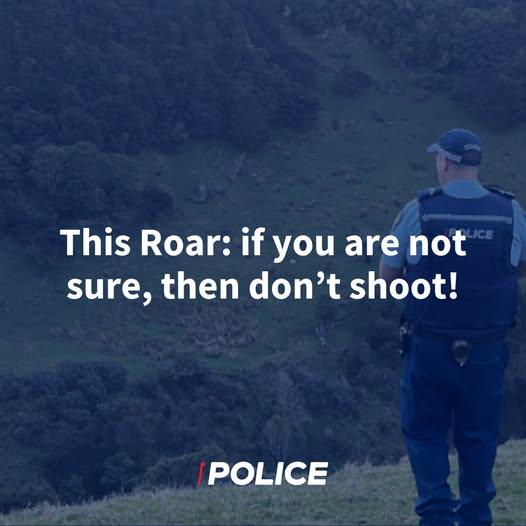
“The consequences of not fully identifying your target beyond all doubt can be catastrophic. Our message to hunters is a really simple one: If you are not sure, then don’t shoot.”
Mike McIlraith says while hunting fatalities are thankfully rare, research has shown that misidentification of the target is the largest firearms related risk to New Zealand deer hunters, and 80% of the time this involves members of the same hunting group.
The Authority says hunters should not feel pressured to take a shot: “Instead, hunters should take the time to analyse their target, wait and see if it is a hind or stag, how old is the animal, how many points does its antlers have? Identifying your target means never firing at sound, shape, colour or movement alone.”
Mike McIlraith says good hunters will slow down, and run through some simple mental checks:
- Can I see the whole animal, or could this be another hunter?
- Where are my hunting companions – could this be them or someone else?
- How much of the animal can you see, if it is a hind or stag, how old is the animal, how - many points does its antlers have?
“Taking a little extra time to identify your target and check the firing zone is the key to safer hunting. No meat or no trophy is better than no mate,” he says.
 Loading…