




Westport disaster a ‘bottom of the cliff’ approach — new report
From local democracy reporter Brendon McMahon:
Westport is an example of a 'bottom of the cliff' approach to disaster response and recovery, according to a new report.
Te Uru Kahika, representing the country's regional and unitary council sector, is advocating the Government co-invest in a whole range of projects to reduce flood risk to communities.
As Westport waits with bated breath for an answer on the $56 million proposed flood scheme, Te Uru Kahika says it is not clear how the Government intends to address the case.
"Te Uru Kahika members remain totally supportive of the West Coast councils' request for Government co-investment of $45m," the report says.
The business case was lodged last June following a request in February 2022 from then Local Government Minister Nania Mahuta for a co-investment proposal.
Te Uru Kahika describes the Westport case as "a fair cost share".
It asked that it considered together with a broader scheme, which would require the Government to put up $257m to accelerate 92 proposed flood schemes across the country.
"There is an overwhelming national interest in Government assisting to resolve Aotearoa's flood protection challenge."
It suggests the Government partner with the sector by:
-Firstly, committing $257m in the 2023 budget alongside regional council co-investment to collaborate on delivery of a three-year programme of 92 "carefully selected" flood protection projects worth a total of $428m;
-Committing to a long term "collaborative, multi-tool, and well funded" co-investment approach to build resilience against flood risks.
The report said Westport was "a regretful example" of a bottom of the cliff response and recovery, as opposed to the other scheme proposals captured under the $257m co-investment request.
It says floods are New Zealand's No 1 natural hazard and are escalating, consistent with international trends.
The regional and unitary council sector already invested about $200m a year to sustain and improve flood infrastructure. But that investment, with other flood mitigation measures undertaken by councils, could not on their own provide the security and risk mitigation/community resilience now expected of flood schemes.
Increased co-investment alongside broader measures would be required to meet the challenge.
"A step change is required. Measured urgency is needed to adapt existing flood protection measures to be fit to meet present and future risk management expectations. It is clearly in the
national interest that these adaptations occur."
Increased Government and council co-investment was required, and accelerating climate-induced high magnitude floods meant that "now is the time for action".
Te Uru Kahika said it had been attempting to push the case for Government co-investment in flood protection schemes since at least
2018.
"Our efforts have been well received but we are yet to secure the longer-term decisions, co-investment funding and partnership certainty."

Don't overthink this riddle...
I have a silver sole
but no feet,
I make my living by bringing the heat.
What am I?
Do you think you know the answer? Simply 'Like' this post if you know the answer and the big reveal will be posted in the comments at 2pm on the day!
Want to stop seeing these in your newsfeed?
Head here and hover on the Following button on the top right of the page (and it will show Unfollow) and then click it. If it is giving you the option to Follow, then you've successfully unfollowed the Riddles page.


Poll: Does a savoury scone require cheese on top, or folded inside?
Help settle the great kiwi debate ... cheese on top, or folded inside?

-
76.5% Inside!
-
23.5% On top!

A reminder this hunting season
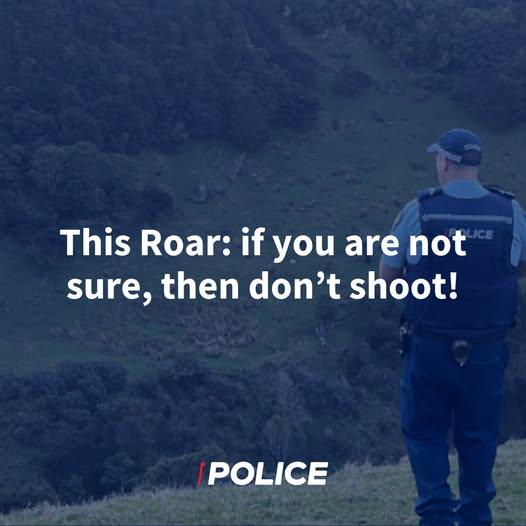
As thousands of hunters are making their plans for autumn – the Roar – recreational firearms groups are urging hunters to always be 100% sure of their targets.
Te Tari Pureke - Firearms Safety Authority NZ, which chairs the Recreational Firearms Users Group, has begun a public information campaign reminding hunters everywhere of Rule #4 of the Firearms Safety Code: to identify their target beyond all doubt.
Director Communities and Corporate, Mike McIlraith, says there is an estimated 50,000-60,000 New Zealanders involved in big game animal hunting each year, and the Roar is the key event for many hunters each year.
“The Roar is a fantastic time of year for hunters to get out into the hills after a trophy animal but hunting safely and making sure everyone gets home in one piece, still must be the most important goal of every trip,” says Mike McIlraith.
“The consequences of not fully identifying your target beyond all doubt can be catastrophic. Our message to hunters is a really simple one: If you are not sure, then don’t shoot.”
Mike McIlraith says while hunting fatalities are thankfully rare, research has shown that misidentification of the target is the largest firearms related risk to New Zealand deer hunters, and 80% of the time this involves members of the same hunting group.
The Authority says hunters should not feel pressured to take a shot: “Instead, hunters should take the time to analyse their target, wait and see if it is a hind or stag, how old is the animal, how many points does its antlers have? Identifying your target means never firing at sound, shape, colour or movement alone.”
Mike McIlraith says good hunters will slow down, and run through some simple mental checks:
- Can I see the whole animal, or could this be another hunter?
- Where are my hunting companions – could this be them or someone else?
- How much of the animal can you see, if it is a hind or stag, how old is the animal, how - many points does its antlers have?
“Taking a little extra time to identify your target and check the firing zone is the key to safer hunting. No meat or no trophy is better than no mate,” he says.
 Loading…