






All About Curtain & Upholstery Fabrics
There are five different styles/category of fabric that form the foundation for the vast array of curtain and upholstery fabrics you see on the market today. Each fabric style outlined below has its own unique characteristics and are produced using different techniques. Some of these fabric types will be well known to you like plain and printed fabrics, while others less so.
You may be wondering why cotton and linen for example are not included here – this is because they are a type of composition that falls within one of these categories below.
Here we give you a high-level overview of the styles of fabrics available to you for your home interior or commercial interior project.
PLAIN
Plain fabrics are characterised by simple weaves and textures not showing any complex design.
Simple weaves are for instance – hopsacks, twills, herringbones and satins. Common fabric compositions used for plain fabrics include natural fibres (cotton, linen) as well as synthetic fibres (polyester, acrylic, etc.)
Plain interior fabrics take on a simple and paired back aesthetic. Ideal for a minimalist décor, you can complement plain fabrics with more textured and tactile textiles for added interest to your home décor.
PRINTED
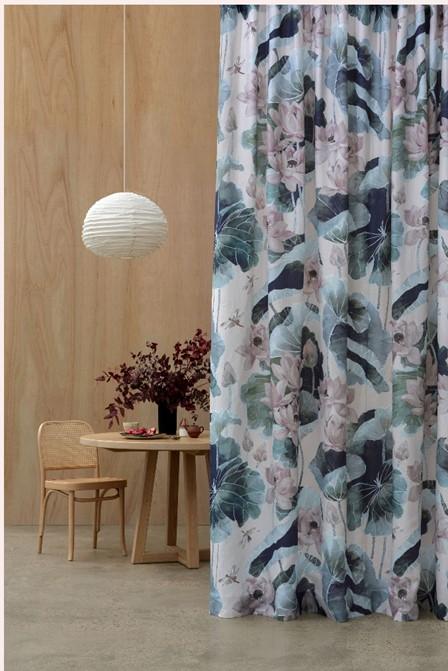
Printing is the process of applying coloured designs and patterns to a woven textile. One or more colours are applied to the fabric in specific parts only, using thickened dyes to prevent the colour from spreading beyond the limits of the pattern or design. In quality printed fabrics, the colour is bonded with the fibre so as to resist loss of dye from washing and friction (crocking). Printing is an ancient textile manufacturing technique of which there are five print production methods you can use:
Burn Out Printing:
A process which uses chemicals, rather than colour, to burn out or dissolve away one fibre in a fabric. The purpose is to achieve a sheer design on a solid or opaque fabric. The chemicals used during production can make this fabric sensitive to ultraviolet degradation when hung in direct sunlight.
Digital Printing:
Rapidly becoming a popular and commercially viable printing method due to its flexibility, precision and consistency. With this new printing technique it is now possible to print any design, even with photographic detail, onto fabric. There are no restrictions in the amount of colour that can be used.
Engraved Roller Printing:
The printing method used for the majority of fabrics worldwide. The colours are printed directly onto the fabric. There must be one roller for each colour used in the print. The more colours used, the better the print definition and depth of colour. The number of colours used is printed on the left hand selvedge of a fabric along with the brand.
Hand Block Printing:
The oldest form of printing. Print designs are created by transferring dyestuffs onto fabric with the help of wooden, linoleum, or copper blocks. Artisans hand craft individual blocks to carry each different colour in a design and perfectly match block placement to create the all-over design.
Keep reading: www.curtainclean.co.nz...

Poll: 🤖 What skills do you think give a CV the ultimate edge in a robot-filled workplace?
The Reserve Bank has shared some pretty blunt advice: there’s no such thing as a “safe” job anymore 🛟😑
Robots are stepping into repetitive roles in factories, plants and warehouses. AI is taking care of the admin tasks that once filled many mid-level office jobs.
We want to know: As the world evolves, what skills do you think give a CV the ultimate edge in a robot-filled workplace?
Want to read more? The Press has you covered!

-
53.5% Human-centred experience and communication
-
14.6% Critical thinking
-
29.3% Resilience and adaptability
-
2.5% Other - I will share below!

Annuyal Book Sale -Tauranga Rotary Club
The annual Rotary second-hand Book Sale is on again, Sat 28th Feb and Sun 1st March. Come and get cheap reads for yourself and the kids!
We still need books to sell - also art, jigsaws and music. Proceeds go to a range of local activities including K Valley conservation, Riding for the Disabled, and Foodbank.
Drop off points are:
Farmlands Tauriko and Te Puna
Wet&Forget, Chapel St
Caltex Greerton, Bayfair and Katikati
Z Energy, 11th Ave
Philips Garage, Fraser St
BP Delta, Cherrywood
Villa 71, Bob Owens Village, Bethlehem
Bunnings on Cameron Rd
20 Ririnui Place, Maungatapu
Papamoa Sports & Rec Centre, in Gordon Spratt Reserve
The Coffee Club, Omokoroa
Challenge Service Station, Omokoroa

Have you got New Zealand's best shed? Show us and win!
Once again, Resene and NZ Gardener are on the hunt for New Zealand’s best shed! Send in the photos and the stories behind your man caves, she sheds, clever upcycled spaces, potty potting sheds and colourful chicken coops. The Resene Shed of the Year 2026 winner receives $1000 Resene ColorShop voucher, a $908 large Vegepod Starter Pack and a one-year subscription to NZ Gardener. To enter, tell us in writing (no more than 500 words) why your garden shed is New Zealand’s best, and send up to five high-quality photos by email to mailbox@nzgardener.co.nz. Entries close February 23, 2026.
 Loading…