





Natures Bounty | Bast is Best
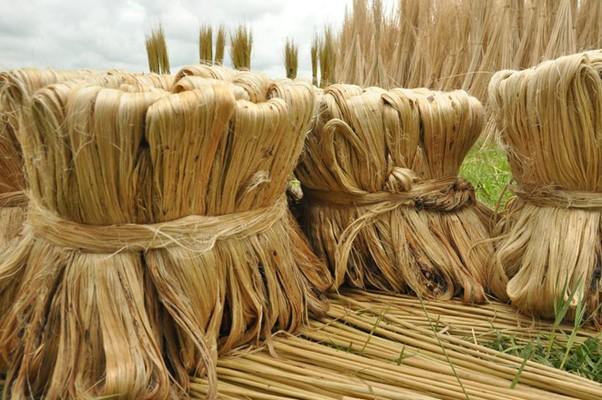
Commonly known as ‘soft’ fibres, bast fibres are the fine, flexible fibres obtained from the stems of dicotyledonous plants.
Bast fibres have been used to manufacture ropes, sacks, sails, and other industrial fabrics for hundreds of years. Commonly known as ‘soft’ fibres, bast fibres are the fine, flexible fibres obtained from the stems of dicotyledonous plants. A sustainable choice, bast fibres support regenerative agricultural practices that can help the soil sequester carbon and as a natural resource, are entirely biodegradable. In this article we will investigate four of the most utilised bast fibres: flax, hemp, ramie, and jute.
Between the epidermis (the outermost layer of cells) and the core of the plant’s stems are soft, woody fibre bundles or strands which can be over one metre long. The strands are composed of individual filaments made up of cellulose and hemicellulose cells bonded together by pectin or lignin, a cohesive gum which strengthens the stem of the plant.
During harvest the stems are cut close to the ground and the fibres are separated either through a natural decomposition process called retting (engaging moisture and bacteria to rot away the gummy cellular tissues) or by decortication (peeling the stems manually or mechanically). After retting, the fibres can be mechanically extracted through a process known as scutching.
In contrast to bast fibres, leaf fibres are obtained from the leaves of monocotyledonous plants with parallel-veined leaves, such as grasses, lilies, orchids, and palms. The long, stiff fibres of plants including abaca, cantala, Mauritius hemp, and sisal are generally used to create cordage or ropes, however, due to labour-intensive harvesting processes they are used less frequently than synthetic options.
Flax (Linen): Famously grown across northern France, Belgium, the Netherlands, and Ireland, flax is the most popular and strongest of the bast fibres. Wild flax fibres found in the Upper Palaeolithic layers of a Georgian cave indicate that humans have been crafting cords and weaving flax baskets for over 30,000 years.
Keep reading: www.curtainclean.co.nz...

Poll: 🤖 What skills do you think give a CV the ultimate edge in a robot-filled workplace?
The Reserve Bank has shared some pretty blunt advice: there’s no such thing as a “safe” job anymore 🛟😑
Robots are stepping into repetitive roles in factories, plants and warehouses. AI is taking care of the admin tasks that once filled many mid-level office jobs.
We want to know: As the world evolves, what skills do you think give a CV the ultimate edge in a robot-filled workplace?
Want to read more? The Press has you covered!

-
53.9% Human-centred experience and communication
-
14.3% Critical thinking
-
29.2% Resilience and adaptability
-
2.6% Other - I will share below!

Annuyal Book Sale -Tauranga Rotary Club
The annual Rotary second-hand Book Sale is on again, Sat 28th Feb and Sun 1st March. Come and get cheap reads for yourself and the kids!
We still need books to sell - also art, jigsaws and music. Proceeds go to a range of local activities including K Valley conservation, Riding for the Disabled, and Foodbank.
Drop off points are:
Farmlands Tauriko and Te Puna
Wet&Forget, Chapel St
Caltex Greerton, Bayfair and Katikati
Z Energy, 11th Ave
Philips Garage, Fraser St
BP Delta, Cherrywood
Villa 71, Bob Owens Village, Bethlehem
Bunnings on Cameron Rd
20 Ririnui Place, Maungatapu
Papamoa Sports & Rec Centre, in Gordon Spratt Reserve
The Coffee Club, Omokoroa
Challenge Service Station, Omokoroa

Have you got New Zealand's best shed? Show us and win!
Once again, Resene and NZ Gardener are on the hunt for New Zealand’s best shed! Send in the photos and the stories behind your man caves, she sheds, clever upcycled spaces, potty potting sheds and colourful chicken coops. The Resene Shed of the Year 2026 winner receives $1000 Resene ColorShop voucher, a $908 large Vegepod Starter Pack and a one-year subscription to NZ Gardener. To enter, tell us in writing (no more than 500 words) why your garden shed is New Zealand’s best, and send up to five high-quality photos by email to mailbox@nzgardener.co.nz. Entries close February 23, 2026.
 Loading…