





Natures Bounty | Bast is Best
Commonly known as ‘soft’ fibres, bast fibres are the fine, flexible fibres obtained from the stems of dicotyledonous plants.
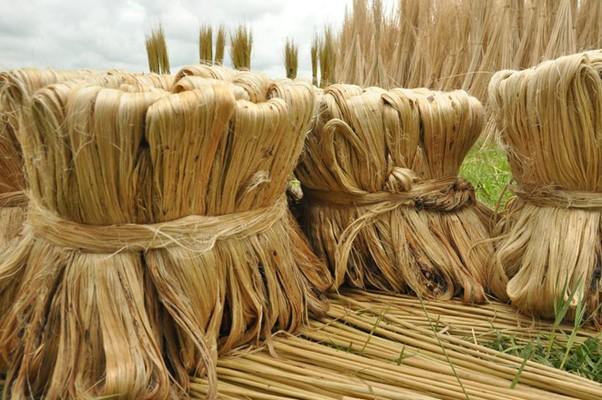
Bast fibres have been used to manufacture ropes, sacks, sails, and other industrial fabrics for hundreds of years. Commonly known as ‘soft’ fibres, bast fibres are the fine, flexible fibres obtained from the stems of dicotyledonous plants. A sustainable choice, bast fibres support regenerative agricultural practices that can help the soil sequester carbon and as a natural resource, are entirely biodegradable. In this article we will investigate four of the most utilised bast fibres: flax, hemp, ramie, and jute.
Between the epidermis (the outermost layer of cells) and the core of the plant’s stems are soft, woody fibre bundles or strands which can be over one metre long. The strands are composed of individual filaments made up of cellulose and hemicellulose cells bonded together by pectin or lignin, a cohesive gum which strengthens the stem of the plant.
During harvest the stems are cut close to the ground and the fibres are separated either through a natural decomposition process called retting (engaging moisture and bacteria to rot away the gummy cellular tissues) or by decortication (peeling the stems manually or mechanically). After retting, the fibres can be mechanically extracted through a process known as scutching.
In contrast to bast fibres, leaf fibres are obtained from the leaves of monocotyledonous plants with parallel-veined leaves, such as grasses, lilies, orchids, and palms. The long, stiff fibres of plants including abaca, cantala, Mauritius hemp, and sisal are generally used to create cordage or ropes, however, due to labour-intensive harvesting processes they are used less frequently than synthetic options.
Flax (Linen): Famously grown across northern France, Belgium, the Netherlands, and Ireland, flax is the most popular and strongest of the bast fibres. Wild flax fibres found in the Upper Palaeolithic layers of a Georgian cave indicate that humans have been crafting cords and weaving flax baskets for over 30,000 years.
Keep reading: www.curtainclean.co.nz...

Poll: How important is the ability to book a doctor’s appointment online?
Hi Neighbours
Here at The Doctors we would love to hear how you prefer to book your doctor’s appointments. With busy schedules, different people find different methods easier.
For some, online booking is very convenient, you can make an appointment anytime without needing to wait on the phone. Others still prefer calling the clinic and speaking to a real person, especially if they have specific questions about their visit.
Your feedback helps us understand what works best for our patients and how we can improve access to care.

-
34.9% I prefer booking online whenever possible
-
26.4% Online booking is helpful but not essential
-
34% I prefer calling the clinic
-
4.7% I didn’t know online booking was available

A reminder this hunting season
As thousands of hunters are making their plans for autumn – the Roar – recreational firearms groups are urging hunters to always be 100% sure of their targets.
Te Tari Pureke - Firearms Safety Authority NZ, which chairs the Recreational Firearms Users Group, has begun a public information campaign reminding hunters everywhere of Rule #4 of the Firearms Safety Code: to identify their target beyond all doubt.
Director Communities and Corporate, Mike McIlraith, says there is an estimated 50,000-60,000 New Zealanders involved in big game animal hunting each year, and the Roar is the key event for many hunters each year.
“The Roar is a fantastic time of year for hunters to get out into the hills after a trophy animal but hunting safely and making sure everyone gets home in one piece, still must be the most important goal of every trip,” says Mike McIlraith.
“The consequences of not fully identifying your target beyond all doubt can be catastrophic. Our message to hunters is a really simple one: If you are not sure, then don’t shoot.”
Mike McIlraith says while hunting fatalities are thankfully rare, research has shown that misidentification of the target is the largest firearms related risk to New Zealand deer hunters, and 80% of the time this involves members of the same hunting group.
The Authority says hunters should not feel pressured to take a shot: “Instead, hunters should take the time to analyse their target, wait and see if it is a hind or stag, how old is the animal, how many points does its antlers have? Identifying your target means never firing at sound, shape, colour or movement alone.”
Mike McIlraith says good hunters will slow down, and run through some simple mental checks:
- Can I see the whole animal, or could this be another hunter?
- Where are my hunting companions – could this be them or someone else?
- How much of the animal can you see, if it is a hind or stag, how old is the animal, how - many points does its antlers have?
“Taking a little extra time to identify your target and check the firing zone is the key to safer hunting. No meat or no trophy is better than no mate,” he says.

Poll: Does a savoury scone require cheese on top, or folded inside?
Help settle the great kiwi debate ... cheese on top, or folded inside?
-
76.4% Inside!
-
23.6% On top!
 Loading…