







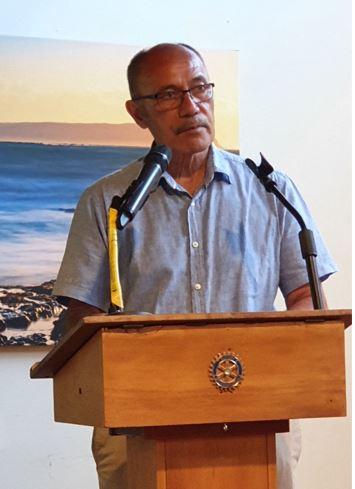
Sir Jerry Mateparae talks about ‘Healthier Lives’.
This week’s speaker was Sir Jerry Mateparae, a distinguished New Zealander who is accustomed to talking and answering questions about his career as a soldier, diplomat, and of course, Governor-General.
On this occasion he was relieved, he said, to tell us about his latest role. He is chair of the Board of one of the government’s National Science Challenges, which was set up in 2014 with funding guaranteed for ten years. The Challenges are mission-led, employ the best available research teams, embrace Vision Matauranga, and encourage stakeholders to set the research agendas.
Sir Jerry chairs one of the three health-related Challenges, called ‘Healthier Lives’. This one focuses on the health issues in the adult population which place the heaviest burden on the system. There are four prominent diseases under special study: cancer, cardiovascular disease, diabetes, and obesity.
Interestingly, the bulk of work is not laboratory-based biomedical research - the search for ‘cures’ - but deals more with the detection, assessment, and management of diseases out in the community.
This is going well, and Sir Jerry gave some examples. Diabetes can be better controlled via ‘health navigators’ who will guide sufferers into better lifestyles. A tool has been developed to help GPs predict who is most at risk from cardiovascular events. CCDna testing of blood samples can detect cancers at low cost, and indicate whether tumours are growing or shrinking.
The health status of Maori and Pasifika populations is relatively poor, and ‘Healthier Lives’ is looking at issues around equitable access to health services which, as Bill McAulay noted, has become evident in the current pandemic.
Finally, Sir Jerry paid tribute to the dedicated and highly skilled scientists involved in the Healthier Lives challenge.


🪱🐦 When are you the most productive? 🌙🦉
The Post has been diving into our daily habits, and research suggests being an early bird or a night owl isn’t just a choice—it’s biology! We all have that specific time when our brains finally "click" into gear.
This raises a big question for the modern workplace. To get the best out of everyone, should employers accommodate our natural body clocks? This idea is at the heart of the four-day work week and flexible scheduling movements.
We want to hear from you:
1. When does your brain "click" into gear?
2. Would a flexible (or shortened) schedule change the way you work?

Poll: Are you still heading to your local for your caffeine fix, or has the $$ changed your habits? ☕
Wellington’s identity is built on its cafe culture, but with costs climbing, that culture is under pressure. We’ve seen the headlines about recent closures, and it’s a tough pill to swallow along with a $6+ coffee.
We all want our favourite spots to stay open, but we also have to balance our own budgets ⚖️
We want to know: How are you handling the "coffee math" in 2026? Are you still heading to your local for a chat and a caffeine fix, or has the cost of living changed your habits?
Keen to read more about "coffee math"? The Post has you covered.

-
45.4% I avoid spending money on coffee
-
42.6% I still indulge at my local cafe
-
12% Irrelevant - coffee is not for me
Poll: If we want to reduce speeding, what do you think actually changes driver behaviour? 🛻🚨🚓
In the Post's article on speeding penalties, the question is asked whether speeding fines are truly about road safety, or are they just a way to boost revenue for the Crown?
What do you think? Should speeding motorists receive speeding fines or demerit points?

-
35.8% The sting of a fine (Money talks!)
-
64.2% The threat of demerit points (Nobody wants to lose their license!)
 Loading…