







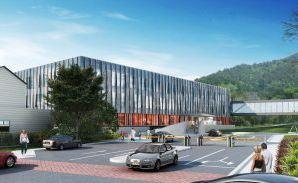
Wellington Children’s Hospital
'It’s all about our children and grandchildren' and supporting the new Children’s Hospital, says Mike Doig in his report on last night's speakers.
Wellington’s third-generation children’s hospital is well underway and should open in November this year.
It follows the King Edward VIIth Memorial Hospital, built in 1912, and its successor, opened in 1988, both of which were familiar to local Rotarians.
New Zealand will have three regional children’s hospitals: Starship in Auckland, our new one, and Christchurch. Each will specialise to some degree. The Wellington hospital will serve about one million citizens from Taranaki southwards to the top of the south island.
Last evening Bill Day, chair of the Wellington Hospitals Foundation, and Adrienne Murray, a former President of our club and now chair of the Rotary Children’s Health Trust, came to talk about the progress of the new hospital and Rotary’s part in it.
Bill is a former banker and has chaired the Life Flight Trust, Outward Bound, Wellington Free Ambulance, and has been a director of numerous other community organisations.
The new Children’s Hospital was made possible by a gift of $50 million from Mark Dunajtschik and Dorothy Spotswood, after whom the new building will be named.
Bill explained the design of the building with the aid of photos and plans. It will be innovative and state-of-the-art when completed.
Adrienne explained the fundraising aspects of the project. Our Rotary District has committed to raising $400,000 by March 2022 which will be used to provide two whanau rooms in the hospital. We are close to $170,000 so far, with our own club donating $2500.
The Rotary Children’s Health Trust was formed to support the building of the new hospital but will carry on afterwards to underwrite other child-centred health services in our region.

Poll: Are you still heading to your local for your caffeine fix, or has the $$ changed your habits? ☕
Wellington’s identity is built on its cafe culture, but with costs climbing, that culture is under pressure. We’ve seen the headlines about recent closures, and it’s a tough pill to swallow along with a $6+ coffee.
We all want our favourite spots to stay open, but we also have to balance our own budgets ⚖️
We want to know: How are you handling the "coffee math" in 2026? Are you still heading to your local for a chat and a caffeine fix, or has the cost of living changed your habits?
Keen to read more about "coffee math"? The Post has you covered.

-
45.7% I avoid spending money on coffee
-
42.3% I still indulge at my local cafe
-
12% Irrelevant - coffee is not for me

🌉🛶 Early Birds Might Crack This One First… or Not? 🥚🧠
A person is crossing a bridge and sees a boat full of people, yet there isn't a single person on board.
How is this possible?
(Susan from Massey kindly provided this head-scratcher ... thanks, Susan!)
Do you think you know the answer? Simply 'Like' this post if you know the answer and the big reveal will be posted in the comments at 2pm on the day!
Want to stop seeing these in your newsfeed?
Head here and hover on the Following button on the top right of the page (and it will show Unfollow) and then click it. If it is giving you the option to Follow, then you've successfully unfollowed the Riddles page.

🪱🐦 When are you the most productive? 🌙🦉
The Post has been diving into our daily habits, and research suggests being an early bird or a night owl isn’t just a choice—it’s biology! We all have that specific time when our brains finally "click" into gear.
This raises a big question for the modern workplace. To get the best out of everyone, should employers accommodate our natural body clocks? This idea is at the heart of the four-day work week and flexible scheduling movements.
We want to hear from you:
1. When does your brain "click" into gear?
2. Would a flexible (or shortened) schedule change the way you work?

 Loading…