




Father of two left without a voice and given days to live
From reporter Hamish McNeilly
Andy Dalton went to hospital after struggling to breathe. He would later learn he had days to live.
The 41-year-old father-of-two found himself breathless while running, then later when lying down.
On October 11, he went to Dunedin Hospital’s emergency department where a tumour was detected pressing against his windpipe.
“He wasn’t able to get air into his lungs,” Amanda O’Connor, 36, speaking on behalf of her partner, said.
A scan revealed Dalton was breathing through a space of only about 3 millimetres. He was transferred to the hospital’s intensive care unit (ICU) that night.
Surgery to remove the tumour revealed he had a super aggressive and rare form of cancer called anaplastic thyroid cancer, which they couldn’t remove.
He was given a tracheostomy – a hole through the front of the neck and into the windpipe – so he could breathe.
But while in ICU the tumour continued to grow and began to restrict his airway.
A few days later Dalton was told he had “days left”.
“We were a bit shell shocked,” O’Connor said.
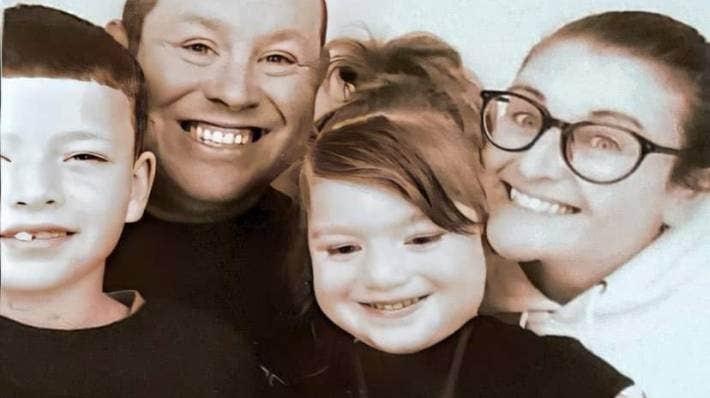
Dalton’s two children – a son, 8, and a daughter, 4, were “doing as well as you can expect”, she said.
The pair highlighted the incredible support they had at hospital, which included a consultant coming in on his day off to bring Dalton home in an ambulance for three hours, so he could say goodbye to family and friends.
“We were expecting any time,” O’Connor said.
Dalton, who communicates via a tablet, told Stuff hospital staff had “gone above and beyond treating me with the utmost care in what has been an incredibly scary, stressful and emotional experience”.
On Tuesday, Dalton had his final radiation treatment aimed at prolonging his life, which appeared to help slow the growth.
While the cancer was incurable, testing revealed he had a specific mutation known as the Braf gene.
Unfunded drugs that cost $5500 a month targeted the mutation and slowed the growth of the tumour.
“It does slightly improve prognosis, gives him slightly more time but nothing is a curative treatment for Andy’s cancer,” O’Connor said.
The family wanted him to have more time, particularly for his children, so they had set up a Givealittle page, hoping to raise $50,000.
Another potential treatment option was also unfunded, immunotherapy medication, PDL-1, which cost $100,000 a year.
“Nobody thinks he will get that amount of time,” O’Connor said.
He had returned home and the family had realised they were “on shaky ground”, she said.
“Every day since then has been a gift.
“I have found it a challenge, as his partner, to try and put on a positive face every day.”
The best case scenario was for the tumour to shrink around the windpipe, and he could speak – albeit quietly – with the tracheostomy still in place.
Dalton was able to talk with the help of an electronic device, as well as ‘’charades’’ with his children.
His son was desperate to have his dad watch him play sport, which included futsal and touch.
‘’It is about maximising memories for the kids,’’ O’Connor said.

Poll: Does a savoury scone require cheese on top, or folded inside?
Help settle the great kiwi debate ... cheese on top, or folded inside?

-
76.6% Inside!
-
23.4% On top!
Got more greens than you know what to do with? 🥦🌱🥕
Whether it’s a courgette takeover or a feijoa frenzy, don’t let those garden gems go to waste!
Our suggestion to you: Did you know you can grate and freeze excess courgettes to use in chocolate cake later? It sounds a bit dodgy, but it makes the cake incredibly moist ... and hey, it counts as a serving of veg, right? 🍫
What’s your go-to move for a bumper harvest? Drop your best "glut" recipes or preservation hacks in the comments below! 👇


Get decorating with the Resene Sale !
20% off Resene premium paints, wood stains, primers & sealers and 20% off wallpaper and 20% off decorating accessories.
See your Resene Colorshop and bring out the best in your home.

 Loading…