




Cuts to Dunedin Hospital project pose 'reputational, operational and clinical risk'
From reporter Hamish McNeilly:
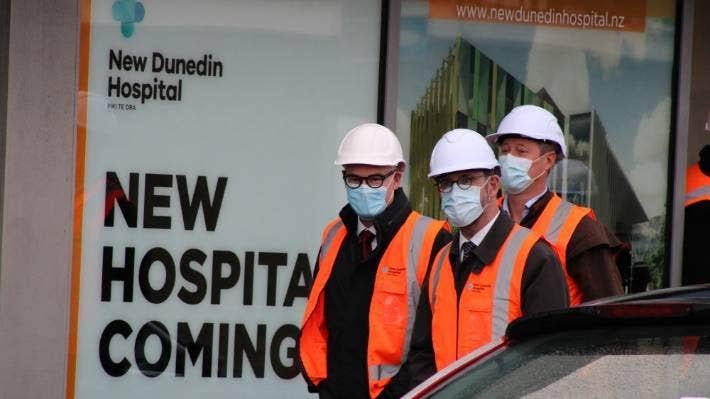
One of the largest infrastructure projects in the country – the $1.4billion rebuild of Dunedin Hospital – is under pressure.
Earlier this year those involved with the project were told to trim $100m from its budget while preserving as much as the design and clinical capacity as possible within a ‘’reduced footprint’’, a report from Te Whatu Ora Southern has revealed.
That report also detailed some of the risks of cost-cutting around the current design, some four years in the planning.
It suggests “undoing this in as many months carries significant reputational, operational and clinical risk”.
Those short term solutions, as part of what is known as “Option 4.2”, could result in increased costs over the life of the hospital, the report, dated September 2, warns.
“Without this due diligence, Te Whatu Ora Southern are unable to provide confidence that all potential risks associated with Option 4.2 have been adequately identified.”
Those risks included fewer beds being available than the current – albeit ageing – hospital, while the size of a laboratory would be cut.
The new option would also see changes to a mental health unit for older people, less storage for drinking water, and the removal of two logistics lifts and a bridge linking the inpatients’ and outpatients’ buildings.
While the design of the facility was “advanced”, significant changes to the design, particularly a reduction in size, would have a “negative impact on the reputation of the project and the NDH (New Dunedin Hospital) amongst both the public and Te Whatu Ora Southern staff”.
The report highlighted other concerns about that reputational risk, including public perception that the burden of providing health services is being pushed onto primary and community providers, and staff airing concerns and grievances to media.
The risk to the project’s reputation, alongside interested parties in the south, was “significant”.
“The need for a new hospital has been well interrogated, and public interest in the NDH is high,” the report said.
It also noted key clinical staff had given input into the design, and are “concerned that decisions are being made against clinical advice and data, and this will lead to poorer clinical and operational outcomes”.
That included growing anxiety over the possible exclusion of services, and the presumption that alternative funding would be found elsewhere.
“Staff feel there is significant risk that sufficient funding will not eventuate to offer these services in suitable facilities, and the community will suffer as a consequence.”
The report concluded: “Any change in the size or scope of the NDH, and any demand for significant redesign with accompanying consultant costs and demands on clinical staff’s time, will have a widespread negative effect on the reputation and expectations of the NDH project and facility.”
That would be perceived as a “broken promise” from what was approved in the detailed business case two years ago.
The revamp of Dunedin Hospital is part of the Government’s $7 billion programme to upgrade the country’s public hospitals.
Former Health Minister Chris Hipkins said the new hospital would “transform healthcare” in the region and deliver “improved health outcomes for future generations”.
Te Whatu Ora Southern’s report also highlighted how an interprofessional learning centre, with the support of the University of Otago and Otago Polytechnic, may also be missing from the project after an “official error or omission”.
The professional development unit would offer simulation spaces for training purposes, with Dunedin offering the widest range of health sciences disciplines in New Zealand.
The three parties were set to contribute around $17m each, but the cost pressure of the project meant the university would look at constructing the facility.
But due to its own cost pressures with other projects the university withdrew its offer in February.
That advice was passed onto the Ministry of Health, but never incorporated into written advice to ministers.
“Accordingly the records shows ministers approving a saving that did not, and does not, exist,” the report said.
A Te Whatu Ora – Health New Zealand spokesperson said: “Our position on the new Dunedin Hospital remains unchanged since the release of this report.
“We remain committed to ensuring Dunedin will receive a fit-for-purpose, state-of-the-art facility. Better care for patients remains the priority.”
Health Minister Andrew Little said he had not seen the report.
He said: “Every major building project in the hospital system has been asked to look carefully at their costs, because in the current climate we expect cost escalation.
“However, any substantial change to the new Dunedin Hospital project would require ministerial approval. I have received no advice about proposed changes to the scope or scale of that project.”

Poll: Does a savoury scone require cheese on top, or folded inside?
Help settle the great kiwi debate ... cheese on top, or folded inside?

-
76.6% Inside!
-
23.4% On top!
Got more greens than you know what to do with? 🥦🌱🥕
Whether it’s a courgette takeover or a feijoa frenzy, don’t let those garden gems go to waste!
Our suggestion to you: Did you know you can grate and freeze excess courgettes to use in chocolate cake later? It sounds a bit dodgy, but it makes the cake incredibly moist ... and hey, it counts as a serving of veg, right? 🍫
What’s your go-to move for a bumper harvest? Drop your best "glut" recipes or preservation hacks in the comments below! 👇


Get decorating with the Resene Sale !
20% off Resene premium paints, wood stains, primers & sealers and 20% off wallpaper and 20% off decorating accessories.
See your Resene Colorshop and bring out the best in your home.

 Loading…