





Regional council ECan proposes hefty rate rises
By reporter Keiller MacDuff:
Environment Canterbury (ECan) floated one of the largest proposed average rates rises in the country on Wednesday - more than 24% - a day after the Christchurch City Council adopted a draft proposal for a 13% rates rise.
Councils nationwide are proposing significant rises as interest rates bite and increasing severe weather calls for more resilience work.
ECan councillors voted 14:2 to adopt the consultation document for its long-term plan (LTP), which outlines the council's activities, services and finances for the next decade, with councillors Clair McKay and Deon Swiggs voting against the recommendation.
The plan will see ECan spend more than $340 million in the first year, a 26% increase on the $270m programme carried out in 2023-24.
The draft says the council gave “strong consideration“ to the financial pressures the community is facing, but previous decisions on flood management and public transport combined with high inflation meant just maintaining current work required a double digit increase.
The actual rating impact will differ depending on location and targeted rates, meaning the increase will be between 13% and 27%.
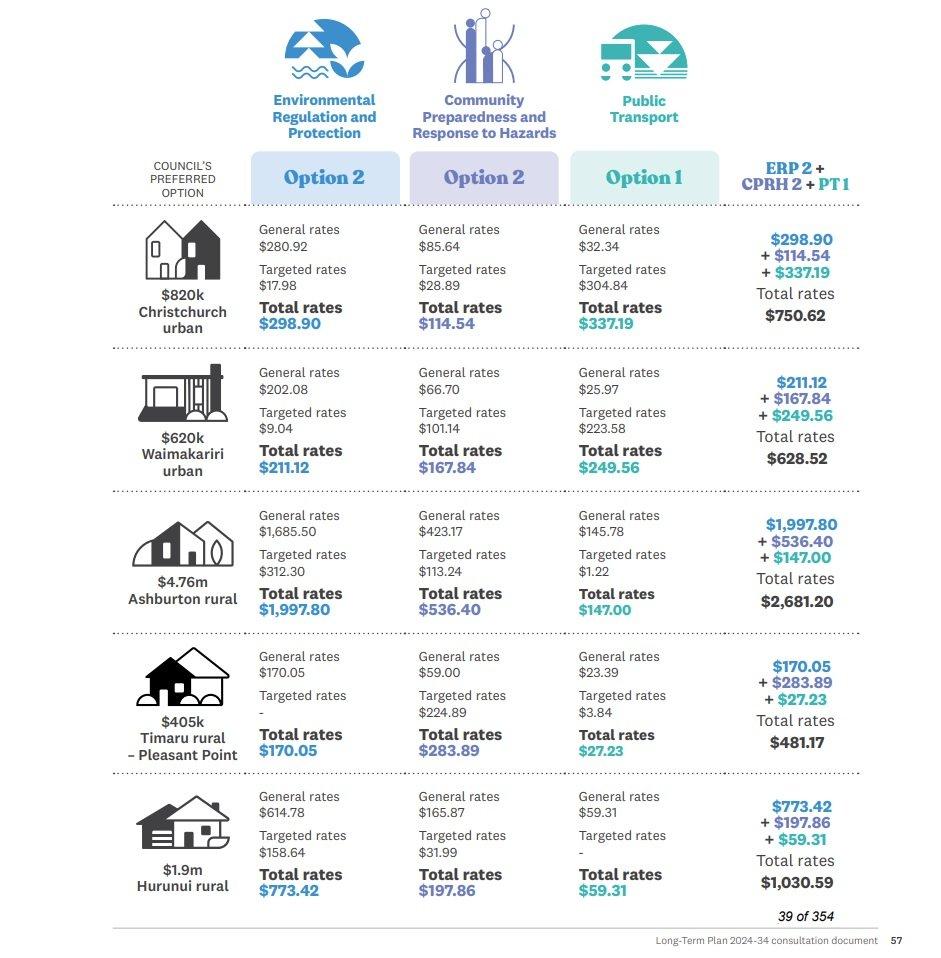
If the regional council’s preferred options are adopted, a Christchurch city ratepayer with a $820,000 property would pay $750 in the first year of the plan, while a $1.9m rural property in Hurunui faced a $1030 rates bill for 2024-25, and a $4.76m rural Ashburton property would pay $2681 in rates.
Of ECan's three core services - environmental regulation and protection, hazard preparedness and response, and public transport - the latter has the biggest cost.
The council’s preferred public transport option has a $160m price tag for the first year (a total of $542m over three years) and would see the Public Transport Futures programme improvements delivered within seven years, including upping core bus routes to ten minute frequencies or better by 2028, with average wait times of five minutes.
It also includes:
- More direct services to parts of Waimakariri and Selwyn, starting in 2026-27.
- A review of connector and local services by mid-2026, with improvements implemented by 2031.
- An additional Diamond Harbour ferry and refurbishment of the existing ferry.
- Improvements to the network, such as increasing capacity on crowded buses and small tweaks to routes or frequency
- Enhanced safety improvements, increased investment in reliability and the continued replacement of end-of-life diesel buses with new electric buses.
The option also includes funding to “explore opportunities” to improve transport to and from Te Kaha, on demand services in Greater Christchurch, and - long term - looking at asset ownership.
The document notes the region has “historically under-invested in public transport,” leading to low usage, and proposes “considerable investment.” But both the regional council and the auditor, whose report was also tabled, drew attention to the “high level of uncertainty” surrounding the government’s contribution.
The council’s preferred option for environmental regulation and protection would cost $135m for the LTP’s first year, and could sit alongside a targeted rate for additional biodiversity work in Christchurch and Banks Peninsula.
The separate biodiversity rate works out at 72 cents per $100,000 capital value of rateable properties.
ECan’s preferred option for community preparedness and hazard response - $50.5m - includes a targeted rate for Selwyn residents for district-wide flood and river resilience work.
The targeted rate would cost $7.08 per rate paying property in the first year, $10.62 in the second year, and $14.16 in the third year, raising $400,000 in 2026-27.
Most councillors expressed misgivings about the scale of the proposed rise, but backed the document through the consultation process.
McKay accused her fellow councillors of being “tone deaf”, and asked what right the council had “to treat our ratepayers as an ATM machine?”
She criticised the amount of borrowing and said she was “embarrassed to be associated” with the amount council sought.
Swiggs also expressed misgivings about debt funding, and criticised the local government funding model in general.
“Imagine if Wellington had to budget the way we have to,” Swiggs said, commenting on the discrepency in tax take between central and local government,.
On Tuesday, the Christchurch City Council voted 13 to 4 in favour of a draft long-term plan that proposes an average rates increase of 13.24% from June, followed by 7.76% in the following financial year, and 4.67% the year after.
Consultation on ECan’s draft LTP will run from mid-March to mid-April, with hearings scheduled for the end of April and early May. The council is scheduled to deliberate at the end of May with a view to adopt the plan and set rates in late June.

Poll: Do you have a go-to adverse-weather checklist for your family? ☔⚠️
As reported in the Press, the same low-pressure system that lashed the North Island over the weekend is now making its way south, bringing heavy rain and strong winds with it. It’s a soggy start to the week for many of us.
With more wild weather on the cards, we’re curious: do you have a go-to adverse-weather checklist for your family? Or are you more of a “grab the torches and hope for the best” household?

-
0% Yes - we like to be prepared
-
0% Nah
-
0% This is on my to-do list!
Poll: Should the government levy industries that contribute to financial hardship?
As reported in the Post, there’s a $30 million funding gap in financial mentoring. This has led to services closing and mentors stepping in unpaid just to keep helping people in need 🪙💰🪙
One proposed solution? Small levies on industries that profit from financial hardship — like banks, casinos, and similar companies.
So we want to hear what you think:
Should the government ask these industries to contribute?

-
59.5% Yes, supporting people is important!
-
26% No, individuals should take responsibility
-
14.5% ... It is complicated

Please Share This Story From Otautahi Newsroom Far and Wide To Help These Men
Otautahi Newsroom
Concerns are being raised about the safety, care standards, and duty of care at a Comcare-supported residential flat in Bishopdale, Christchurch, where vulnerable older men with significant mental health conditions are living.
An advocate speaking on behalf of four residents , says the men are experiencing ongoing intimidation, alleged abuse, and serious safety risks within the flat. The residents are described as having limited capacity to advocate for themselves and have asked for help to bring the situation to public attention.
The flat houses five male residents, all aged over 60 and all considered vulnerable adults with psychiatric illnesses. It is alleged that one resident, I (64), has displayed escalating aggressive and intimidating behaviour over a period of approximately five years. According to reports from residents and those advocating for them, this behaviour has included verbal threats, alleged physical incidents, repeated boundary violations, and conduct that has left others living in fear.
Reported incidents include police attendance following an alleged knife-related event and theft of personal property, an incident in which one resident was allegedly restrained in his bed, repeated verbal intimidation, and unauthorised entry into other residents’ bedrooms. There are also claims that staff members have been assaulted or felt unsafe attending the property, with some reportedly conducting visits from outside the flat due to safety concerns.
Advocates say the ongoing situation has had a severe impact on the mental and physical wellbeing of the affected residents. All four men report feeling unsafe in their own home, with some considering leaving the property despite believing they should not be forced out of housing they were promised would be safe and stable.
One resident, D, who has both mental health needs and a heart condition, is said to have taken on an informal role trying to protect others. Advocates argue this is inappropriate and unsafe, stating that residents should not be expected to manage high-risk situations without professional support. They also claim that Comcare has breached contractual commitments to provide safe, peaceful, and stable housing.
Further concerns have been raised about the suitability of the property itself. The Bishopdale house was originally a four-bedroom home with one bathroom but was altered to accommodate a fifth resident by converting a sunroom into a bedroom. Critics argue that having one toilet for five men over the age of 63 is inadequate and compromises dignity, health, and wellbeing.
There are also claims from a family member of a former resident that care provided to her terminally ill brother at the property was insufficient, adding to broader concerns about oversight and duty of care.
Despite multiple complaints reportedly being lodged with agencies, advocates say they have seen no meaningful action. They are now calling for urgent intervention, including:
• Immediate rehousing of resident I into a 24-hour staffed care facility, dementia care, or appropriate hospital setting
• An urgent, independent investigation into Comcare’s management of the Bishopdale property
• Assessment of whether elder abuse or neglect is occurring
• A full review of duty of care, risk management, and safeguarding practices
• Immediate measures to ensure the safety and wellbeing of the remaining residents
Advocates warn that without urgent action, there is a serious risk of harm. They say the men deserve to live without fear and with appropriate care that protects their dignity, mental health, and quality of life.
 Loading…