





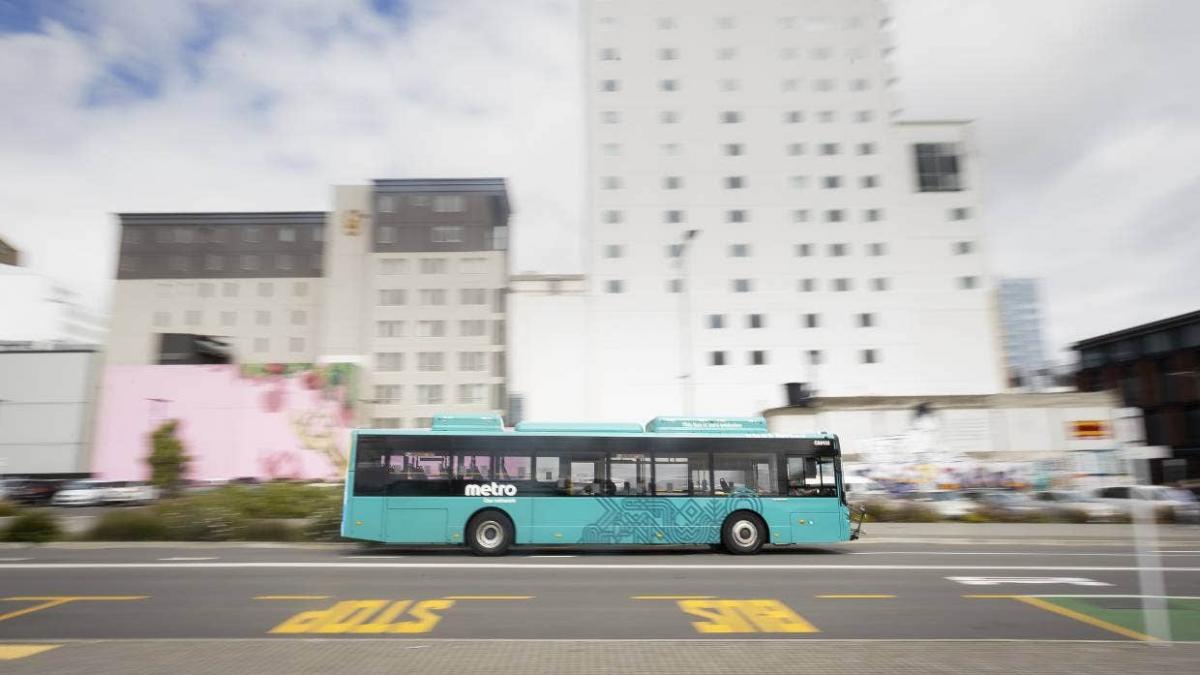
A bus every 7.5 minutes: Govt spending $78m to revamp Christchurch bus network
From reporter Steven Walton:
A $78 million government grant to improve Christchurch's “unreliable” bus service will only cover about one-third the project's total cost.
Local councils and Waka Kotahi will cover the remaining $160m to ensure buses arrive every 7.5 minutes on key routes.
The Government money is coming out of the budget of the ditched $785m cycling and walking bridge planned for the Auckland Harbour Bridge.
A major revamp of the Christchurch bus network was first revealed in late 2020, but the time frame for the work was going to be about 12 years. The Government contribution, announced on Friday, would allow the revamp to happen within five to six years.
“This will offer people living in Christchurch regular and much more reliable bus services,” Transport Minister Michael Wood said.
Amongst the planned improvements are 100 extra buses, 22km of new bus lanes, and more than 470 new bus shelters. Some of the work has already begun, like adding bus lanes to Lincoln Rd.
The 100 new buses are being introduced despite recent struggles nationwide with a driver shortage. The shortage has caused thousands of bus trips being cancelled in Christchurch in recent months, frustrating commuters.
Wood said there had been “good progress” with the driver shortage in Christchurch. The shortage was now only 49 drivers, he said.
The 2020 business case for the city’s bus revamp said buses were unreliable and not as quick as taking a car.
It also estimated the revamp’s infrastructure (capital) work would cost about $115m, but Wood confirmed that number had now risen.
He said the revamp’s total cost would be $238m, but this figure also included the operational costs of running new buses and paying the new drivers. He was not able to say how much of the $238m cost was capital costs and how much was operational costs.
Of the $238m, the Government is covering $78m of it directly and the remaining $160m will be split between local councils and Waka Kotahi. Waka Kotahi and councils in Christchurch have already planned to spend millions on the revamp, but it is not clear how much each party will end up spending. Wood’s office has been asked to provide this detail.
Mayor Phil Mauger said it was great to be at the Government’s funding announcement on Friday, even though he voted against the revamp’s business case in 2020.
Asked if he would still vote against it, he said “probably not” because he had “learnt a lot more about how buses will make a difference [with reducing emissions]”.
Buses were a “good thing” that would help the climate change situation, he said.
Mauger said he also supported the 22km of new bus lanes, “as long as they’re in the right place”. Narrow roads should not be made narrower, he said.
“It’s all very well to have bus lanes everywhere, but if no-one else can get along [the road] everyone's going to get all snarly and upset.”
As part of the revamp, Christchurch’s main bus routes will have dedicated bus lanes with traffic lights that give buses priority.
The city’s main bus routes are Rangiora to Cashmere (#1), Airport to Sumner (#3), Rolleston to New Brighton (#5) and Halswell to Queenspark (#7). All of these services go into the central city and stop at the bus interchange.
The fifth main route is The Orbiter, which does a circular route.
The revamp aims to convert the main routes to “turn-up-and-go” services, where a bus would arrive every 7.5 minutes between 7am and 7pm on weekdays.
Presently, these routes only have a 10 or 15-minute frequency.
The business case for the revamp said 14 million trips were taken on Christchurch buses in 2018, and it hoped to increase this to 20 million by 2028.


Poll: How important is the ability to book a doctor’s appointment online?
Hi Neighbours
Here at The Doctors we would love to hear how you prefer to book your doctor’s appointments. With busy schedules, different people find different methods easier.
For some, online booking is very convenient, you can make an appointment anytime without needing to wait on the phone. Others still prefer calling the clinic and speaking to a real person, especially if they have specific questions about their visit.
Your feedback helps us understand what works best for our patients and how we can improve access to care.

-
27.6% I prefer booking online whenever possible
-
41.4% Online booking is helpful but not essential
-
27.6% I prefer calling the clinic
-
3.4% I didn’t know online booking was available

A reminder this hunting season
As thousands of hunters are making their plans for autumn – the Roar – recreational firearms groups are urging hunters to always be 100% sure of their targets.
Te Tari Pureke - Firearms Safety Authority NZ, which chairs the Recreational Firearms Users Group, has begun a public information campaign reminding hunters everywhere of Rule #4 of the Firearms Safety Code: to identify their target beyond all doubt.
Director Communities and Corporate, Mike McIlraith, says there is an estimated 50,000-60,000 New Zealanders involved in big game animal hunting each year, and the Roar is the key event for many hunters each year.
“The Roar is a fantastic time of year for hunters to get out into the hills after a trophy animal but hunting safely and making sure everyone gets home in one piece, still must be the most important goal of every trip,” says Mike McIlraith.
“The consequences of not fully identifying your target beyond all doubt can be catastrophic. Our message to hunters is a really simple one: If you are not sure, then don’t shoot.”
Mike McIlraith says while hunting fatalities are thankfully rare, research has shown that misidentification of the target is the largest firearms related risk to New Zealand deer hunters, and 80% of the time this involves members of the same hunting group.
The Authority says hunters should not feel pressured to take a shot: “Instead, hunters should take the time to analyse their target, wait and see if it is a hind or stag, how old is the animal, how many points does its antlers have? Identifying your target means never firing at sound, shape, colour or movement alone.”
Mike McIlraith says good hunters will slow down, and run through some simple mental checks:
- Can I see the whole animal, or could this be another hunter?
- Where are my hunting companions – could this be them or someone else?
- How much of the animal can you see, if it is a hind or stag, how old is the animal, how - many points does its antlers have?
“Taking a little extra time to identify your target and check the firing zone is the key to safer hunting. No meat or no trophy is better than no mate,” he says.


Poll: Does a savoury scone require cheese on top, or folded inside?
Help settle the great kiwi debate ... cheese on top, or folded inside?

-
76.4% Inside!
-
23.6% On top!
 Loading…