






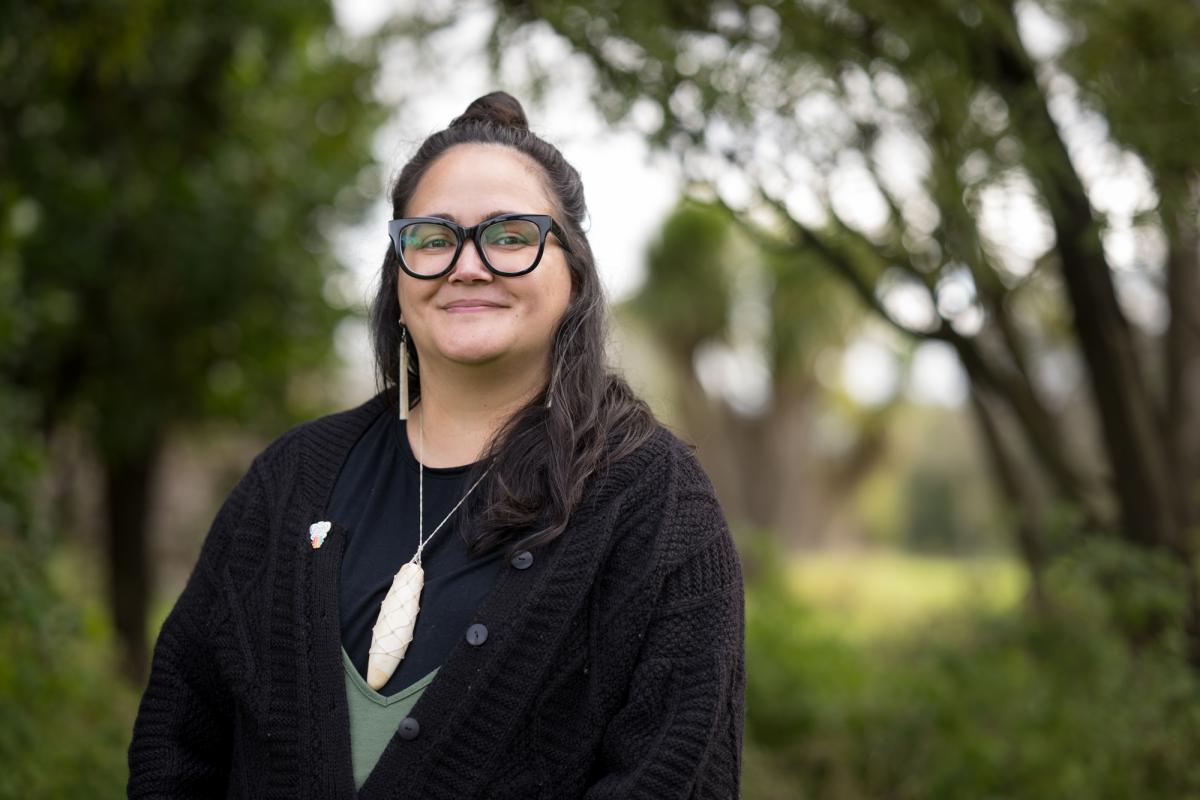
Tarryn
“It’s only since I've been in my 30's that I've had proper conversations about being Māori. I started to question all of that stuff when I moved away.
I left New Zealand just before I turned 19. I went to Australia for a few years, to the UK for a couple of years, then back to Australia. People would ask me, ‘are you a native New Zealander?’ Or ‘Are you a Māori?’. I always thought that was really weird, because being Māori wasn't a positive thing growing up.
I came back to go to university in Wellington. I didn't do well at school so it was quite scary to be suddenly going to university. I decided I wouldn't work for my first year, but that also meant that I was going to be really hard up for cash.
I found out about this accommodation called Whānau House. It's subsidized by the marae at uni, the catch is that you have to help out at the marae. I didn't really know what I was signing up for. There were 14 people living there, a range of ages. All of them were North Island Māori and spoke te reo to some extent. Suddenly being Māori was everywhere in my life, and it shocked me into seeing everything that I'd been missing out on. I spent a lot of time at the marae, and started to learn about te ao Māori.
I moved to Germany and for the first time ever, I got homesick. I couldn't figure out why, I'd never felt homesick for New Zealand before. And then I got pregnant, and I just said, I've gotta go home. I can't do this over here. I don't want my son growing up without his culture the way that I did. I didn't live in Christchurch for a really long time when I finally did come back, I had a baby. I was a pretty different person.
I started learning te reo when Thomas was four months old. and then the pandemic hit. We were in lockdown and I was doing all my classes online.
There were words that Dad used that I didn't realize were Māori until I started learning, which I think is quite funny. The first one I realized was a Māori word was pōtae - hat. And I was like, I know that word. Dad used that word my whole life!
We finished our first year, and we made lots of friends and kept in touch over the summer, so we didn’t lose what we've learnt over the year. We started trying to meet up at a cafe or for games nights so that we could practice using our te reo outside of the class.
That’s how Kōrero ki Ōtautahi became what it is. Initially it was just a group of friends. It's about supporting speakers and learners so that they can take what they've learned and put it into practice. We need more support for the intermediate people to push them into being fluent, and being confident, to be able to use it in everyday situations.
The ideal for me would be to see Christchurch as a bilingual city; you can just walk into any space and choose either English or te reo Māori. There's plenty of places around the world that are bilingual, and people switch between the two just casually.
In order for te reo to not just survive, but to thrive, we need everybody on board, whether you be Māori, Pākehā, tauiwi.”
Celebrating Te Wiki o te reo Māori - 15–19 September 2025

Got more greens than you know what to do with? 🥦🌱🥕
Whether it’s a courgette takeover or a feijoa frenzy, don’t let those garden gems go to waste!
Our suggestion to you: Did you know you can grate and freeze excess courgettes to use in chocolate cake later? It sounds a bit dodgy, but it makes the cake incredibly moist ... and hey, it counts as a serving of veg, right? 🍫
What’s your go-to move for a bumper harvest? Drop your best "glut" recipes or preservation hacks in the comments below! 👇

Poll: Does a savoury scone require cheese on top, or folded inside?
Help settle the great kiwi debate ... cheese on top, or folded inside?
-
76.3% Inside!
-
23.7% On top!

Help to change 2 tyres
Hi, we would like help, today, please, to put 2 spare tyres on small truck. Will need jack etc. Hoon Hay, can pay $20 🙂
0220211864
 Loading…