





🔴News straight from Millhouse Integrative Medical Centre🔴
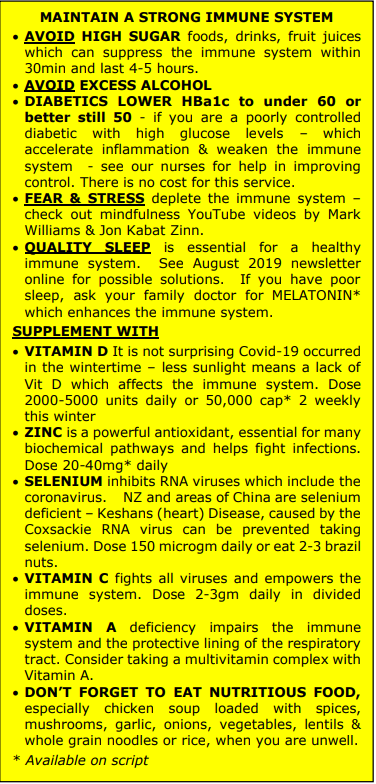
This is really an interesting read. I have included the reference links that were in the original story as well as the image that has an excellent guide to maintaining a strong immune system.
MARCH 2020
*An unpublished study from China suggests that Covid-19 largely affects older people. Those over 80 had a death rate of 14.8%, compared with 8.0% for those ages 70 to 79; 3.6% for those ages 60 to 69; 1.3% for those ages 50 to 59; 0.4% for those ages 40 to 49, and 0.2% for those ages 10 to 39. No deaths have been reported among children from birth to age 9.
*www.livescience.com...
REMAINING SAFE.
• KNOW YOUR RISK. If you are a smoker, elderly, or suffer from chronic disease, especially cancer or poorly controlled diabetes, your immune system will be depleted and less able to fight infection. When the 2020 flu vaccination becomes available, I strongly recommend having the immunisation, to build an early protective antibody response before influenza hits this winter. That will be one less illness to deal with.
• WASHING HANDS. This is the main way to avoid personal contact with the virus from contaminated surfaces. Wash your hands thoroughly, exposing all skin surfaces to soap and water, for at least 20 seconds. Then dry your hands on a disposable paper towel, as wet skin aids the transmission of the virus. Remember to carry a small sanitiser bottle with you to disinfect your hands when washing is unavailable.
• WEARING FACE MASKS. It is more important that those with cough and cold symptoms wear masks as this protects others from being infected. However, if you enter a high-risk area (hospitals, clinics), wearing a mask
is protective, and men being clean shaven is an advantage.
• COUGHING AND SNEEZING. Use armpit, elbow or handkerchief to prevent release of infected droplets over others.
• KEEP YOUR DISTANCE. Don’t shake hands, hug, kiss, or hongi with anyone who has respiratory symptoms or is unwell.
• AVOID UNSAFE PLACES. If Covid-19 becomes pandemic, I strongly recommend that those at greater risk stay home and don’t allow anyone with cold symptoms to enter. I well remember reading the exploits of the courageous and tempestuous Dr Rawene Smith (real name - Dr George McCall Smith, superintendent of Rawene Hospital in Northland), who during the 1918 flu epidemic blocked cars entering the Hokianga and
preventing the entry of influenza.
• BE PREPARED AND PLAN AHEAD. Ask yourself what will you do if you become infected, or if your relatives, friends or flatmates are quarantined for 2 weeks. Read the **Civil Defence website which has practical advice to assist in developing an emergency survival plan – food, long term medication, toiletries, and toilet paper required for at least 2 weeks, and don’t forget the needs of your pets. Ensure there is a
neighbour, friend or family member who will check on you.
**www.civildefence.govt.nz...
COVID-19 PREVENTION AND TREATMENT
~Excess sugar and alcohol are detrimental to your health.
~Negative emotions subtly weaken the immune system but mindfulness, prayer, and talking with friends and counsellors, as well as, writing therapy, strengthen our healing abilities.
~I am always concerned when I see diabetics with high Hba1c levels, who I know have a compromised immune system and an inability to fight infection. Please see our nursing team, who at no expense, will guide in ways to improve your diabetic control.
~Sound sleep is curative. Eat well and consider supplementation,
especially Vitamin D, Vitamin C, zinc and selenium.
MAINTAIN A STRONG IMMUNE SYSTEM - see image attached
Intravenous Vitamin C (IVC)
In the April 2019 newsletter (available on-line) I told of the usefulness of IVC in emergency situations, though NZ hospitals are reluctant to use it. It has been reported that a number of studies are underway to examine the effectiveness of IVC in treating coronavirus patients.
***March 3 -The government of Shanghai, China has announced its official
recommendation that COVID-19 should be treated with high amounts of
intravenous vitamin C. (1) Dosage recommendations vary with severity
of illness, from 50 to 200 milligrams per kilogram body weight per day to
as much as 200 mg/kg/day.
***orthomolecular.org...
Yours in good health,
Dr Richard J Coleman


🧩😏 Riddle me this, Neighbours…
I am an odd number. Take away a letter and I become even. What number am I?
Do you think you know the answer?
Want to stop seeing these in your newsfeed? No worries! Simply head here and click once on the Following button.


Scam Alert: Bank cold calls
ASB is warning customers about reports of cold calls from scammers claiming to be from ASB. These scammers are trying to obtain personal information, including usernames, dates of birth, and verification codes sent to your mobile phone.
🛡️ The "Caller Check" Test
If you get a call from someone claiming to be from ASB and you’re unsure, just ask them for a Caller Check. You will then be able to verify the call through the app.
Remember, banks will:
❌ Never ask for your banking passwords, PINs, or verification codes
❌ Never need to know your full credit card number – especially the CVC
❌ Never ask you to download software or remotely access your device
❌ Never ask you to purchase gift cards or transfer funds.
If you have received a phone call and think your account has been compromised, call ASB on 0800 ASB FRAUD (0800 272 372), or visit your local branch.

Notice of intention to control targeted weeds
Weather permitting spot spraying will be carried out in the following areas during March 2026.
Albert-Eden,
Puketapapa & Whau
Local Boards,
Auckland Domain,
Manukau Memorial Gardens,
North Shore
Memorial Park,
Waikumete Cemetery.
Herbicide applications will be carried out in reserves, cycleways, street gardens, street kerb and channels and berms/boundary edges. No spraying will be undertaken in agreed no-spray zones, during this period.
Auckland Council operates from a Code of Practice that governs all spray operations. Spraying will be undertaken by Programmed Facility Management.
For more information please phone Auckland Council on 09 301 0101.

 Loading…