





Collecting stickers or supermarket savings: Which is the better way to get your cookware?
Smeg knives. Spiegelau glasses. New World supermarket’s past sticker promotions have driven shoppers wild and sparked outrageous bidding wars. This year the exclusive offering is a range of MasterChef cookware. But could shoppers just buy similar cookware by making savings on their groceries at other supermarkets? James Pocock reports.
Saving supermarket stickers to get free cookware might be a fun thing to do, but it’s not necessarily the most financially savvy decision for your family to make over the next 10 weeks.
New World sticker promotions are almost always hot ticket items, but they take significant amounts of money to actually collect.
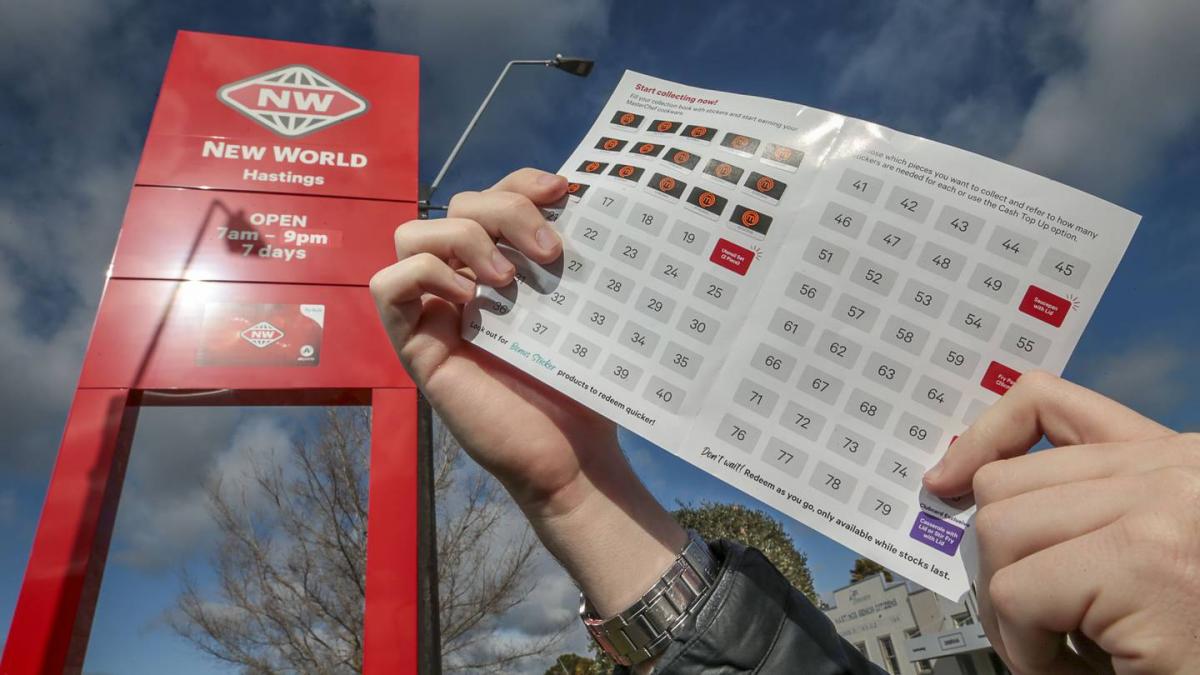
To collect a MasterChef Non-Stick Roaster with Rack in the current promotion, a New World customer needs 70 stickers, the equivalent of a $1400 spend in store.
So Hawke’s Bay Today decided to do a rather non-scientific comparison - would a shopper be better off just going to Pak ‘n Save for their weekly shop and then buying their own cookware with the savings?
With an average weekly shop rounding up to $140, a New World Hastings customer would earn 70 stickers in 10 weeks.
But our comparison, which doesn’t take into account changes in prices between stores week to week, shows someone purchasing the same items from fellow Foodstuffs-owned brand Pak ‘n Save Hastings could save about $100 after 10 weeks.
The exact same items in the same quantities through Pak ‘n Save’s online shopping feature set to Pak ‘n Save Hastings came to $129.25, for savings of $10.72 each week.
Michael McLay, manager of Total Food Equipment, said he didn’t know what the quality of the New World exclusive MasterChef cookware was, but you could purchase a top-quality roasting dish and rack from his store for $95.
New World’s own recommended retail price (RRP) cited the MasterChef roasting dish and rack as being valued at $140.
There are five other items that stickers can be traded for during the promotion which kicked off at the end of last month.
They range from a two-piece utensil set for 20 stickers or 10 stickers plus $10, all the way to the 24cm casserole dish with a lid available to club card members for 80 stickers or 40 stickers plus $40.
Two utensils and a 26cm frying pan that McLay estimated to be about equivalent in quality to the MasterChef items New World was offering cost $144 together at his stores.
The combined RRP of the MasterChef 26cm frying pan and two utensils was $145 according to New World’s website.
A Foodstuffs spokesperson said the cookware promotion aimed to bring a little cooking joy and inspiration into kitchens.
“From the popularity of our previous promotions with the likes of Smeg and KitchenAid, it’s clear Kiwis love quality items from well-known brands. Through our initial customer research, we had an overwhelmingly positive response towards the MasterChef cookware range.”
The spokesperson noted its New World and Pak ’n Save brands were very different.
“New World is all about a providing a great range of products at fair value, and excellent customer service, all wrapped up in a modern supermarket environment.
“Over at Pak ‘n Save, the aim is to deliver New Zealand’s lowest food prices and everything our teams do, whether it’s the no-frill warehouse format or buying in bulk, is designed to do just that.
McLay said most people he knew gave their New World stickers away, but “a promo is a promo” and there were fanatics for them.
He doubted that this year’s cookware promotion would be enough to make many people go out of their way to New World. “People will just continue to shop where they usually shop.”
=============================================
www.nzherald.co.nz...
=============================================

Dry cleaners mt Roskill
Hello our fellow neighbors I was hoping someone would know where the old dry cleaners we had up at the lights on dominion road have moved to?? I was out of town and when I came back they were gone .... I had some items that I would really love to get back but if only I new where they moved to or how to get In Touch with the owners to see what they did with our clothes if they closed down or moved elsewhere? Any updates or news about it would be amazing neighbors. Have a great day

Valentine’s Special | Custom Massage & Energy Healing
A 120-minute bespoke massage and energy-healing session designed to bring awareness and sensation back into the body. Ideal for a grounding, nervous-system reset, and embodied presence.
Valentine’s Special: $200 (120 minutes)
Session includes
- Intuitive, tailored full-body massage
- Integrated energy-healing work
- Premium organic massage oils
- Custom aromatherapy
- 432Hz healing frequency soundscape throughout
Why Valentine’s?
Valentine’s doesn’t have to be outward or performative. This session is a way to reconnect internally, release stored tension, and return to the body with clarity and ease.
About
Experienced professional masseuse and energy healer. Sessions are one-on-one only and adapted precisely to what the body presents on the day.
Available in Helensville, Auckland CBD, or as a mobile service.
Limited Valentine’s availability.
Message to book or enquire.


Poll: As a customer, what do you think about automation?
The Press investigates the growing reliance on your unpaid labour.
Automation (or the “unpaid shift”) is often described as efficient ... but it tends to benefit employers more than consumers.
We want to know: What do you think about automation?
Are you for, or against?
-
9.3% For. Self-service is less frustrating and convenient.
-
43.6% I want to be able to choose.
-
47.1% Against. I want to deal with people.
 Loading…