





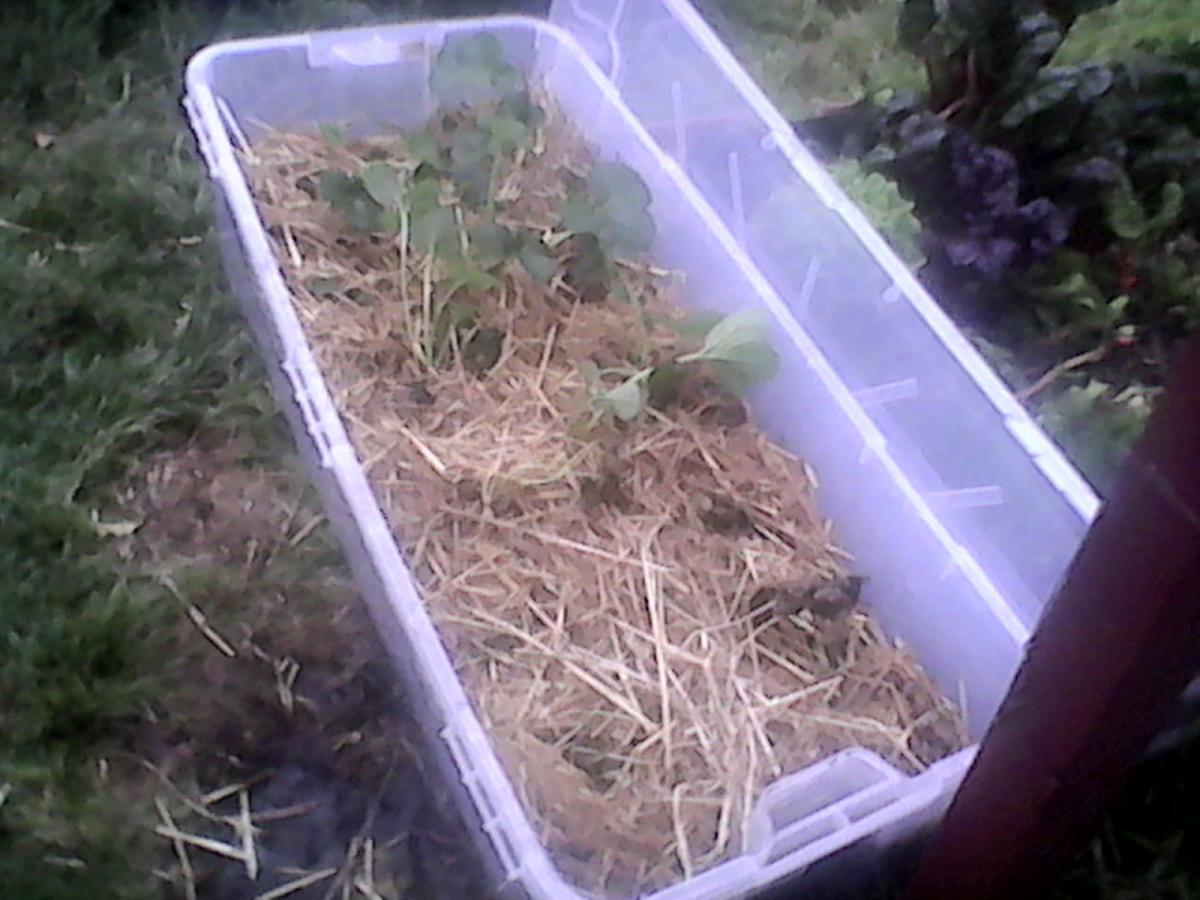
My NEW strawberry-growing operation. =D
A 163-litre plastic storage container bought from the Warehouse for $35, THEN I drilled holes in the base with a compass point for drainage so they don't get waterlogged, THEN half-filled it with three 30L bags of strawberry potting mix, then I took the strawberries out of their pots and put them in, fed (with liquid feed AND solid, longer-lasting fertiliser granules!!!) and watered them well, using the existing straw from the pots as mulch, and the tall sides of the container will afford them some protection from the wind (strawberries do not like the wind, it seems!), while if it gets too bad I have the clip-on lid leaning against the galvanised steel raised vege garden bed beside it, and BOTH the container and lid are transparent so the strawberry plants can get as much light as they want (strawberries NEED plenty of sun to grow fruit!), and they are in a sunny spot (although not on an overcast day like today!). =D HOPEFULLY I should have more luck with growing the strawberries!!!!!!!! =P The HEALTHY plants are the ones I just bought, the unfortunate brown ones are the ones that got damaged by the wind, and the little wee short ones with a green leaf or two (one or two have flowers, and one has a berry forming!) are Claire Tran's plants. =D I am doing the best I can to learn from her and others how to grow them (mine keep dying!), so any input as to what I'm doing wrong/what to do would be appreciated. =D Thanks. =D

Poll: If we want to reduce speeding, what do you think actually changes driver behaviour? 🛻🚨🚓
In the Post's article on speeding penalties, the question is asked whether speeding fines are truly about road safety, or are they just a way to boost revenue for the Crown?
What do you think? Should speeding motorists receive speeding fines or demerit points?
-
37.2% The sting of a fine (Money talks!)
-
62.8% The threat of demerit points (Nobody wants to lose their license!)

Energy Resilience & Security
“India is facing a highly precarious situation for its energy security if the Strait of Hormuz – the world’s most critical oil shipping chokepoint – remains closed amidst the escalating Middle East crisis.”
Can you imagine how easy it is to choke New Zealand’s supply of oil & gas if it ever found itself in a conflict situation? How easy it is to blow up a 1 Billion Dollar LNG facility? Evan as a non-combatant like India you can be badly effected.
How about distributed solar installations on tens of thousands of roofs? Supported by distributed wind and tidal power?
Alternative energy won’t make companies rich - but it beats coal, oil, gas on not only price but security, resilience (just ask Ukraine), job creation, and the environment hands down.
It’s a no-brainer - unless you are a profit-oriented used car salesman … how did NZ ever end up with him? Nearly as bad as Trump.

Some Choice News!
DOC is rolling out a new tool to help figure out what to tackle first when it comes to protecting our threatened species and the things putting them at risk.
Why does this matter? As Nikki Macdonald from The Post points out, we’re a country with around 4,400 threatened species. With limited time and funding, conservation has always meant making tough calls about what gets attention first.
For the first time, DOC has put real numbers around what it would take to do everything needed to properly safeguard our unique natural environment. The new BioInvest tool shows the scale of the challenge: 310,177 actions across 28,007 sites.
Now that we can see the full picture, it brings the big question into focus: how much do we, as Kiwis, truly value protecting nature — and what are we prepared to invest to make it happen?
We hope this brings a smile!

 Loading…