





What’s the cheapest supermarket?
This is the first story in a Consumer NZ investigation into New Zealand’s supermarket prices. In our second story, we’ll delve into the confusing and murky world of supermarket specials.
New Zealanders are still feeling the pain at the checkout. In Consumer’s latest Sentiment Tracker survey results, the cost of food and groceries was respondents’ most widespread concern for the coming 12 months.
In our supermarket investigation, we tracked online prices for a basket of 22 grocery items for 8 weeks at New World, Pak’nSave and Woolworths stores in Auckland, Wellington and Christchurch in our quest to find the cheapest supermarket. We also calculated the savings made by Woolworths’ and New World’s loyalty card members.
End dodgy 'specials' at the supermarkets
=================================
We have been looking into loyalty pricing – we don’t think loyalty schemes always offer the most competitive price. If you see any examples of products with a big difference between member and non-member pricing please share it with us.
Consistently the cheapest
=====================
Pak’nSave – with its claim of having “New Zealand’s lowest food prices” – was the cheapest store in our survey in all three regions.
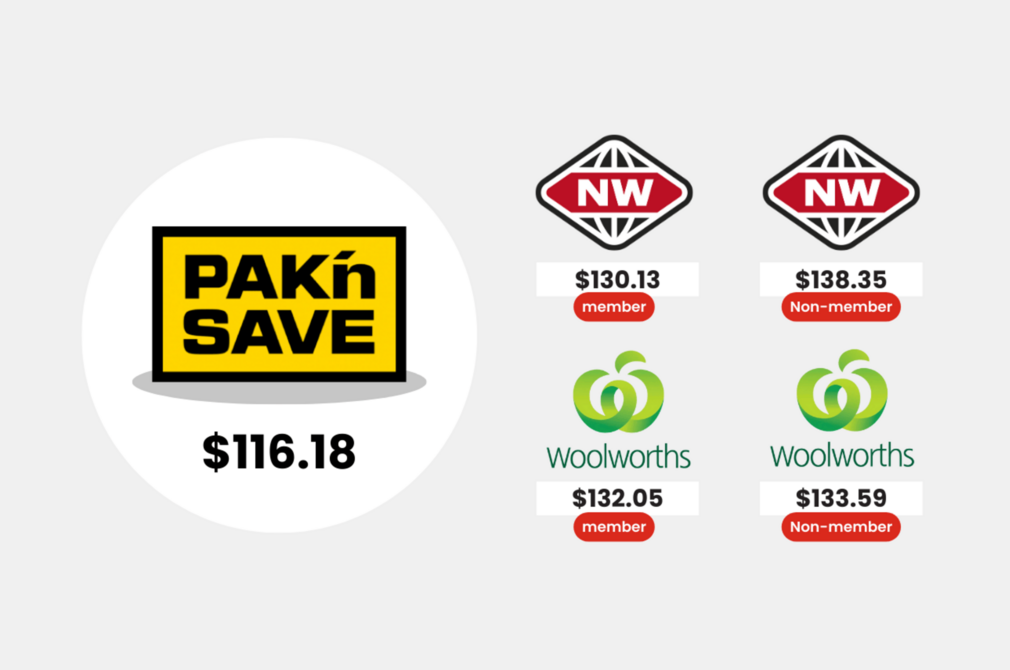
On average, across all regions, our basket of goods from Pak’nSave was $116.18, nearly $14 a week cheaper than the average basket of the same items for New World Clubcard members (the second cheapest store in our survey). That’s a saving of more than $700 a year.
The savings were even greater when compared with the average cost for Woolworths loyalty members (savings of $15.87 per week/$825 per year).
New World customers who weren’t loyalty club members paid the highest price at the checkout in the stores we surveyed (an average of $138.35 across all regions). There was little savings benefit for Woolworths Everyday Rewards members – on average, swiping your card would have saved less than $1.60 each week.
We weren’t surprised that prices have significantly increased since our equivalent 2020 survey. A very similar basket of goods cost 30% or more in 2024 at all the supermarkets we surveyed again.
Increasing grocery prices
====================
It’s no surprise that food and grocery prices have taken a hike in the past few years – we’ve all been feeling the dent in our weekly supermarket budget.
According to the Grocery Commissioner’s 2024 First Annual Grocery Report, grocery food prices increased more than any other common household expense between 2019 and 2023. A Statistics New Zealand Household Economic Survey found that per week on average, households spent $214 on grocery food in 2023, up from $166 in 2019.
The Grocery Commissioner’s report also states that in 2022, New Zealand had the fourth highest grocery expenditure in the OECD – we’re spending more on groceries than people living in Australia and the UK.
In 2020, we tracked the prices of a very similar basket of goods in the same Auckland and Wellington supermarkets. The basket also contained 22 items – the only difference in the 2024 baskets was the brand of peanut butter and toilet paper.
While we expected prices to have increased, we were surprised by how much. In Auckland, Pak’nSave Mt Albert prices had increased by 33%, Woolworths Mt Eden by 37% and New World Mt Roskill by 37%.
It was a similar story in Wellington. We recorded price increases of 31% at Pak’nSave Lower Hutt, and 37% at both Woolworths and New World’s Lower Hutt stores.
Foodstuffs said: Two-thirds of the price on the shelf is our cost of buying products from suppliers – it’s 68 cents in every dollar. We’ve seen a higher rate of supplier cost increases which we’ve been absorbing where we can to ensure these don’t get passed on to New Zealanders at the checkout.
Beware the loyalty lure
===================
New World and Woolworths both offer a loyalty rewards programme. These programmes are big business. New World’s and Woolworths’ offerings each have 1.6 million members, and a Consumer NZ poll of 1,650 supporters found 84% belonged to a supermarket loyalty programme.
While loyalty cards offer benefits such as accumulated rewards and points, their main appeal is the discounted prices at the checkout. But we found that belonging to a loyalty programme doesn’t always reward you with the lowest prices.
Overall, in each region, Pak’nSave (which doesn’t require customers to be loyalty programme members to get a cheaper price) was the cheapest supermarket to shop at for our basket of goods. As well, some products marked as member or club deal specials at Woolworths and New World were cheaper at the no-frills retailer.
For example, at New World Lower Hutt, Clubcard members paid $2.99 for 4 weeks of our survey for Palmolive Dishwashing Liquid 500ml (its regular price was $3.89). However, over the same 4 weeks, the same product could have been purchased at Pak’nSave Lower Hutt for $2.79 or less.
On 17 July, Woolworths Everyday Rewards members could buy Chelsea White Sugar 1.5kg at its Mt Eden store for $3.80 (regular price $4.89). But on the same day all shoppers at Pak’nSave Mt Albert would pay the regular price of $3.79.
In March, we warned people to be wary of supermarket loyalty programmes and questioned the value of them.
Consumer’s head of research and advocacy Gemma Rasmussen said if you’re providing the supermarket with your personal data, purchase history and shopping habits, you should be getting a fair discount in return. Our latest survey shows this isn’t always the case.
Over the 8 weeks of our survey, Woolworths Everyday Rewards members saved on average less than $1.60 per week on our basket of goods. New World members fared better, particularly in the South Island. New World Bishopdale Clubcard members saved on average $11.72 on our basket of goods, compared with New World Mt Roskill and Lower Hutt members who saved approximately $6.50 on average per week.
The commissioner’s grocery report is also scathing of loyalty programmes. It states that despite their potential benefits, loyalty programmes can reduce price transparency and make it more difficult for consumers to make informed decisions. It also said its market study into the grocery sector found consumer understanding of the schemes was low, particularly about how rewards are earned and redeemed.
Another concern we have with loyalty programme discounts is whether non-member prices are inflated to create the illusion of a special for members.
Will we ever see cheaper supermarket prices?
=====================================
There are significant issues with the state of the supermarket sector in New Zealand. Consumer applauded the Grocery Commissioner’s first annual grocery report, which provides much needed transparency on the concerning state of the supermarket sector. However, it’s dismaying the sector has seen no meaningful improvement since the commissioner’s market study was released in 2022.
There’s a lot that needs to change – from fixing pricing inaccuracies to reducing the barriers for a new supermarket player. We anticipate these changes will be slow to happen and even slower to make a meaningful impact at the checkout, and the grocery commissioner has been quick to emphasise that himself.
We think the government needs to keep a closer eye on the grocery sector and be ready to take more intensive action if we don’t see improvement in the sector soon, especially considering the financial stress being experienced across Aotearoa.
In the interim, we’ll continue to advocate in this space, from calling out government when we think progress isn’t fast enough, to mystery shopping everything from unit pricing to dodgy pricing specials.
About our survey
==============
We tracked the online price of 22 products for 8 weeks. As well as food and drink, cleaning products were also on our shopping list. We didn’t include fresh meat or produce because for a fair comparison we’d need to consider quality. Wine and beer were also excluded.
In most cases, all items were the same brand and size in each supermarket (we didn’t track supermarket home brands). The exceptions were in New World and Pak’nSave Christchurch stores, where we substituted Anchor 2L Standard Milk for MeadowFresh 2L Standard Milk. Some weeks, Purex 12-roll toilet paper was not available, so we substituted for Purex 6-roll Mega-Long (which has more sheets per packet). Where multi-buys were offered and cheaper, we calculated a single item price.
================================================
www.consumer.org.nz...
===============================================

Dry cleaners mt Roskill
Hello our fellow neighbors I was hoping someone would know where the old dry cleaners we had up at the lights on dominion road have moved to?? I was out of town and when I came back they were gone .... I had some items that I would really love to get back but if only I new where they moved to or how to get In Touch with the owners to see what they did with our clothes if they closed down or moved elsewhere? Any updates or news about it would be amazing neighbors. Have a great day

Valentine’s Special | Custom Massage & Energy Healing
A 120-minute bespoke massage and energy-healing session designed to bring awareness and sensation back into the body. Ideal for a grounding, nervous-system reset, and embodied presence.
Valentine’s Special: $200 (120 minutes)
Session includes
- Intuitive, tailored full-body massage
- Integrated energy-healing work
- Premium organic massage oils
- Custom aromatherapy
- 432Hz healing frequency soundscape throughout
Why Valentine’s?
Valentine’s doesn’t have to be outward or performative. This session is a way to reconnect internally, release stored tension, and return to the body with clarity and ease.
About
Experienced professional masseuse and energy healer. Sessions are one-on-one only and adapted precisely to what the body presents on the day.
Available in Helensville, Auckland CBD, or as a mobile service.
Limited Valentine’s availability.
Message to book or enquire.


Poll: As a customer, what do you think about automation?
The Press investigates the growing reliance on your unpaid labour.
Automation (or the “unpaid shift”) is often described as efficient ... but it tends to benefit employers more than consumers.
We want to know: What do you think about automation?
Are you for, or against?
-
9.2% For. Self-service is less frustrating and convenient.
-
43.7% I want to be able to choose.
-
47.1% Against. I want to deal with people.
 Loading…