






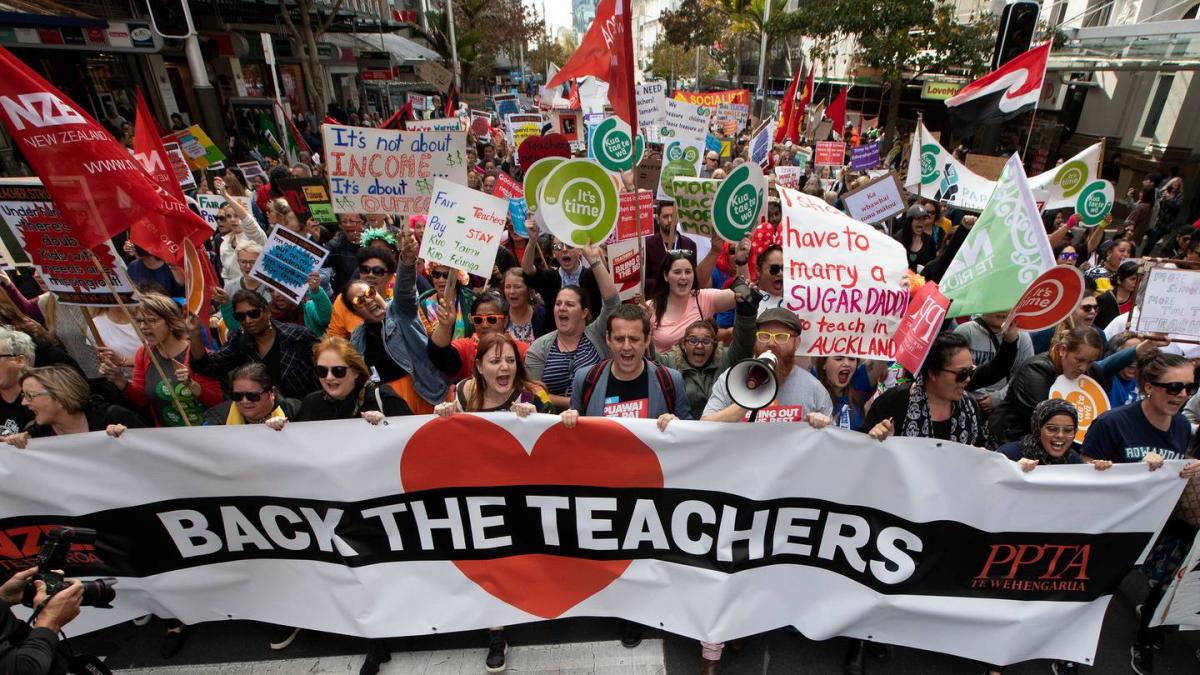
Secondary and Primary school teachers to strike next Thursday across New Zealand
It comes after members of two teachers’ unions voted to take industrial action to protest against the lack of progress with collective agreement negotiations ongoing since May 2022.
“Secondary teachers want ... pay rates and conditions to keep skilled and experienced teachers in the classroom, make secondary teaching a first choice career and encourage thousands of ex-teachers to return,” the Post Primary Teachers Association (PPTA) said.
Teachers in the PPTA and New Zealand Educational Institute (NZEI) will hold events around the country, including rallies and volunteering, with most starting at 11am.
An NZEI email said: “We will join our area school teacher colleagues and principals, primary principals and kindergartens alongside PPTA secondary school teachers in holding joint action across Aotearoa New Zealand.
“This is a combined workforce of 50,000 people and together our voices will be loud.”
Several schools have already announced they will be closed.
In Auckland, disgruntled teachers will march from along Queen St and Fort St to Aotea Square.
In Christchurch, teachers will meet at Victoria Square and march on the local Ministry of Education office on Hereford St.
Meanwhile, in Wellington, a rally will be held at Parliament at midday.
The strike decision was made after union members “overwhelmingly” rejected Ministry of Education offers.
NZEI President Mark Potter said: “The offer did little to address the concerns we have as a sector, and did not go far enough in ensuring that teaching is a valued and attractive profession.”
The rising cost of living was an issue for teachers, Potter said, but the pay offer was only part of why union members rejected the Ministry’s offer.
Staffing numbers and school and kindergarten funding remained important concerns, he said.
“This rejection of the offers and the move to a strike ballot is just the first step,” Potter said.
“I’m sure our members will be making their voices and opinions heard from now until the general election.”
=============================================
www.nzherald.co.nz...
=============================================

A Neighbourly Riddle! Don’t Overthink It… Or Do?😜
Do you think you know the answer? Simply 'Like' this post if you know the answer and the big reveal will be posted in the comments at 2pm on the day!
If you multiply this number by any other number, the answer will always be the same. What number is this?


Poll: As a customer, what do you think about automation?
The Press investigates the growing reliance on your unpaid labour.
Automation (or the “unpaid shift”) is often described as efficient ... but it tends to benefit employers more than consumers.
We want to know: What do you think about automation?
Are you for, or against?
-
9.5% For. Self-service is less frustrating and convenient.
-
43.5% I want to be able to choose.
-
47.1% Against. I want to deal with people.

Even Australians get it - so why not Kiwis???
“Ten years ago, if a heatwave as intense as last week’s record-breaker had hit the east coast, Australia’s power supply may well have buckled. But this time, the system largely operated as we needed, despite some outages.
On Australia’s main grid last quarter, renewables and energy storage contributed more than 50% of supplied electricity for the first time, while wholesale power prices were more than 40% lower than a year earlier.
[…] shifting demand from gas and coal for power and petrol for cars is likely to deliver significantly lower energy bills for households.
Last quarter, wind generation was up almost 30%, grid solar 15% and grid-scale batteries almost tripled their output. Gas generation fell 27% to its lowest level for a quarter century, while coal fell 4.6% to its lowest quarterly level ever.
Gas has long been the most expensive way to produce power. Gas peaking plants tend to fire up only when supply struggles to meet demand and power prices soar. Less demand for gas has flowed through to lower wholesale prices.”
Full article: www.theguardian.com...
If even Australians see the benefit of solar - then why is NZ actively boycotting solar uptake? The increased line rental for electricity was done to make solar less competitive and prevent cost per kWh to rise even more than it did - and electricity costs are expected to rise even more. Especially as National favours gas - which is the most expensive form of generating electricity. Which in turn will accelerate Climate Change, as if New Zealand didn’t have enough problems with droughts, floods, slips, etc. already.
 Loading…