





Why make picking up reserved library books harder? What do you think? Challenge: Write the last stanza for the first poem attached below.
Once books are reserved in Auckland Libraries books, when they are available no longer go alphabetically by customer but instead go into a Holds pickup shelf number based presumably somehow on when each book needs to be picked up by.
I had two books reserved that arrived on two different days in the Blockhouse Bay Library and hence each book has a different shelf number. Hard to find unless you knew the shelf number in the notification email. Even if you knew the shelf number I found myself three books by the same author on the two shelf numbers.
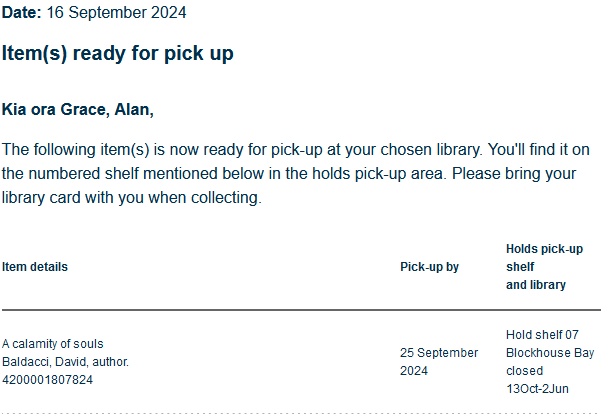
More recently yesterday a book I reserved was on a different shelf number than was specified in my notification email (see image below).
Sadly it is clear from library staff that a numerical system for reserves is here to stay.
I suggest that so that all books for each person has the same shelf number, the shelf number becomes the last digit of a person's library card (0-9).
Within each shelf number a book is found under the day the reserve arrives in the library (01 to 31, hopefully the same date the email is sent).
Since a customer appears to have 10 days to pick up a book, ten days of the month would appear to be required at any time (for each digit 0-9).
Once there are 10 days used the next day's reserves could go back at the beginning of the shelf number after any remaining books not collected (hopefully none) are removed (along with the old day number and the new day number (01 to 31) inserted) after the last day available and future days' books remaining moved forward to make room.
Each day number (01-31) would appear once for each shelf number (0-9) before the first book on that day- perhaps cover an old withdrawn book with paper with each day number on the spine?
When a reserved book arrives in the library the last digit of the library card could be placed on a piece of paper in the book to be removed when it is put on the shelf, to be recycled the next day.
What do you think?
See the image below and page 3 below for a letter appearing in the Western Leader on 9 September:
www.neighbourly.co.nz...
Also see:
aaamazingphoenix.wordpress.com...


Poll: Does a savoury scone require cheese on top, or folded inside?
Help settle the great kiwi debate ... cheese on top, or folded inside?
-
76.7% Inside!
-
23.3% On top!

has anyone got some pond/oxygen weed
I'm too late for tadpoles but am hoping someone might sell me some of their oxygen weed or any sort of aquatic pond plant??? Maybe tadpoles as well?


 Loading…