






Throwing The Baby Out With The Bathwater
The historian Thomas Carlyle said, “The history of the world is but the biography of great men.” Carlyle’s patriarchal expression being somewhat dated, and politically incorrect I would want to rephrase in today's climate. I would add that history “is but the biography of great men and women.”
One only needs to think of a few examples to ratify this truth. HItler in terms of infamy, Mother Theresa in terms of mercy, Einstein in terms of physics, Da Vinci in terms of art, and the list is endless. If I were to bring that closer to home, in the light of her recent win, I might even mention our own homegrown Vicki Wilson who has left her mark on the Equestrian world in Kentucky- having just taken out the title twice in a row.
But all of this begs the question, how well will any of this be clearly remembered after a couple of thousand years?
Will any holidays be instituted on the anniversary of these events?
We have Anzac day to mark the landing of Australian and NZ troops on Gallipoli, but what other major holidays do we set aside in our calendar in celebration of, out of respect for, and in recognition of the impact and the contribution made to our culture?
Of course many of you will immediately recognize where I’m going with this now, and you have no doubt you don’t need my permission to stop reading and change the subject. But for those tenacious souls who see words and must read- I am of course speaking of the impact on the world of Jesus the Christ.
The Bible itself honestly records the incredulity of people of the time who, though they were expecting a great leader to arise from the failing ashes of Jewish hope, couldn’t countenance the possibility that this auspicious occasion could originate in a no-account place as humble as Nazareth.
“Can anything good come out of Nazareth?” was the haunting question.
Love him or loathe him, the master wordsmith, Malcolm Muggeridge, wryly observed the great power struggles of the world over a lifetime of journalism. I think he got it right when he spoke of the impact on the world of this nobody, from a non-descript village, from a Roman controlled backwater at the periphery of the then civilized world.
“We look back upon history and what do we see?
Empires rising and falling, revolutions and counterrevolutions, wealth accumulating and and then disbursed, one nation dominant and then another. Shakespeare speaks of the ‘rise and fall of great ones that ebb and flow with the moon.’
In one lifetime I have seen my own countrymen ruling over a quarter of the world, the great majority of them convinced, in the words of what is still a favorite song, that “God who’s made them mighty would make them mightier yet.”
I’ve heard a crazed, cracked Austrian proclaim to the world the establishment of a German Reich that would last for a thousand years; an Italian clown announce he would restart the calendar to begin with his own assumption of power; a murderous Georgian brigand in the Kremlin acclaimed by the intellectual elite of the western world as wiser than Solomon, more enlightened than Asoka, more humane than Marcus Aurelius.
I’ve seen America wealthier and in terms of military weaponry more powerful than all the rest of the world put together, so that Americans, had they so wished, could have outdone an Alexander or a Julius Caesar in the range and scale of their conquests.
All in one little lifetime. All gone with the wind.
England now part of an island off the coast of Europe and threatened with dismemberment and even bankruptcy.
Hitler and Mussolini dead and remembered only in infamy.
Stalin a forbidden name in the regime he helped to found and dominate for some three decades.
America haunted by fears of running out of the precious fluid that keeps the motorways roaring and the smog settling, with troubled memories of a disastrous campaign in Vietnam and of the great victories of the Don Quixote's of the media when they charged the windmills of Watergate. All in one lifetime, all in one lifetime, all gone. Gone with the wind.
—Malcom Muggeridge, “But Not of Christ,” Seeing Through the Eye: Malcolm Muggeridge on Faith, ed. Cecil Kuhne (San Francisco: Ignatius Press, 2005), 29-30.
When Ravi Zacharias quotes a version of these memorable words from Muggeridge, he often adds his own appropriate postscript:
"Behind the debris of these solemn supermen, and self-styled imperial diplomatists, there stands the gigantic figure of one, because of whom, by whom, in whom and through whom alone, mankind may still have peace: The person of Jesus Christ. I present him as the way, the truth, and the life."
Variously labelled as mad, luminary, prophetic and whose works are now known as seminary, the poet William Blake wrote:
"This life's dim windows of the soul, distorts the heavens from pole to pole, and leads you to believe a lie when you see with, and not through the eye"
Are you looking at the life, the death and the resurrection of Christ, through the jaundiced eye of humanism, or the clear eyed vision of truth?
Here is how Muggeridge put his own life in perspective:
"I may, I suppose, regard myself as a relatively successful man. People occasionally stare at me in the streets: that’s fame. I can fairly easily earn enough to qualify for admission to the higher slopes of the internal revenue. That’s success. Furnished with money and even a little fame, even the elderly if they care to- may partake of trendy diversions. That’s pleasure. It might happen once in a while that something I said or wrote was sufficiently headed for me to persuade myself that it represented a serious impact on our time. That’s fulfillment. Yet I say to you and beg you to believe me. Multiply these tiny triumphs by a million, add them all together, and they are nothing – less than nothing – a positive impediment measured against one draft of that Living Water Christ offers to the spiritually thirsty, irrespective of who or what they are."
As you celebrate Easter, think again about whether or not to relegate Jesus to the dustbin of history.
youtu.be...

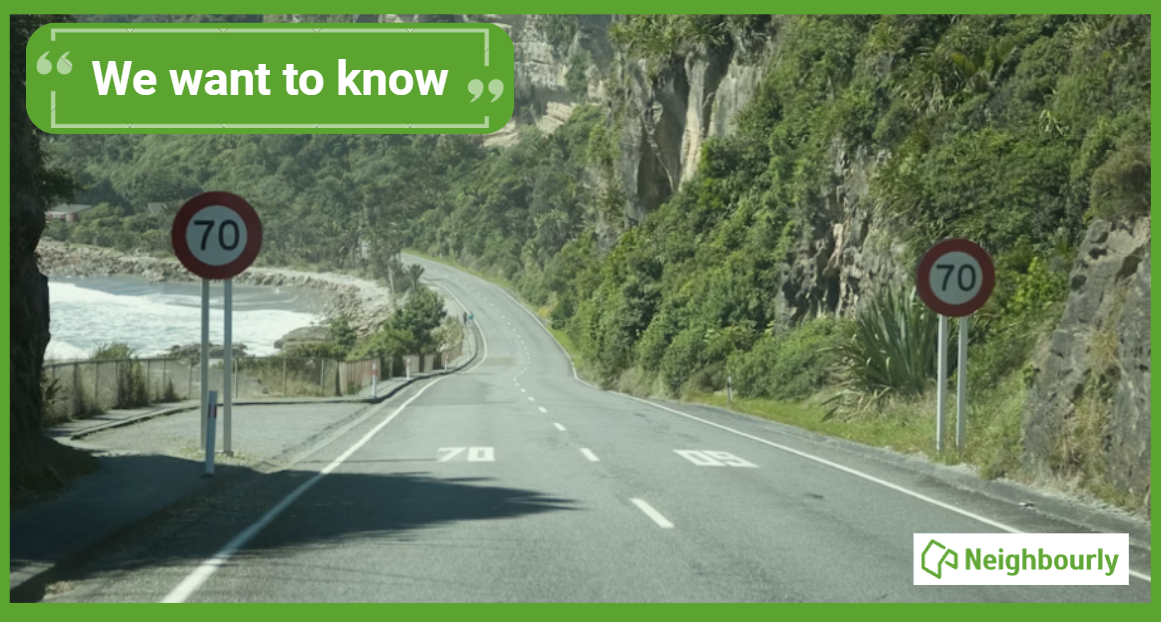
Poll: If we want to reduce speeding, what do you think actually changes driver behaviour? 🛻🚨🚓
In the Post's article on speeding penalties, the question is asked whether speeding fines are truly about road safety, or are they just a way to boost revenue for the Crown?
What do you think? Should speeding motorists receive speeding fines or demerit points?
-
37% The sting of a fine (Money talks!)
-
63% The threat of demerit points (Nobody wants to lose their license!)

Some Choice News!
DOC is rolling out a new tool to help figure out what to tackle first when it comes to protecting our threatened species and the things putting them at risk.
Why does this matter? As Nikki Macdonald from The Post points out, we’re a country with around 4,400 threatened species. With limited time and funding, conservation has always meant making tough calls about what gets attention first.
For the first time, DOC has put real numbers around what it would take to do everything needed to properly safeguard our unique natural environment. The new BioInvest tool shows the scale of the challenge: 310,177 actions across 28,007 sites.
Now that we can see the full picture, it brings the big question into focus: how much do we, as Kiwis, truly value protecting nature — and what are we prepared to invest to make it happen?
We hope this brings a smile!


🎉 Riddle me this, legends! 🎉
He/She who makes it, sells it.
He/She who buys it, doesn't use it.
The user doesn't know they are using it.
What is it?
(Shezz from Ngāruawāhia kindly provided this head-scratcher ... thanks, Shezz!)
Do you think you know the answer? Simply 'Like' this post if you know the answer and the big reveal will be posted in the comments at 2pm on the day!
Want to stop seeing these in your newsfeed?
Head here and hover on the Following button on the top right of the page (and it will show Unfollow) and then click it. If it is giving you the option to Follow, then you've successfully unfollowed the Riddles page.

 Loading…