



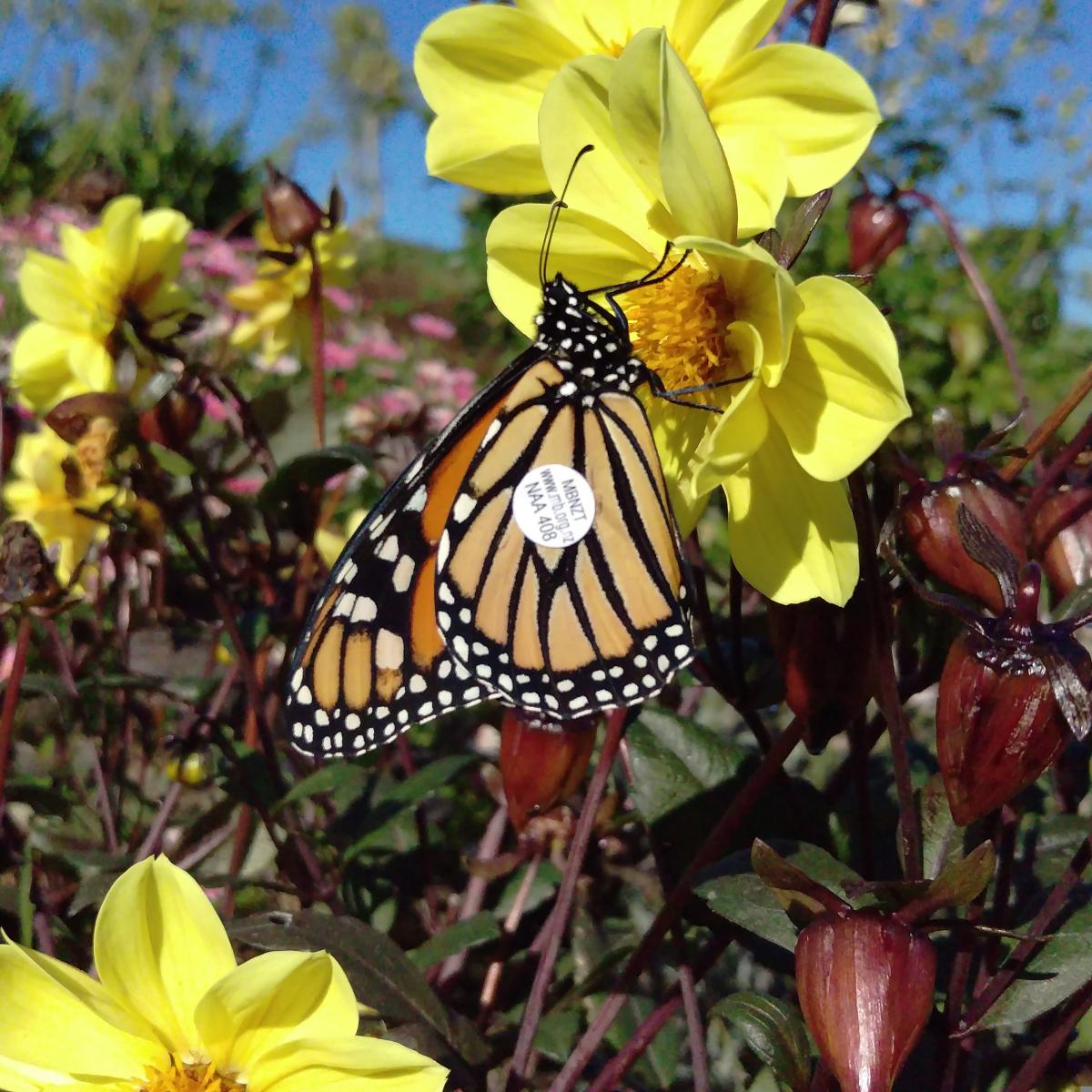
Monarch butterfly season
Something has definitely affected monarchs this year. Those who have raised monarchs are finding male to female ratio is roughly even. However, many of the female monarchs are not laying eggs. Could they be sterile? Could the males be infertile? The Monarch Butterfly NZ Trust is investigating... (600 respondents all over the country showed that 2/3 of the country had 'virtually no/fewer monarch eggs than a typical year').
You can see the survey results on our website.
www.monarch.org.nz...
Yes, social wasps (includes paper wasps), praying mantises, ants etc are natural predators and there are also parasites and pathogens which affect eggs, caterpillars and chrysalises... but if you don't have eggs, you don't get past base!
What can you do to help? Here's three top tips:
(1) supporting the MBNZT is a good beginning: funds will help us work with scientists analysing the data we've collected PLUS you get a fantastic magazine BUTTERFLIES in your mailbox four times a year with lots of tips...
www.monarch.org.nz...
(2) Plant more swan plants! Where you have swan plants in inappropriate places, let the monarchs weed them OR share them with others OR put them in a bucket of water and let the caterpillars eat them.
(3) DON'T use pesticides. It could be pesticides which are affecting the monarch... more research will help identify the cause. Find out through our website alternatives to what you've used in the past.
Hope this is helpful! There's more info. of course on our website. Please share, let's see what we can do to help the monarchs.

Poll: If we want to reduce speeding, what do you think actually changes driver behaviour? 🛻🚨🚓
In the Post's article on speeding penalties, the question is asked whether speeding fines are truly about road safety, or are they just a way to boost revenue for the Crown?
What do you think? Should speeding motorists receive speeding fines or demerit points?
-
32.6% The sting of a fine (Money talks!)
-
67.4% The threat of demerit points (Nobody wants to lose their license!)

Some Choice News!
DOC is rolling out a new tool to help figure out what to tackle first when it comes to protecting our threatened species and the things putting them at risk.
Why does this matter? As Nikki Macdonald from The Post points out, we’re a country with around 4,400 threatened species. With limited time and funding, conservation has always meant making tough calls about what gets attention first.
For the first time, DOC has put real numbers around what it would take to do everything needed to properly safeguard our unique natural environment. The new BioInvest tool shows the scale of the challenge: 310,177 actions across 28,007 sites.
Now that we can see the full picture, it brings the big question into focus: how much do we, as Kiwis, truly value protecting nature — and what are we prepared to invest to make it happen?
We hope this brings a smile!
Poll: Are you still heading to your local for your caffeine fix, or has the $$ changed your habits? ☕
Wellington’s identity is built on its cafe culture, but with costs climbing, that culture is under pressure. We’ve seen the headlines about recent closures, and it’s a tough pill to swallow along with a $6+ coffee.
We all want our favourite spots to stay open, but we also have to balance our own budgets ⚖️
We want to know: How are you handling the "coffee math" in 2026? Are you still heading to your local for a chat and a caffeine fix, or has the cost of living changed your habits?
Keen to read more about "coffee math"? The Post has you covered.

-
46.4% I avoid spending money on coffee
-
44.1% I still indulge at my local cafe
-
9.5% Irrelevant - coffee is not for me
 Loading…