





What is Yarn: What It’s Made From, How You Make It and More
When researching or reading about different fabrics, you are likely to see the word yarn mentioned a lot. ‘Made from spun yarns’ or ‘with synthetic yarns’ are a couple of examples. But what is yarn? What is spun yarn? Are there other types? What does it all mean, and how much relevance does this bear to your final fabric? That’s what we are here to look at in a little more detail.
What is Yarn?
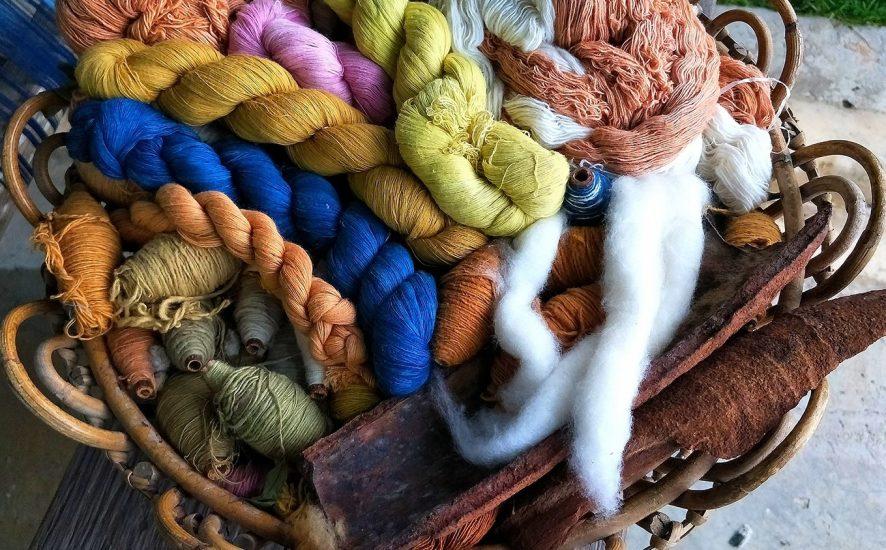
Yarn is a length of fibres. That’s the simplest way to explain it. It is a continuous length of fibres which are interlocked, and it’s used to produce fabrics, as well as in crocheting, knitting, embroidery and ropemaking.
This means that we can split yarn into two different ‘categories’ of sorts. The thread that is used for embroidery or in sewing machines, as well as yarn (commonly known as balls-of-wool) used in crafts such as knitting or crocheting, are long lengths that are bought as yarns.
The alternative would be a yarn which is then knitted or woven into a fabric. The textile is then bought as fabric, in lengths, rather than the yarn itself being purchased separately. This second description is the one that we will explore further in this post.
What is Yarn Made From?
Yarn can be made from such a variety of different fibres. This includes both natural and synthetic fibres. The most common plant fibre is cotton, however, you can also use other natural fibres such as bamboo. Alongside cotton, the synthetic polyester fibre makes up the two most commonly used fibres. Animal fibres are also often used, such as wool, harvested from sheep, as well as cashmere (harvested from goats) Angora (from rabbits) and silk (from insect larvae).
What is the Difference Between Spun and Filament Yarn?
Spun yarn is made by twisting staple fibres together in either an S or Z twist, to make a single thread. The process of twisting the fibres together into yarn is called spinning and it was one of the first processed to be industrialised. Spun yarns can contain a single type of fibre, or you can spin various types of fibre together to give you a blend.
Filament yarn is made up of filament fibres which are either twisted together or simply grouped together. It can either be composed of one filament, which is called a monofilament, or it could be made of more than one, in which case it would be known as a multifilament. This can be as few as two or three filament fibres, or even up to 50, or more.
Keep reading: www.curtainclean.co.nz...

Trusted Painters for Every Home
Hi neighbours!
At Graham’s Painters we bring 40+ years of experience, a friendly team of over 20+ full-time professionals, and a “get-it-done” attitude to every job big or small.
We specialise in interior/exterior painting, roof painting, house washing, decking, fencing, wallpapering, and cedar weatherboards. We’re tidy, punctual, and perfect for busy families, non-DIYers, and retirees.
Discounts available for SuperGold Card holders
Serving all of Wellington, Hutt Valley & up to Plimmerton.
Message us today for a free quote, we’d love to help bring your home to life!


Poll: 🤖 What skills do you think give a CV the ultimate edge in a robot-filled workplace?
The Reserve Bank has shared some pretty blunt advice: there’s no such thing as a “safe” job anymore 🛟😑
Robots are stepping into repetitive roles in factories, plants and warehouses. AI is taking care of the admin tasks that once filled many mid-level office jobs.
We want to know: As the world evolves, what skills do you think give a CV the ultimate edge in a robot-filled workplace?
Want to read more? The Press has you covered!
-
58.6% Human-centred experience and communication
-
13.3% Critical thinking
-
25.4% Resilience and adaptability
-
2.8% Other - I will share below!

Brain Teaser of the Day 🧠✨ Can You Solve It? 🤔💬
Make a hearty dish. Take just half a minute. Add four parts of kestrel. Then just add one. What have you made?
(Trev from Silverdale kindly provided this head-scratcher ... thanks, Trev!)
Do you think you know the answer? Simply 'Like' this post and we'll post the answer in the comments below at 2pm on the day!
Want to stop seeing these in your newsfeed? No worries! Simply head here and click once on the Following button.
 Loading…