




'Bishops, Boozers, Brethren & Burkas: A Cartoon History of Religion in New Zealand' by Mike Grimshaw
Date: Friday, 21 June, 2019
Time: 12:10pm to 1:00pm
Cost: Free. You don't need to book.
Location: Te Ahumairangi (ground floor), National Library, corner Molesworth and Aitken Streets, Thorndon
Author Mike Grimshaw discusses his book
Mike Grimshaw discusses his new book, 'Bishops, Boozers, Brethren & Burkas', published in June 2019 as part of the New Zealand Cartoon Archive’s monograph series. Grimshaw will use cartoons from 1860s to the present day to discuss the way religion in New Zealand has been represented by our cartoonists.
History via cartoons
There is no general history of religion in New Zealand, so this book is a unique contribution, providing not only a cartoon history of religion in this country but also a history via cartoons.
Changing views on religion
From the 1860s, settlers viewed issues of religion and politics as problematic, but in the main, religion remained part of the fabric of society. However, religion was more of a concern for our cartoonists as New Zealand became an increasingly secular nation from the 1970s onwards. This not only reflects the generation of cartoonists whose work was published from the 1970s but also a shift in New Zealand society more generally.
Overall, when religion was less of a contested identity and influence, cartoonists tended to leave religion — and the church alone. However, as the country became, very quickly, a secular society from the 1970s onwards, religion was a target of cartoonists. Religion and the religious were increasingly presented as representing religious and social attitudes and beliefs regarded as out of step with a modern society.
About the speaker
Mike Grimshaw (PhD Otago) is Associate Professor in Sociology at University of Canterbury, New Zealand. A founding series editor for Radical Theologies and Philosophies (Palgrave Macmillan) and founding co-editor of Continental Thought & Theory (), he toils at the intersections of radical theology, continental thought and cultural and social theory.
Mike also has a focus on New Zealand religious and intellectual history; recently publishing a book of interviews with the New Zealand radical religious thinker Sir Lloyd Geering 'Geering Interviews'(Polebridge, USA, 2018), and edited the letters of the noted New Zealand philosopher Arthur Prior "Arthur Prior, ‘a young progressive'" (Canterbury University Press, 2018).
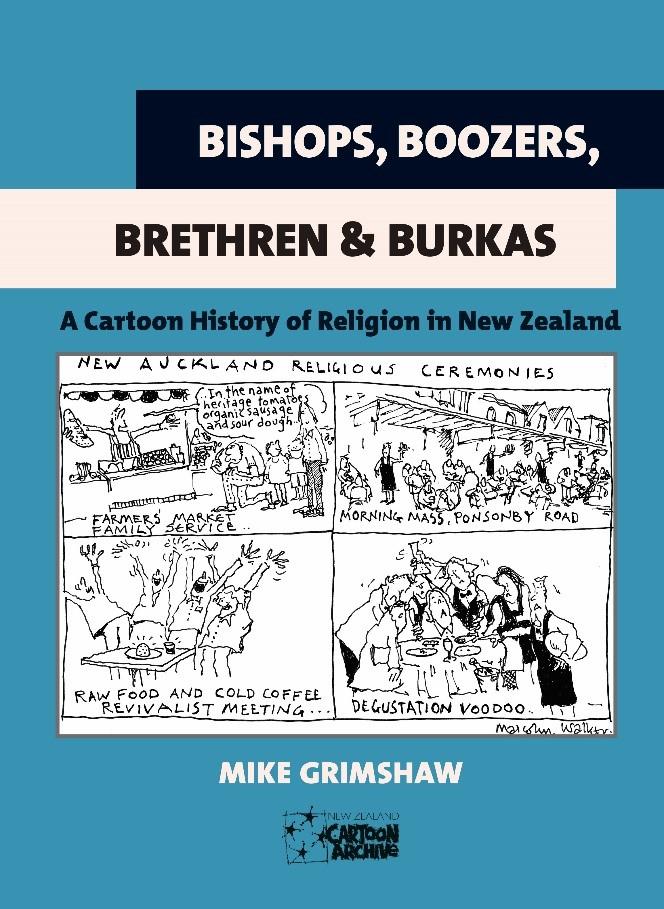
Image: Cover of 'Bishops, Boozers, Brethren & Burkas' by Mike Grimshaw (New Zealalnd Cartoon Archive, 2019)

Some Choice News!
DOC is rolling out a new tool to help figure out what to tackle first when it comes to protecting our threatened species and the things putting them at risk.
Why does this matter? As Nikki Macdonald from The Post points out, we’re a country with around 4,400 threatened species. With limited time and funding, conservation has always meant making tough calls about what gets attention first.
For the first time, DOC has put real numbers around what it would take to do everything needed to properly safeguard our unique natural environment. The new BioInvest tool shows the scale of the challenge: 310,177 actions across 28,007 sites.
Now that we can see the full picture, it brings the big question into focus: how much do we, as Kiwis, truly value protecting nature — and what are we prepared to invest to make it happen?
We hope this brings a smile!


🎉 Riddle me this, legends! 🎉
He/She who makes it, sells it.
He/She who buys it, doesn't use it.
The user doesn't know they are using it.
What is it?
(Shezz from Ngāruawāhia kindly provided this head-scratcher ... thanks, Shezz!)
Do you think you know the answer? Simply 'Like' this post if you know the answer and the big reveal will be posted in the comments at 2pm on the day!
Want to stop seeing these in your newsfeed?
Head here and hover on the Following button on the top right of the page (and it will show Unfollow) and then click it. If it is giving you the option to Follow, then you've successfully unfollowed the Riddles page.


Poll: If we want to reduce speeding, what do you think actually changes driver behaviour? 🛻🚨🚓
In the Post's article on speeding penalties, the question is asked whether speeding fines are truly about road safety, or are they just a way to boost revenue for the Crown?
What do you think? Should speeding motorists receive speeding fines or demerit points?
-
37.2% The sting of a fine (Money talks!)
-
62.8% The threat of demerit points (Nobody wants to lose their license!)
 Loading…