




Cable Car turns 119
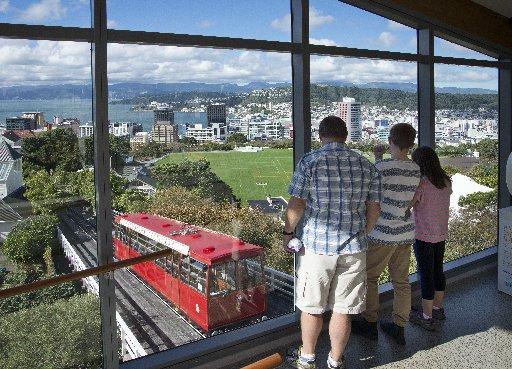
Wellington’s Cable Car is turning 119 this month.
Here are some interesting facts and figures.
- The Cable Car is a funicular railway rising 120 metres over a length of 609 metres. The line rises at a constant grade of 1 in 5 (18%), through three tunnels and over three bridges.
- The Cable Car has two cars, which start from opposite ends of the line and pass in the middle. They are attached to each other by a 30 mm diameter cable, guided by 120 rollers, which runs round a pulley at the top of the hill.
-The normal operating speed is 14.5 kmh, with a maximum load of about 75 passengers. Each car weighs about 13 tonnes when empty and 20 tonnes when full.
- It is used by about 1.1 million people each year.
- The original Cable Car railway was built and operated by the Kelburne & Karori Tramway Company. The line opened to the public on 22 February 1902.
- The hilltop location of Victoria University’s main campus was influenced by the company’s offer of a donation of £1000 if the university were located in Kelburn, so students would patronise the car when travelling between the city and the university.
- The designer of the system was James Fulton, a Dunedin-born engineer who had earlier helped build and operate the privately-owned Wellington-Manawatu railway.
- The Cable Car’s original steam-powered winding gear was replaced by an electric motor in 1933.
- In the 1940s the Cable Car suffered from increased competition: City Council buses ran to Karori and other western suburbs, bypassing it. The company believed that it was wrong for the City Council to compete with a private company, and a legal dispute broke out. The argument ended when the City Council agreed to purchase the company in 1947.
- The safety of the original Cable Car system, including its antique carriages, became a major issue in the 1970s. At that time the Ministry of Works concluded that aspects of the Cable Car were unsafe, particularly the use of unbraked trailers, and called for the system to be scrapped. Luckily for us, instead the Cable Car was replaced in 1979 with the design that we have today.
- Since the replacement, each car has completed over 993K trips, which is a total distance of over 605,000 km. That is 15 times around the earth, or 290 trips from Bluff to Cape Reinga


Brain Teaser of the Day 🧠✨ Can You Solve It? 🤔💬
Make a hearty dish. Take just half a minute. Add four parts of kestrel. Then just add one. What have you made?
(Trev from Silverdale kindly provided this head-scratcher ... thanks, Trev!)
Do you think you know the answer? Simply 'Like' this post and we'll post the answer in the comments below at 2pm on the day!
Want to stop seeing these in your newsfeed? No worries! Simply head here and click once on the Following button.


Poll: 🤖 What skills do you think give a CV the ultimate edge in a robot-filled workplace?
The Reserve Bank has shared some pretty blunt advice: there’s no such thing as a “safe” job anymore 🛟😑
Robots are stepping into repetitive roles in factories, plants and warehouses. AI is taking care of the admin tasks that once filled many mid-level office jobs.
We want to know: As the world evolves, what skills do you think give a CV the ultimate edge in a robot-filled workplace?
Want to read more? The Press has you covered!

-
56.6% Human-centred experience and communication
-
13.2% Critical thinking
-
26.3% Resilience and adaptability
-
3.9% Other - I will share below!
Poll: Should the government levy industries that contribute to financial hardship?
As reported in the Post, there’s a $30 million funding gap in financial mentoring. This has led to services closing and mentors stepping in unpaid just to keep helping people in need 🪙💰🪙
One proposed solution? Small levies on industries that profit from financial hardship — like banks, casinos, and similar companies.
So we want to hear what you think:
Should the government ask these industries to contribute?

-
59.8% Yes, supporting people is important!
-
26.1% No, individuals should take responsibility
-
14.1% ... It is complicated
 Loading…