






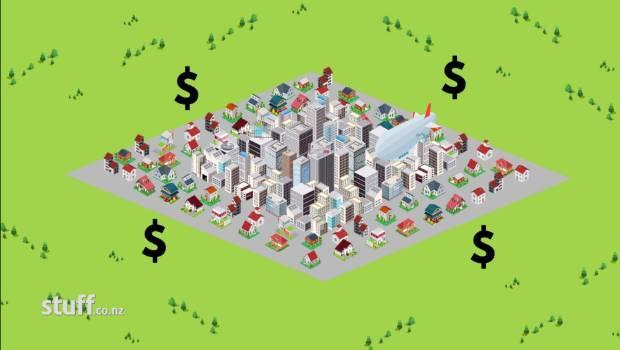
Why are New Zealand homes so pricey? It has nothing to do with avocados!
Now you can buy a house! Well, not really. Kiwi houses are still very expensive. Charlie Gates looks at why and finds out it has nothing to do with avocados on toast.
In May 2017, property developer Tim Gurner was asked if young people faced the prospect of never owning a home.
His answer gave the world a symbol for the housing crisis.
"Absolutely, when you're spending $40 a day on smashed avocado and coffee and not working. Of course. Absolutely," he said.
It was an offhand comment that crystalised a debate over housing affordability that has often split down generational lines.
Are young people struggling to buy homes because they are spending recklessly on luxury items like "smashed avocado"? Or are they struggling because generational shifts and sweeping economic changes playing out over many decades have slowly made houses less and less affordable?
Spoiler alert: it's the latter.
Despite a recent shift in house prices, Kiwi homes are still among the least affordable in the world.
But, how do we measure housing affordability?
One method economists use is to compare the median house price to the median household annual income. For example, in June 2018 the median annual household income was $88,904, but the average median house price was $560,000, according to interest.co.nz.
This means the median house price was 6.3 times bigger than the median annual income in June. The national figure has not changed dramatically, shifting to about 6.2 for August this year.
Economists generally agree that the median multiple, as it is known, should be around three for housing to be considered affordable.
But when was the last time the median multiple was that low in New Zealand?
Economists Selena Eaqub and Shamubeel Eaqub crunched New Zealand housing affordability figures going back to 1957 for their book Generation Rent.
The figures show that from 1957 to the late 80s, the median multiple remained under three, but in the late 1980s it started to rise and rise, before rocketing up at the turn of the millennium.
There are some regional variations in these figures. According to demographia.com, in the third quarter of 2017, Auckland had a median multiple of 8.8, while Wellington was at 5.5 and Christchurch was 5.4. Figures from interest.co.nz for August this year show Christchurch at 5, Wellington at 6.12 and Auckland at 9.2.
In 2011, Auckland had some of the most expensive housing in the world.
But why? To find out I asked economist Shamubeel Eaqub and housing expert Hugh Pavletich about the main problems keeping house prices so high. Here are the three main problems they raised.
1. Land supply
Eaqub said that "by far the biggest culprit behind higher house prices ... is the cost of land."
Since 1995 land costs have risen 73 per cent faster than incomes, he wrote in his book.
Land is expensive because there is not enough that can be used for housing. A lot of land is tied up in complex and restrictive planning rules.
Restrictions on land use constrict the supply of homes, Eaqub said.
Pavletich and Eaqub agreed that we should expand the city limits and build high density housing in the city centre.
2. Infrastructure funding
Land without infrastructure is just a paddock.
The roads, sewerage and powerlines needed for new homes are expensive.
Councils have under funded infrastructure for decades and are reluctant to borrow money to pay for it because that is politically unpopular.
Changes since the late 1980s, like privatising public assets, also mean councils are less able to fund infrastructure, Eaqub said.
"Councils were stripped of their assets," he said.
"Councils went from having lots of sources of income to just rates for infrastructure funding."
Pavletich said councils lost control of their costs.
"They could not keep up with growth and meet their infrastructure requirements."
"Costs have blown out and they haven't got the money to do it."
This means land that could be used for housing often remains a paddock.
Eaqub said that liberal economic reform in the late 1980s, known as Rogernomics, also changed the housing market because people could more easily borrow money.
"The pre-1980s banking system was very differently regulated and you couldn't get any money. That was gradually lessening from the 1960s onwards."
3. Political resistance
Attempts to change planning rules to free up more land and increase density have often met with political resistance.
In 2013, Auckland Council's unitary plan was watered down after resistance to higher density rules and expanded city limits.
People who already have houses are resistant to changes that would make houses cheaper.
"In the end, current vested interests have clearly taken a nimby approach in their voting," Eaqub said.
The consensus needs to change so a new generation can participate in the wealth and security of buying a home, he said.
So, the facts are clear, it is harder to buy a house now than at almost any other time in the last 60 years.
And it is also clear that young people's spending habits are not to blame.
"Millennials save more of their income than any other age group we have seen for generations," Eaqub said.
So are we going to do something about it, or just keep blaming young people for eating avocados on toast?

Some Choice News!
DOC is rolling out a new tool to help figure out what to tackle first when it comes to protecting our threatened species and the things putting them at risk.
Why does this matter? As Nikki Macdonald from The Post points out, we’re a country with around 4,400 threatened species. With limited time and funding, conservation has always meant making tough calls about what gets attention first.
For the first time, DOC has put real numbers around what it would take to do everything needed to properly safeguard our unique natural environment. The new BioInvest tool shows the scale of the challenge: 310,177 actions across 28,007 sites.
Now that we can see the full picture, it brings the big question into focus: how much do we, as Kiwis, truly value protecting nature — and what are we prepared to invest to make it happen?
We hope this brings a smile!


Poll: If we want to reduce speeding, what do you think actually changes driver behaviour? 🛻🚨🚓
In the Post's article on speeding penalties, the question is asked whether speeding fines are truly about road safety, or are they just a way to boost revenue for the Crown?
What do you think? Should speeding motorists receive speeding fines or demerit points?
-
37.8% The sting of a fine (Money talks!)
-
62.2% The threat of demerit points (Nobody wants to lose their license!)

🎉 Riddle me this, legends! 🎉
He/She who makes it, sells it.
He/She who buys it, doesn't use it.
The user doesn't know they are using it.
What is it?
(Shezz from Ngāruawāhia kindly provided this head-scratcher ... thanks, Shezz!)
Do you think you know the answer? Simply 'Like' this post if you know the answer and the big reveal will be posted in the comments at 2pm on the day!
Want to stop seeing these in your newsfeed?
Head here and hover on the Following button on the top right of the page (and it will show Unfollow) and then click it. If it is giving you the option to Follow, then you've successfully unfollowed the Riddles page.

 Loading…