





1080 Poison Drop
Greater Wellington Regional council has approached us and our neighbours regarding the 1080 drop and Brodifacoum Poisoning
We are based on Karapoti Road but overlook the Akatarawa River. Turns out that we, and our 4 neighbours, are going to be very close to the 1080 drop.
We are concerned as we back right onto the Greater Wellington Regional Council land (at our back fence) as do another 3 of our neighbours. The 1080 will be dropped with a 50m buffer from our boundary.
We have a water catchment system that supplies water from our property, but the catchment starts on the council land above our property. This services water for us and 2 of our other neighbour's if there is a water shortage, waters stock and greenhouse etc. We all have dogs and 3 of the other neighbour's have cats. We and 2 of the other neighbour's have sheep.
We asked the council if they would drop the 1080 onto the other side of the ridge so our water catchment system wasn't compromised and other creeks feeding from council land to private land wouldn’t be affected.
They agreed to work with us and came up with a solution to bait traps. I thought this would be a good idea so they could get an idea of how many possums they were dealing with in our area and that if not a lot were caught they may consider a bigger buffer up on the hill above our land and drop the 1080 further back.
Turns out it is Brodifacoum bait stations - NOT TRAPS, that would kill so they could take a tally of how many caught and remove carcasses - NOT at all what I was expecting!! These stations are filled with bait that the possums have access to and then go away to die. This Brodifacoum bait can remain in animal livers and may present a danger for other species through both secondary and tertiary poisoning. The half-life of brodifacoum in possum livers is about 36 weeks (9 months)!!!
The time lag between the possum eating a lethal dose of the bait and onset of symptoms is usually several days. So how long is it going to take them to DIE?? How far can they travel in this time?? Article I read said: “travelling up to 2km a night”
Also Livestock: (sheep in particular for us, but also concerns cattle) It says livestock exposed to brodifacoum should not be sent to slaughter or sold. Research has shown that anticoagulant toxins stay in the body for many months, if not years. If death occurs in sheep or cattle, the entire flock or herd should be withheld for 9 months.
Feral Game: landowners and hunters are advised not to sell feral animals, or animals intended for consumption, taken from the operational area within nine months after termination of poisoning OR within 2km (5k for feral pigs) of a poisoning operation boundary
This Brodifacoum is not soluble in water and binds strongly to soils. It will degrade slowly in soils with PH5.3 to pH8 (who knows what we’ve got)?
So the outcome is we. and 3 of our neighbours. have withdrawn our acceptance for the council to set the brodifacoum traps unfortunately 1 neighbour had already agreed and the traps have already been set at their place.
We would still like to see the 1080 drop start at the other side of the ridge above us and hope we can work with the council on this but last email we received stated:
As per my earlier e-mail “Our current boundary allows for a 50 m buffer within the forest along pasture margins, however we could consider a buffer up to 200m. Such a buffer would be contingent on baiting of all your property over some months prior to aerial control.”
So that would be 4mths or more watching dogs etc and then another 4 months or so when the 1080 is dropped!!!!
Is anyone else in this situation??
Does anyone else have any issues with the 1080 drop?
Has anyone else been speaking the council?

🧩😏 Riddle me this, Neighbours…
I am an odd number. Take away a letter and I become even. What number am I?
Do you think you know the answer?
Want to stop seeing these in your newsfeed? No worries! Simply head here and click once on the Following button.


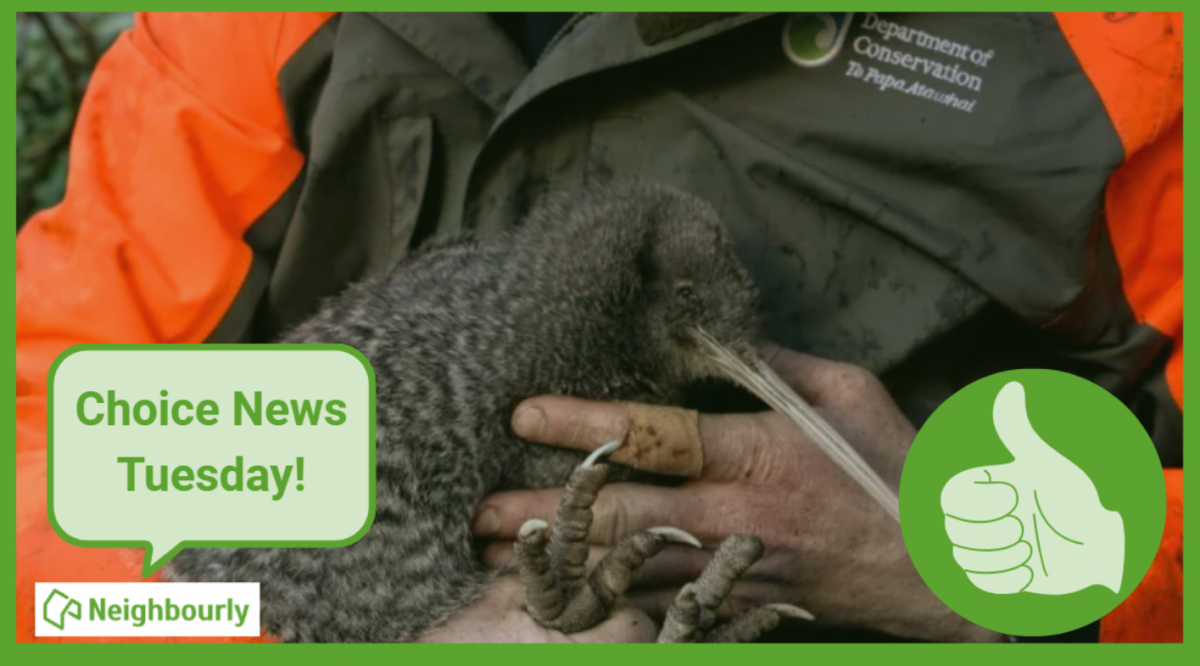
Some Choice News!
DOC is rolling out a new tool to help figure out what to tackle first when it comes to protecting our threatened species and the things putting them at risk.
Why does this matter? As Nikki Macdonald from The Post points out, we’re a country with around 4,400 threatened species. With limited time and funding, conservation has always meant making tough calls about what gets attention first.
For the first time, DOC has put real numbers around what it would take to do everything needed to properly safeguard our unique natural environment. The new BioInvest tool shows the scale of the challenge: 310,177 actions across 28,007 sites.
Now that we can see the full picture, it brings the big question into focus: how much do we, as Kiwis, truly value protecting nature — and what are we prepared to invest to make it happen?
We hope this brings a smile!

Scam Alert: Bank cold calls
ASB is warning customers about reports of cold calls from scammers claiming to be from ASB. These scammers are trying to obtain personal information, including usernames, dates of birth, and verification codes sent to your mobile phone.
🛡️ The "Caller Check" Test
If you get a call from someone claiming to be from ASB and you’re unsure, just ask them for a Caller Check. You will then be able to verify the call through the app.
Remember, banks will:
❌ Never ask for your banking passwords, PINs, or verification codes
❌ Never need to know your full credit card number – especially the CVC
❌ Never ask you to download software or remotely access your device
❌ Never ask you to purchase gift cards or transfer funds.
If you have received a phone call and think your account has been compromised, call ASB on 0800 ASB FRAUD (0800 272 372), or visit your local branch.
 Loading…