





Microforestry: What is it, benefits to the climate and beyond, and how to establish your own microforest.
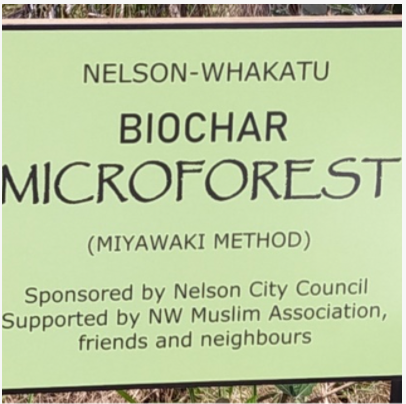
NTCF's Supporting Nature & Storing Carbon group invites you to learn about the Nelson Whakatu Biochar Microforest, believed to be the first biochar microforest in New Zealand. It's modelled on methods developed by Prof Akira Miyawaki in Japan.
DATE: Sunday, 25th July at 10am
VENUE: 5 Francois Way/Heights, Enner Glynn, Nelson
HOST: Colin Davis
TOPIC: Microforestry: What is it, benefits to the climate and beyond, and how to establish your own microforest.
By planting large numbers of mixed native tree species in a small area (minimum 30 sq metres) the theory is that growth rate is enhanced along with carbon sequestration which is claimed to be 30 times that of a plantation forest.
The key feature of our forest, where we have planted almost 300 trees in 100 sq metres, has been the advance treatment of the soil to produce good drainage as well as water retention and long term sharing of soil enhancement benefits. These are supported by drilling 200+ holes in the forest area through the clay subsoil and filling the holes with biochar and compost, allowing them to interact together. We produce the biochar on site by burning wood from cut down trees and producing a high temperature to allow pyrolysis to take place. One drum of burnt timber thus produces about 25 kilos of biochar.
We planted 25 species of native trees and shrubs, appropriate to the area, on 5th April and they are already growing well.
According to the Miyawaki Method, we planted them roughly 60cms apart and must now mulch the forest to a depth of 10-11cms. We must also weed and water for 3 years as necessary, after which the forest should be completely self-supporting.

🧩😏 Riddle me this, Neighbours…
I am an odd number. Take away a letter and I become even. What number am I?
Do you think you know the answer?
Want to stop seeing these in your newsfeed? No worries! Simply head here and click once on the Following button.


Poll: 🤖 What skills do you think give a CV the ultimate edge in a robot-filled workplace?
The Reserve Bank has shared some pretty blunt advice: there’s no such thing as a “safe” job anymore 🛟😑
Robots are stepping into repetitive roles in factories, plants and warehouses. AI is taking care of the admin tasks that once filled many mid-level office jobs.
We want to know: As the world evolves, what skills do you think give a CV the ultimate edge in a robot-filled workplace?
Want to read more? The Press has you covered!

-
52.9% Human-centred experience and communication
-
14.6% Critical thinking
-
29.8% Resilience and adaptability
-
2.7% Other - I will share below!

Some Choice News!
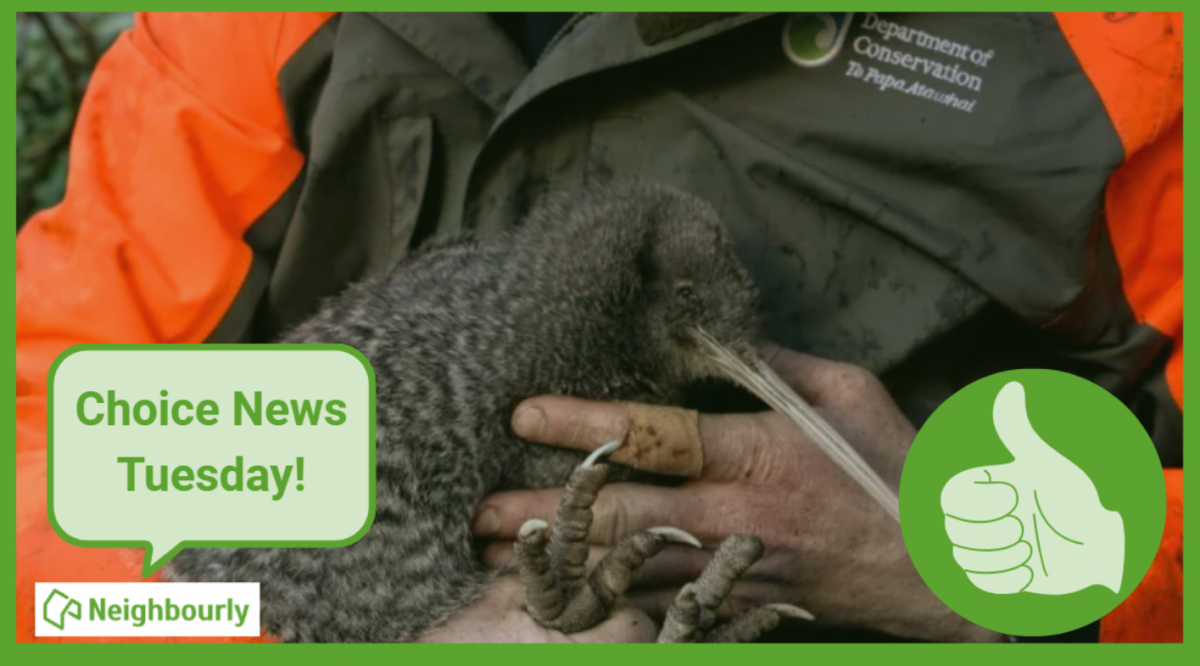
DOC is rolling out a new tool to help figure out what to tackle first when it comes to protecting our threatened species and the things putting them at risk.
Why does this matter? As Nikki Macdonald from The Post points out, we’re a country with around 4,400 threatened species. With limited time and funding, conservation has always meant making tough calls about what gets attention first.
For the first time, DOC has put real numbers around what it would take to do everything needed to properly safeguard our unique natural environment. The new BioInvest tool shows the scale of the challenge: 310,177 actions across 28,007 sites.
Now that we can see the full picture, it brings the big question into focus: how much do we, as Kiwis, truly value protecting nature — and what are we prepared to invest to make it happen?
We hope this brings a smile!
 Loading…