






Coco Coir Fibre
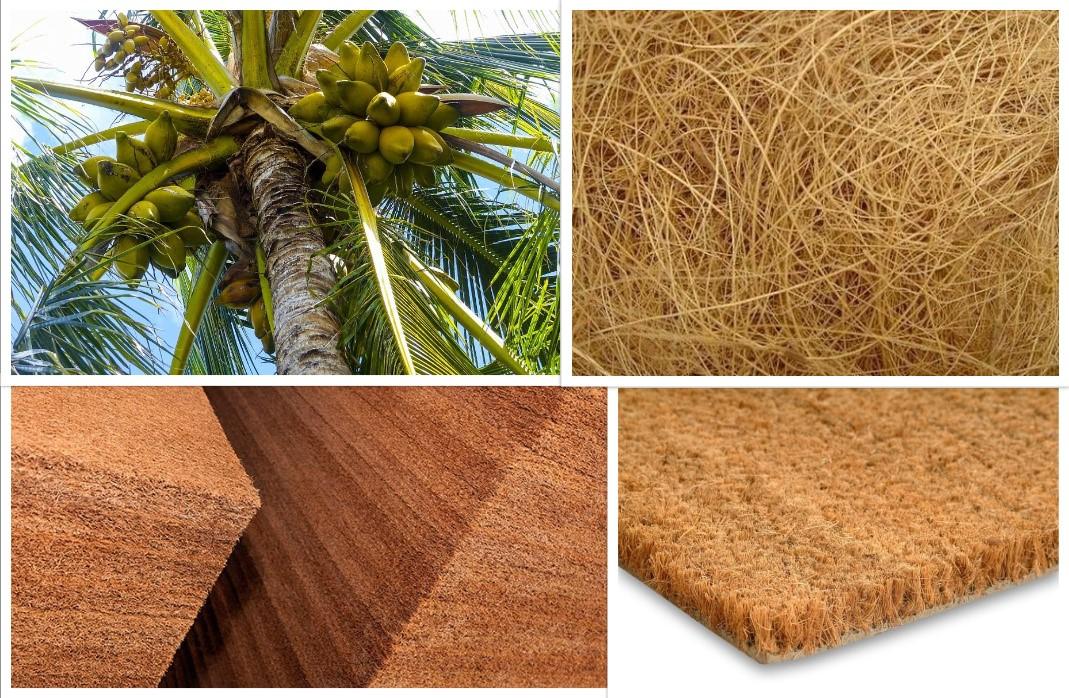
The thickest and most resistant of all commercial natural fibres, coir is a coarse, short fibre extracted from the outer shell of coconuts.
Coconut coir or, “Coco coir”, is a very versatile resource that is harvested from a fibrous layer underneath the exterior shell of the coconut. Since coconut growers consider it a waste product, its utilization is highly sustainable. You may have heard of coco coir being used in gardening, but there are many applications for it across multiple industries, beyond horticulture. Here are 10 interesting facts about coco coir that you probably didn’t know!
• Coco coir has many uses including in textiles, upholstery, making rope/fishing nets, environmental cleanup and horticulture, floor mats, doormats, brushes and mattresses.
• There is brown coco coir & white coco coir, each with different properties. When coconuts are ripe, they produce brown coir which is used in gardening and horticulture. White coir is harvested from unripe coconuts, and is much finer and lighter, it even floats on water. This makes it ideal for fishing nets, brushes, and finer textiles.
• Coco coir works well as a snail deterrent when used in the garden.
• Coco coir is highly absorbent and can hold up to 10x the water as peat moss. Some use it as a sustainable alternative to peat moss
• People often use coco coir as bedding in terrariums for snakes, lizards, turtles, and spiders.
• When used for gardening, coco coir is usually packed in a compressed brick. You need to soak the brick with water which allows it to expand substantially. You can then use it as a growing medium or potting mix additive.
• Coco coir contains very low levels of nutrients, so you can’t normally use it as the sole growing medium for plants, EXCEPT, you can use it for microgreens due to their extremely short grow cycle. This is because they don’t require soil nutrients. You also use coco coir in hydroponics since you add the nutrients directly into the water.
• You can re-use coco coir several times in gardening as it retains its properties over time.
• Because of its highly absorptive properties, people sometimes use coco coir to help clean up oil spills and other caustic fluids.
• People use coco coir in litter boxes and animal bedding because of its highly absorptive capabilities. It is much more sustainable than traditional clay cat litter pellets, which don’t break down. Coco coir also absorbs much more liquid than hay, straw, or newspaper which people often use as animal bedding.
These are just a few of the many interesting characteristics and applications of coco coir. In the spirit of sustainability, the utilization of coco coir is a sound environmental practice. Spread the word and take a step in a more sustainable direction.

🧩😏 Riddle me this, Neighbours…
I am an odd number. Take away a letter and I become even. What number am I?
Do you think you know the answer?
Want to stop seeing these in your newsfeed? No worries! Simply head here and click once on the Following button.


Some Choice News!
DOC is rolling out a new tool to help figure out what to tackle first when it comes to protecting our threatened species and the things putting them at risk.
Why does this matter? As Nikki Macdonald from The Post points out, we’re a country with around 4,400 threatened species. With limited time and funding, conservation has always meant making tough calls about what gets attention first.
For the first time, DOC has put real numbers around what it would take to do everything needed to properly safeguard our unique natural environment. The new BioInvest tool shows the scale of the challenge: 310,177 actions across 28,007 sites.
Now that we can see the full picture, it brings the big question into focus: how much do we, as Kiwis, truly value protecting nature — and what are we prepared to invest to make it happen?
We hope this brings a smile!


Poll: Are you still heading to your local for your caffeine fix, or has the $$ changed your habits? ☕
Wellington’s identity is built on its cafe culture, but with costs climbing, that culture is under pressure. We’ve seen the headlines about recent closures, and it’s a tough pill to swallow along with a $6+ coffee.
We all want our favourite spots to stay open, but we also have to balance our own budgets ⚖️
We want to know: How are you handling the "coffee math" in 2026? Are you still heading to your local for a chat and a caffeine fix, or has the cost of living changed your habits?
Keen to read more about "coffee math"? The Post has you covered.

-
43.5% I avoid spending money on coffee
-
45.8% I still indulge at my local cafe
-
10.7% Irrelevant - coffee is not for me
 Loading…