






Monday Sport Blast From The Past: Jorge Sandoval
This weeks, I am using a story I wrote about cycling promoter Jorge Sandoval in 2017. I hope you enjoy it.
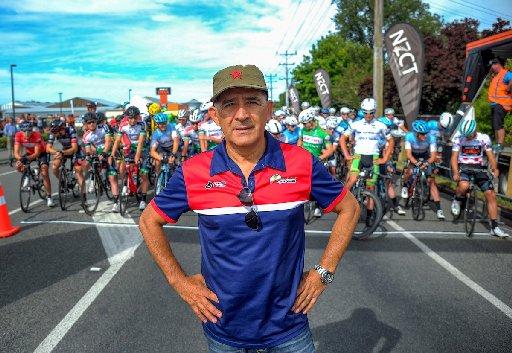
Cyclist Jorge Sandoval has a story that deserves to be widely known.
Recently, he was honoured with a Lifetime Service Award by Cycling New Zealand.
In the nearly quarter of a century I have been a journalist, I have been lucky to meet many interesting people.
But one person who will always stand out is Jorge.
I first met him when he came to the Hutt News looking for publicity for the Tour of Wellington.
Over time, I got to know him well and understand his fascinating story, including his time in a Chilean concentration camp.
Initially, he did not want to talk about when he was thrown into the camp by the Pinochet regime aged 19. He was tortured and saw many fellow prisoners die.
One of the few prisoners to survive the camp, he began a remarkable journey that would ultimately lead to Lower Hutt.
He fled to Argentina and in 1976 came to New Zealand as a refugee.
His first job was working in a Petone factory where the workers treated him as if he was "dumb" because he could not speak English.
Trying to blend in, he picked up some of the words his fellow workers used, including the F...word.
Much to his embarrassment, the Chilean ambassador had to explain its meaning.
Jorge found refuge in cycling and once he joined a club, he soon flourished and was good enough to represent New Zealand.
The lack of local events to ride in eventually annoyed him so much, he set up the Tour of Wellington. It would become an international event.
Jorge lived for cycling and what he regarded as Kiwis' indifference to the sport infuriated him.
When retailers in Lower Hutt and Petone complained about streets being closed for the Tour, he was blunt in his assessment that they were small-minded and lacked vision.
As I got to know him he opened up about his time in the concentration camp.
He was never bitter and his ability to move on was commendable.
Jorge deserves his recent recognition but at a time when some people oppose New Zealand taking refugees, he serves as a reminder as to why we should be generous as a country.
Forty-one years after starting work in a Petone factory, Jorge is a highly successful promoter. He has helped family members settle here, runs his own business and has organised more than 30 international cycling tours.
That is pretty good for a bloke who arrived in our country with nothing but a good attitude.


🧩😏 Riddle me this, Neighbours…
I am an odd number. Take away a letter and I become even. What number am I?
Do you think you know the answer?
Want to stop seeing these in your newsfeed? No worries! Simply head here and click once on the Following button.


Poll: 🤖 What skills do you think give a CV the ultimate edge in a robot-filled workplace?
The Reserve Bank has shared some pretty blunt advice: there’s no such thing as a “safe” job anymore 🛟😑
Robots are stepping into repetitive roles in factories, plants and warehouses. AI is taking care of the admin tasks that once filled many mid-level office jobs.
We want to know: As the world evolves, what skills do you think give a CV the ultimate edge in a robot-filled workplace?
Want to read more? The Press has you covered!

-
53% Human-centred experience and communication
-
14.6% Critical thinking
-
29.6% Resilience and adaptability
-
2.7% Other - I will share below!

Some Choice News!
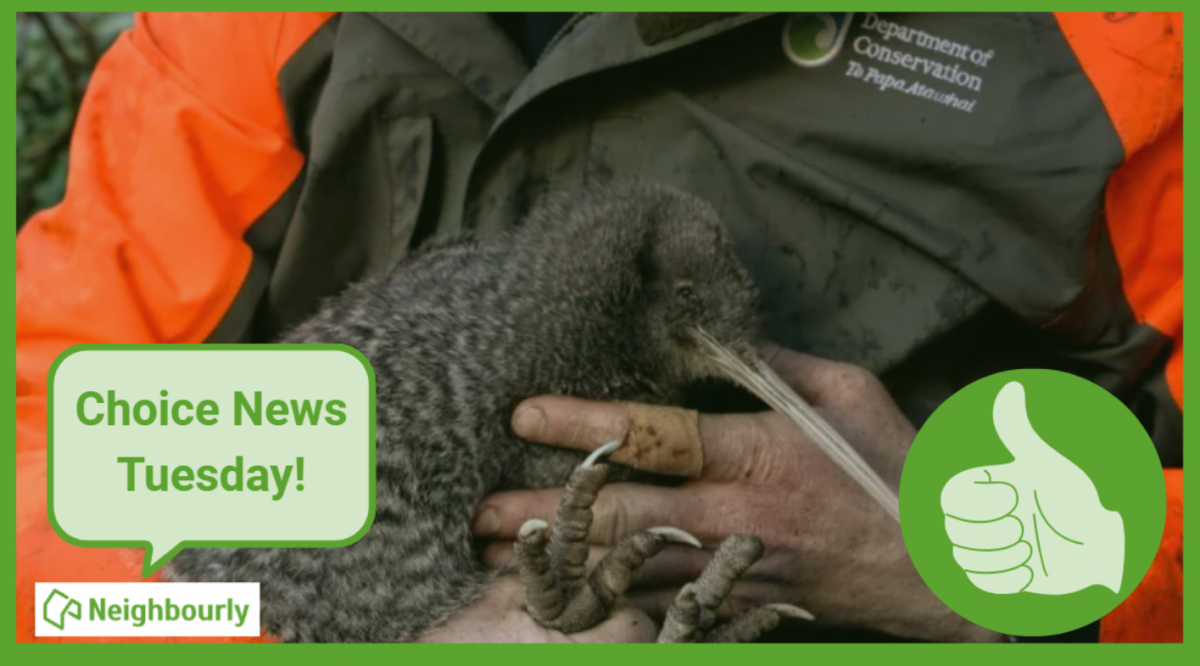
DOC is rolling out a new tool to help figure out what to tackle first when it comes to protecting our threatened species and the things putting them at risk.
Why does this matter? As Nikki Macdonald from The Post points out, we’re a country with around 4,400 threatened species. With limited time and funding, conservation has always meant making tough calls about what gets attention first.
For the first time, DOC has put real numbers around what it would take to do everything needed to properly safeguard our unique natural environment. The new BioInvest tool shows the scale of the challenge: 310,177 actions across 28,007 sites.
Now that we can see the full picture, it brings the big question into focus: how much do we, as Kiwis, truly value protecting nature — and what are we prepared to invest to make it happen?
We hope this brings a smile!
 Loading…