





Textile Fibres and Their Characteristics
We are passionate about fabrics and finding the right solutions for our customers. With over 110 years of experience in the textile industry we have compiled some of this knowledge and look forward to sharing it with you over the next year through our blog series – An Educational Yarn. Our first topic explores the different characteristics of textile fibres.
Textile fibres are natural or synthetic structures that can be spun into yarn. Yarns are then woven, knitted or bonded into fabric. The inherent characteristics of fibre properties directly relate to the performance and required care and maintenance of the finished fabric, therefore understanding fibres and yarns will in turn help you to understand the how to apply specific fabrics within your interior schemes.
Natural Fibres: Occurring in nature; which are of animal, vegetable/plant or mineral origin.
COTTON (Plant Origin)
• A strong fibre, even stronger when wet, cotton has good natural durability.
• Can be affected by mildew however a mildew resistant finish can be applied to reduce this issue.
• Generally has reasonable sunlight resistance but should be protected with a quality lining when used as a drapery and protected from direct sunlight when used as an upholstery.
• It is an absorbent fibre which means it can move with changing humidity levels.
• May shrink with laundering but this can be reduced through a finishing process on the fabric known as sanforising.
Sunlight resistance can be greatly reduced in acidic polluted conditions.
SILK (Animal origin; an animal fibre that comes from the silkworm. The silkworm creates its cocoon from very long silk fibres which are harvested from mulberry trees.)
• It is naturally fine in texture, and colours beautifully.
• Its biggest disadvantage in furnishing is its sensitivity to UV light degradation (direct and reflected). Due to its sensitivity, it should not be used in direct sunlight or even bright light.
• An absorbent fibre, it has the potential to move in humid environments.
• Silk is a relatively strong fibre and can withstand a certain amount of abrasion, particularly when used in conjunction with
• a backing fabric.
• Unrivalled in splendour and smoothness, silk is regarded the most exclusive of all natural fibres.
LINEN
Plant origin; derived from cellulose fibres that grow inside the stalks of the flax plant.
• As with cotton it is affected by acidic pollution.
• Can be affected by mildew which will likely cause the fibre to deteriorate over time.
• Considered to be the strongest of the natural fibres; if constructed for upholstery it is very durable, particularly when blended with up to 10% nylon.
• Is regarded as a luxury fibre because of its lustre and texture.
• It is an absorbent fibre which means it can move with changing humidity levels
• Linen has moderate sunlight resistance and should be protected by a quality lining when used as a drapery and protected from direct sunlight when used as an upholstery.
Keep reading: www.curtainclean.co.nz...


🧩😏 Riddle me this, Neighbours…
I am an odd number. Take away a letter and I become even. What number am I?
Do you think you know the answer?
Want to stop seeing these in your newsfeed? No worries! Simply head here and click once on the Following button.


Some Choice News!
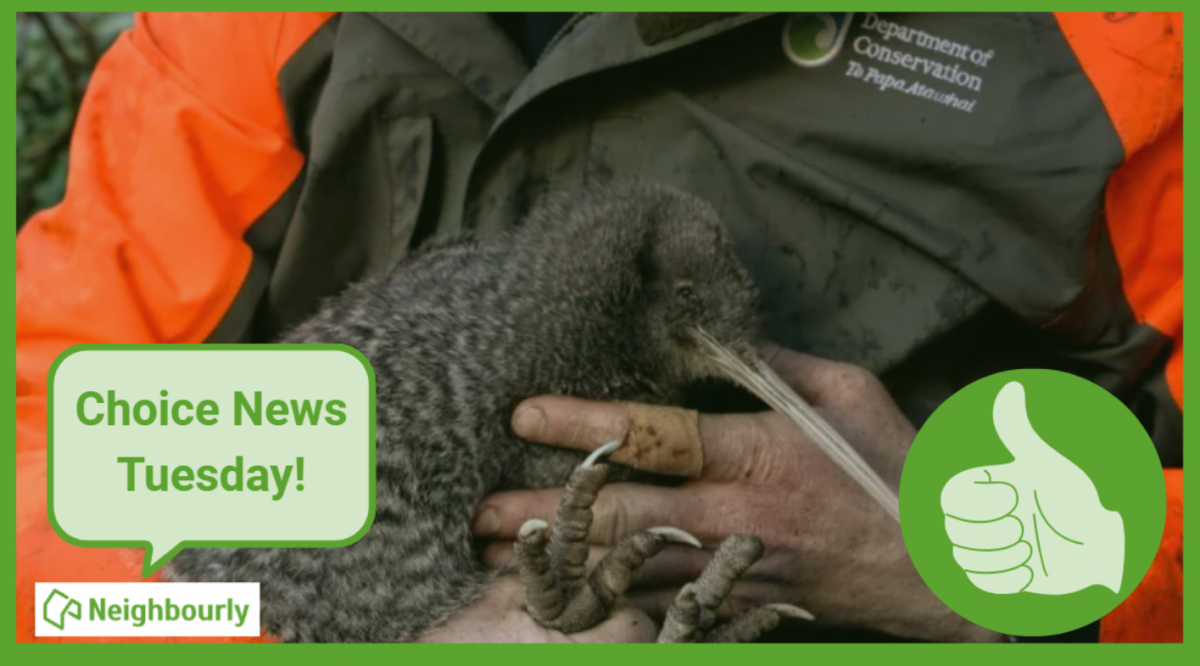
DOC is rolling out a new tool to help figure out what to tackle first when it comes to protecting our threatened species and the things putting them at risk.
Why does this matter? As Nikki Macdonald from The Post points out, we’re a country with around 4,400 threatened species. With limited time and funding, conservation has always meant making tough calls about what gets attention first.
For the first time, DOC has put real numbers around what it would take to do everything needed to properly safeguard our unique natural environment. The new BioInvest tool shows the scale of the challenge: 310,177 actions across 28,007 sites.
Now that we can see the full picture, it brings the big question into focus: how much do we, as Kiwis, truly value protecting nature — and what are we prepared to invest to make it happen?
We hope this brings a smile!

Poll: Are you still heading to your local for your caffeine fix, or has the $$ changed your habits? ☕
Wellington’s identity is built on its cafe culture, but with costs climbing, that culture is under pressure. We’ve seen the headlines about recent closures, and it’s a tough pill to swallow along with a $6+ coffee.
We all want our favourite spots to stay open, but we also have to balance our own budgets ⚖️
We want to know: How are you handling the "coffee math" in 2026? Are you still heading to your local for a chat and a caffeine fix, or has the cost of living changed your habits?
Keen to read more about "coffee math"? The Post has you covered.

-
42.2% I avoid spending money on coffee
-
47.4% I still indulge at my local cafe
-
10.4% Irrelevant - coffee is not for me
 Loading…