






Welcome swallows/warou - heralds of spring and adobe nest builders
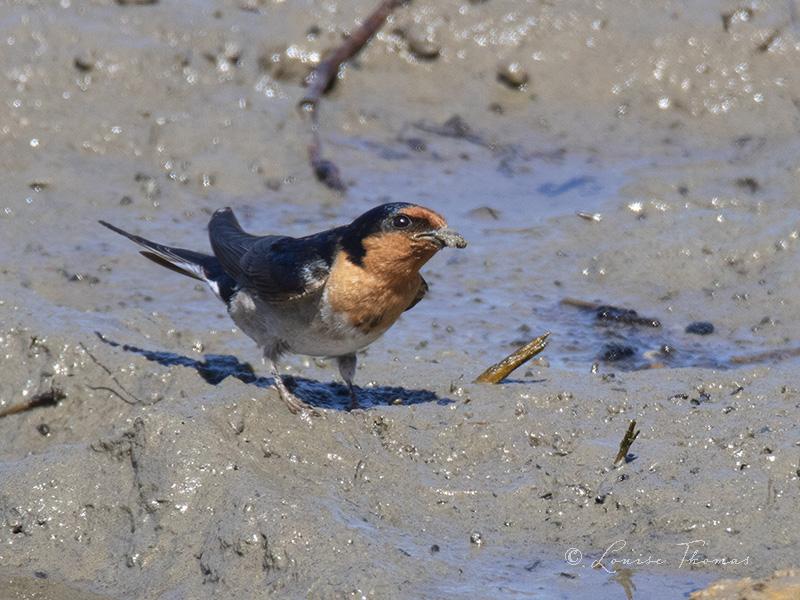
Welcome swallows/warou (Hirundo neoxena) are New Zealand's newest native bird - having arrived here from Australia under their own steam in enough numbers to breed sometime in the 1950s (although there are records of them here as far back as the 1920s). They can be found in many places throughout the Hutt around coastal areas and along our waterways. You can see them hawking for insects over the Hutt River in the early evening between the Ava Railbridge and the Ewen Bridge. They are brilliant architects, building adobe-style pudding-bowl-sized nests often on the sheltered and shaded sides of human buildings. Talk about adaptation. I watched a pair patiently scooping up beakfuls of mud, disappearing, and returning moments later for another beakful. It must take them hundreds of beakfuls of mud to get the nest finished – which is lined with comfy grass and feathers once the mud shell is complete. I've yet to get a good photo of a swallow in flight, but here are two briefly standing still. The second shows one of a pair scooping mud for a nest a few weeks ago.


🧩😏 Riddle me this, Neighbours…
I am an odd number. Take away a letter and I become even. What number am I?
Do you think you know the answer?
Want to stop seeing these in your newsfeed? No worries! Simply head here and click once on the Following button.


Line Dancing
What a pleasure it was to meet so many of youze from Neighbourly at Line dancing.Kathy is such a fitness freak an we luv her at 75.Believe it or Not ?
Great that most of you stayed behind for a cuppa an getting to meet new frenz.See y'all every Mon Ladies n Gents


Some Choice News!
DOC is rolling out a new tool to help figure out what to tackle first when it comes to protecting our threatened species and the things putting them at risk.
Why does this matter? As Nikki Macdonald from The Post points out, we’re a country with around 4,400 threatened species. With limited time and funding, conservation has always meant making tough calls about what gets attention first.
For the first time, DOC has put real numbers around what it would take to do everything needed to properly safeguard our unique natural environment. The new BioInvest tool shows the scale of the challenge: 310,177 actions across 28,007 sites.
Now that we can see the full picture, it brings the big question into focus: how much do we, as Kiwis, truly value protecting nature — and what are we prepared to invest to make it happen?
We hope this brings a smile!

 Loading…