






A warm welcome to our Alaskan godwits
Hi Neighbourly folk it is not Feathered Friend Friday but when I saw this post from Lower Hutt photographer Louise Thomas, I thought it was too good not to use.
Read what she had to say about her godwit/kuaka pictures.
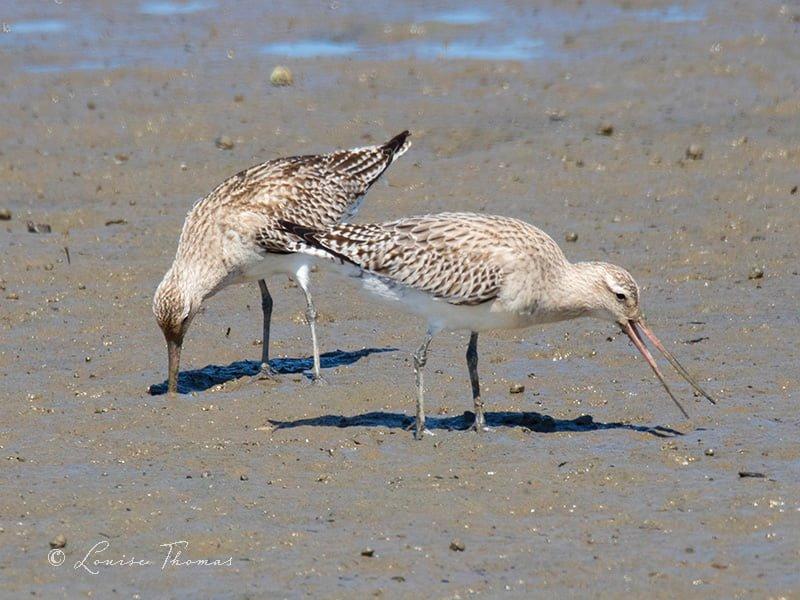
"Sometimes the most extraordinary birds come in the plainest of packaging, and so it is for the bar-tailed godwit/kuaka (Limosa lapponica). Their plain packaging is of course a perfect camouflage - with variegated shades of brown echoing the ripples of mud and sand where they feed.
Seen here foraging on a mud flat at the Waikanae River estuary, they shove their long beaks into the muddy sand and pull up rubbery bits of Godwit-knows-what which they gulp with gusto – not surprising as they are probably absolutely famished.
These migratory birds begin arriving in New Zealand from early September, after an extraordinary often non-stop eight to nine-day 11,000-12,000 km flight from western Alaska.
We are also lucky enough to get the occasional bird on Petone Beach and around the Hutt Estuary, but I was thrilled to see eight in non-breeding plumage congregated on the mud at Waikanae."

🧩😏 Riddle me this, Neighbours…
I am an odd number. Take away a letter and I become even. What number am I?
Do you think you know the answer?
Want to stop seeing these in your newsfeed? No worries! Simply head here and click once on the Following button.

Some Choice News!
DOC is rolling out a new tool to help figure out what to tackle first when it comes to protecting our threatened species and the things putting them at risk.
Why does this matter? As Nikki Macdonald from The Post points out, we’re a country with around 4,400 threatened species. With limited time and funding, conservation has always meant making tough calls about what gets attention first.
For the first time, DOC has put real numbers around what it would take to do everything needed to properly safeguard our unique natural environment. The new BioInvest tool shows the scale of the challenge: 310,177 actions across 28,007 sites.
Now that we can see the full picture, it brings the big question into focus: how much do we, as Kiwis, truly value protecting nature — and what are we prepared to invest to make it happen?
We hope this brings a smile!


Scam Alert: Bank cold calls
ASB is warning customers about reports of cold calls from scammers claiming to be from ASB. These scammers are trying to obtain personal information, including usernames, dates of birth, and verification codes sent to your mobile phone.
🛡️ The "Caller Check" Test
If you get a call from someone claiming to be from ASB and you’re unsure, just ask them for a Caller Check. You will then be able to verify the call through the app.
Remember, banks will:
❌ Never ask for your banking passwords, PINs, or verification codes
❌ Never need to know your full credit card number – especially the CVC
❌ Never ask you to download software or remotely access your device
❌ Never ask you to purchase gift cards or transfer funds.
If you have received a phone call and think your account has been compromised, call ASB on 0800 ASB FRAUD (0800 272 372), or visit your local branch.
 Loading…