






Concerns about legitimacy of Levin landfill agreement
Assurances were given by Horowhenua District Council chief executive David Clapperton that, "he would convince councillors" to vote in favour of closing the Levin landfill by 2025.
David Moore of Ngāti Pareraukawa made the statement at a 17 March public meeting organised by Horowhenua District Ratepayers and Residents Association Inc (HDRRAI) to inform members and the public about a controversial Levin landfill agreement signed by only five of eleven parties.
The statement made by Mr Moore, and refusal of the majority to sign the agreement, adds to a growing concern about the legitimacy of the agreement signed by the Council, HDRRAI, Horowhenua Environmental Kaitiaki Association (HEKA), Ngati Raukawa hapu Ngati Pareraukawa and Peter Everton of Everton Farm Ltd and Lakeview Farm Ltd.
Council's 2017 Significance and Engagement Policy says the Council is legally required to consult the public under Special Consultative Procedure (SCP), "in a meaningful way" as defined by Section 14 of the Local Government Act requiring local authorities to, "conduct its business in an open, transparent and democratically accountable manner."
The parties that didn’t sign include Water and Environmental Care Association (WECA), Palmerston North City Environmental Trust and four individual parties to an Environment Court appeal about odour and leachate concerns at Levin landfill. Mr Moore said over 400 odour complaints have been made in the last four to five years.
Of the five parties to sign the agreement HDRRAI chair Christine Moriarty was also one of three lead negotiators for HEKA and HEKA chair Geoff Keith is also chair of WECA that did not sign the agreement.
Trevor Hinder of WECA said WECA had "stepped away" so that if the Council did not conform to conditions of the agreement WECA would take Council "back to Court."
Environmental campaigner, former member of WECA and life time member of HDRRAI Christina Paton said HEKA was not an incorporated entity yet the statutory title was included on the legal agreement demonstrating, "the parties do not know how to conduct themselves at a basic level."
Ms Moriarty replied, "I can't answer that question. The Environment Court judge chose to accept that HEKA could use the incorporated title."
Mrs Paton also asked how HDRRAI interpreted who comprised "the community" in relation to clauses recommending a new Community Neighbourhood Liaison Group (CNLG) be established.
"Please contact other ratepayer associations throughout the district and get them to come on board to be part of the community," she said.
Former Horowhenua Greypower president and long-time ratepayer member Lew Rohloff asked where the waste would go if the tip closed - which the agreement does not address at all.
"We need to know what is happening in wider terms," he said.

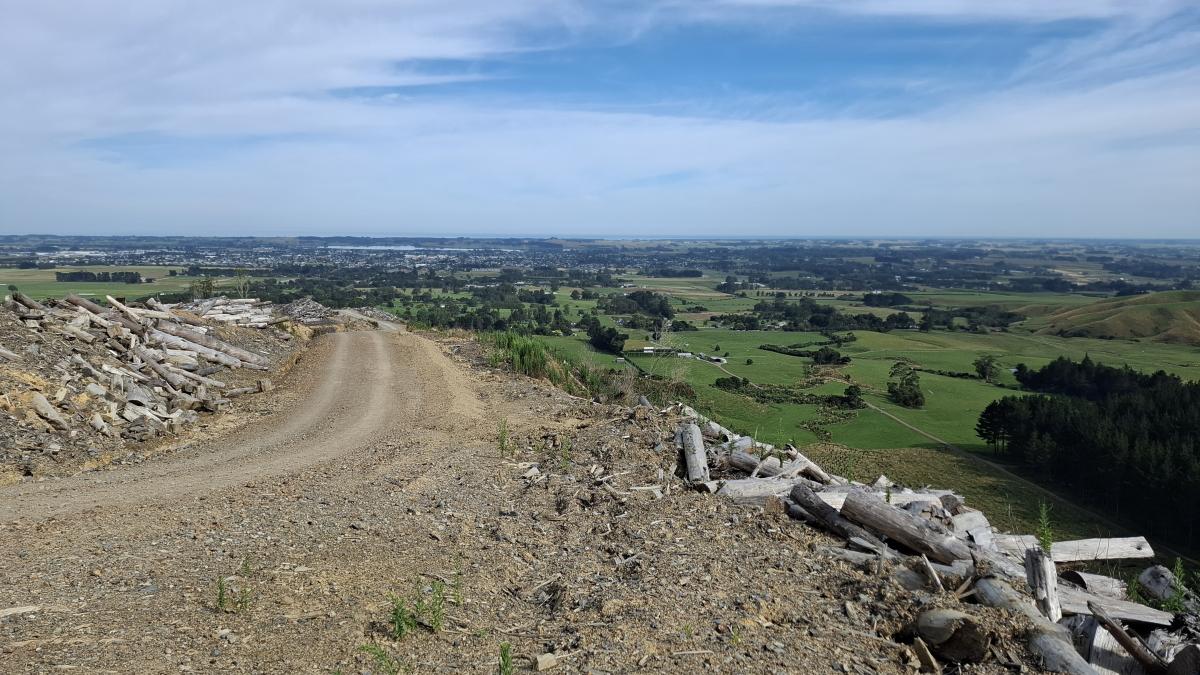
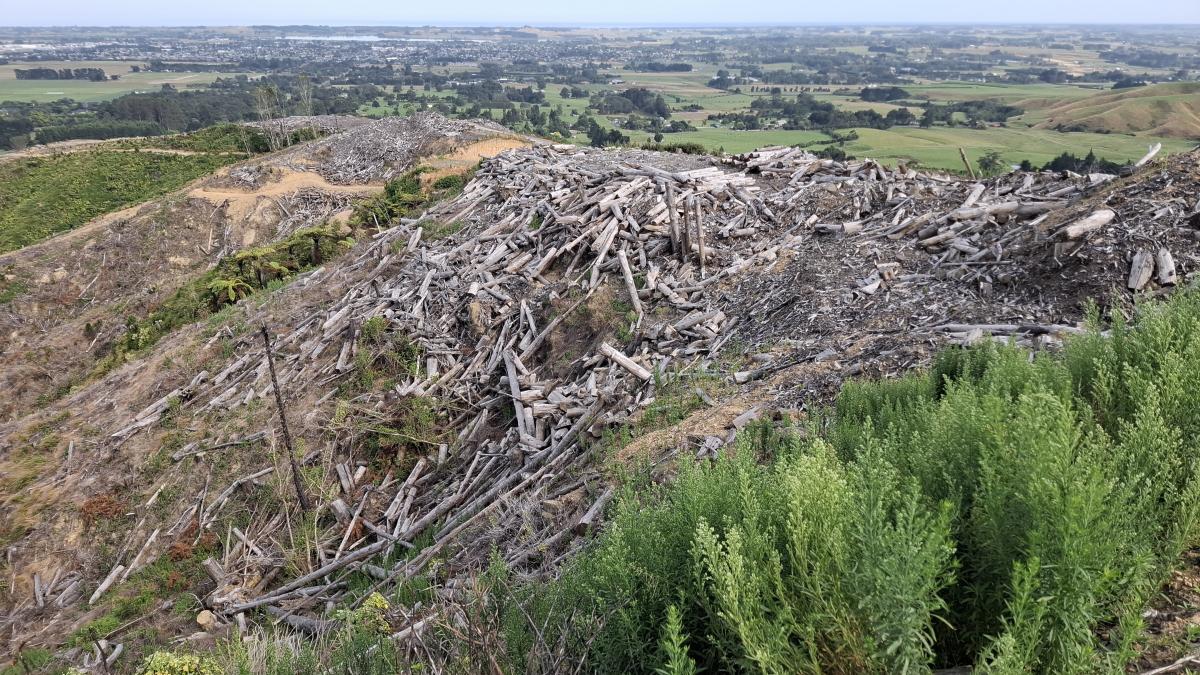
SLASH BESIDE THE TRACK UP TO TRIG
I question the wisdom and the morality of an industry which creates so much waste, waste which is also a cause of widespread and devastating damage. So, I searched the internet for potential uses of slash. It was easy to find.
I recommend a visit to nzbioforestry.co.nz. I quote from the website:
OUR SOLUTION:
NZ Bio Forestry proposes to develop a sustainable renewable forestry model that increases the economic value of the NZ- Aotearoa forestry sector, simply by integrating bio-technologies augmenting the forestry, wood manufacturing, and petrochemistry industries into one model.
Specifically, our strategy is to utilise the whole tree and convert the tree’s sugars into bioenergy, biomaterials, and biochemicals. This means using slash, off cuts, pruning, and wood waste to produce biofuel via bio pellets and biochemicals. It means optimising logs through the whole process….logging, manufacturing freighting, and refining process to serve the many Asia-Pacific markets with high-value products….not just exporting raw logs to one or two large dominant markets! (End of quote)
NZ Bio Forestry then contrasts the financial return from the present exports of raw logs with the potential return from utilising the WHOLE TREE.
In US dollars, the return from exporting logs is between $50 - $140 per log.
Using the whole tree including the slash and other waste for wood processing would return $200 - $800 per tree, and,
Using the bio-refinery process to convert the wood waste into fossil-free biochemicals would return $2,500 - $11,200 per tree.
I can’t help but conclude that our current focus on exporting logs is a pitiful failure of industry and government policy compared with the potential benefits of processing THE WHOLE TREE. And to complete the argument, this not just theory. In Scandinavia, SCA, which owns Europe’s largest private forest with 2.7 million hectares, has built a well-invested value chain that maximises the value of each individual tree and all of the forestry’s resources.
A SUMMARY OF POTENTIAL ADDITIONAL PRODUCTS:
Wood Pellets and Chips: Slash can be collected, dried, and processed into hog fuel or wood pellets for use in industrial boilers, as a replacement for coal, to generate heat and electricity.
Biofuel Production: Research is underway to convert forest residues into marine biofuel to help decarbonize the shipping sector.
Gasification: Advanced, small-scale, on-site processing plants can turn slash into renewable energy products like bio-oil, ethanol, and hydrogen.
Biochemicals: Specialized refineries can convert woody waste into sustainable alternatives to plastics, chemicals, and industrial products.
WAKE UP Aotearoa, New Zealand!!!

🧩😏 Riddle me this, Neighbours…
I am an odd number. Take away a letter and I become even. What number am I?
Do you think you know the answer?
Want to stop seeing these in your newsfeed? No worries! Simply head here and click once on the Following button.


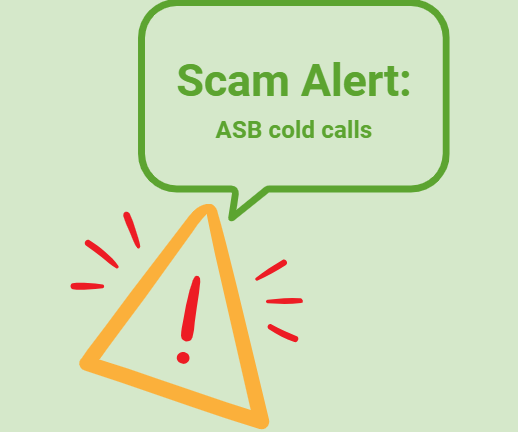
Scam Alert: Bank cold calls
ASB is warning customers about reports of cold calls from scammers claiming to be from ASB. These scammers are trying to obtain personal information, including usernames, dates of birth, and verification codes sent to your mobile phone.
🛡️ The "Caller Check" Test
If you get a call from someone claiming to be from ASB and you’re unsure, just ask them for a Caller Check. You will then be able to verify the call through the app.
Remember, banks will:
❌ Never ask for your banking passwords, PINs, or verification codes
❌ Never need to know your full credit card number – especially the CVC
❌ Never ask you to download software or remotely access your device
❌ Never ask you to purchase gift cards or transfer funds.
If you have received a phone call and think your account has been compromised, call ASB on 0800 ASB FRAUD (0800 272 372), or visit your local branch.
 Loading…