






HeritageTalks for 2021 @ Central Library Auckland, begins tomorrow!
Tamihana Te Rauparaha’s life of Te Rauparaha with Ross Calman
Auckland Central City Library
Wednesday 3 February
12pm to 1pm
In the late 1860s, Te Rauparaha’s son Tamihana wrote an account of his father’s life, now published for the first time in a Māori/English edition. Join us to hear translator and editor Ross Calman talk about restoring the mana of this important work.
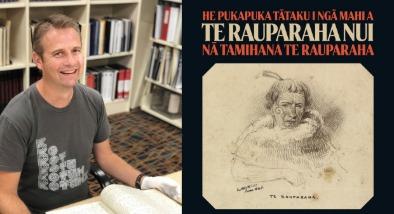
Ross with Tamihana's original manuscript, credit: Auckland Libraries. He Pukapuka Tātaku i ngā Mahi a Te Rauparaha Nui / A Record of the Life of the Great Te Rauparaha, credit: Auckland University Press.
In the late 1860s, Te Rauparaha’s son Tamihana wrote a 50,000-word account of his father’s life - the original manuscript is in the Sir George Grey Special Collections at Tāmaki Pātaka Kōrero Auckland Central City Library (GNZMMS 27). A rich source of Ngāti Toa history, language and culture, it offers fascinating insights into traditional Māori society and the tumultuous history of the 1820s and 1830s.
Tamihana’s account has now been published in full for the first time in a parallel Māori/English edition as He Pukapuka Tātaku i ngā Mahi a Te Rauparaha Nui / A Record of the Life of the Great Te Rauparaha (Auckland University Press, November 2020).
In this talk, the book’s translator and editor Ross Calman will describe some of the detective work it took in order to shed light on the creation of the manuscript, as well as giving an overview of how Tamihana’s account has been represented by various writers and translators over the past 150 years and describing some of the challenges he faced in interpreting the manuscript for a modern audience.
Ross Calman (Ngāti Toa, Ngāti Raukawa-ki-te-tonga, Ngāi Tahu) is a Wellington-based writer, editor and translator, and a descendant of Te Rauparaha. His other works include Te Tiriti o Waitangi/The Treaty of Waitangi (with Mark Derby and Toby Morris), The New Zealand Wars, The Reed Book of Māori Mythology (with A. W. Reed) and The Essential Māori Dictionary (with Margaret Sinclair).
This event will be held in the Whare Wānanga on Level 2 of the Central City Library and online via Zoom.
Book now
Email arc@aucklandcouncil.govt.nz to book (booking essential) or register in advance to join the online webinar via Zoom
www.aucklandlibraries.govt.nz...
After registering for Zoom, you will receive a confirmation email containing information about joining via Zoom.
See other HeritageTalks events for 2021 here:
www.aucklandlibraries.govt.nz...
Ngā mihi nui
Nāku, nā - Seonaid

🎉 Riddle me this, legends! 🎉
He/She who makes it, sells it.
He/She who buys it, doesn't use it.
The user doesn't know they are using it.
What is it?
(Shezz from Ngāruawāhia kindly provided this head-scratcher ... thanks, Shezz!)
Do you think you know the answer? Simply 'Like' this post if you know the answer and the big reveal will be posted in the comments at 2pm on the day!
Want to stop seeing these in your newsfeed?
Head here and hover on the Following button on the top right of the page (and it will show Unfollow) and then click it. If it is giving you the option to Follow, then you've successfully unfollowed the Riddles page.


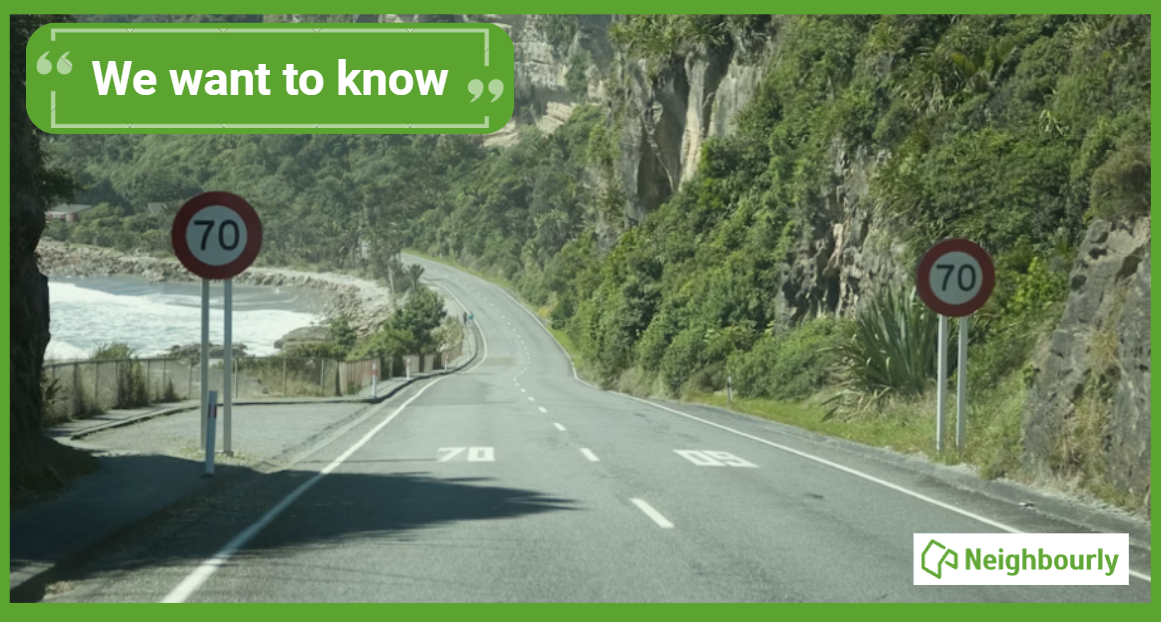
Poll: If we want to reduce speeding, what do you think actually changes driver behaviour? 🛻🚨🚓
In the Post's article on speeding penalties, the question is asked whether speeding fines are truly about road safety, or are they just a way to boost revenue for the Crown?
What do you think? Should speeding motorists receive speeding fines or demerit points?
-
38.3% The sting of a fine (Money talks!)
-
61.7% The threat of demerit points (Nobody wants to lose their license!)

Some Choice News!
DOC is rolling out a new tool to help figure out what to tackle first when it comes to protecting our threatened species and the things putting them at risk.
Why does this matter? As Nikki Macdonald from The Post points out, we’re a country with around 4,400 threatened species. With limited time and funding, conservation has always meant making tough calls about what gets attention first.
For the first time, DOC has put real numbers around what it would take to do everything needed to properly safeguard our unique natural environment. The new BioInvest tool shows the scale of the challenge: 310,177 actions across 28,007 sites.
Now that we can see the full picture, it brings the big question into focus: how much do we, as Kiwis, truly value protecting nature — and what are we prepared to invest to make it happen?
We hope this brings a smile!

 Loading…