





Unit pricing – the secret to saving at the supermarket
Have you ever found yourself standing in a supermarket aisle wondering which size packet offers the better deal? Throw in some products on special, and it’s easy to feel baffled.
Once you know about unit prices though, you won’t need to do any tricky supermarket maths ever again. And it’s easy to learn how to use unit pricing.
The unit price is the smaller money amount that usually sits at the bottom of the price tag. It shows you how much the product costs per unit of measure. The measure could be per kilogram or litre or per item for example. When you use the unit price, you can see how much you’re paying per egg, per nappy or per 100 sheets of toilet paper.
Here's what the unit price looks like:
=============================
Supermarkets that have a floor space of more than 1,000m2 have had to display unit prices on the shelves since August 2024. From 31 August 2025, they will also have to display unit prices online.
But supermarkets aren’t the only ones that have to show unit prices. Unit pricing has to be shown at any store over 1,000m2 that sells food from the following 10 categories.
Bread
Dairy products
Eggs or egg products
Fruit
Vegetables
Meat
Fish
Rice
Sugar
Manufacturer-packaged food.
There’s a list of units of measure that the stores must use depending on the type of product. For example, meat must be priced per kilogram and drinks per litre.
Some products don’t have to display unit pricing. These include alcohol, tobacco and flowers.
How unit pricing is helping shoppers save
=================================
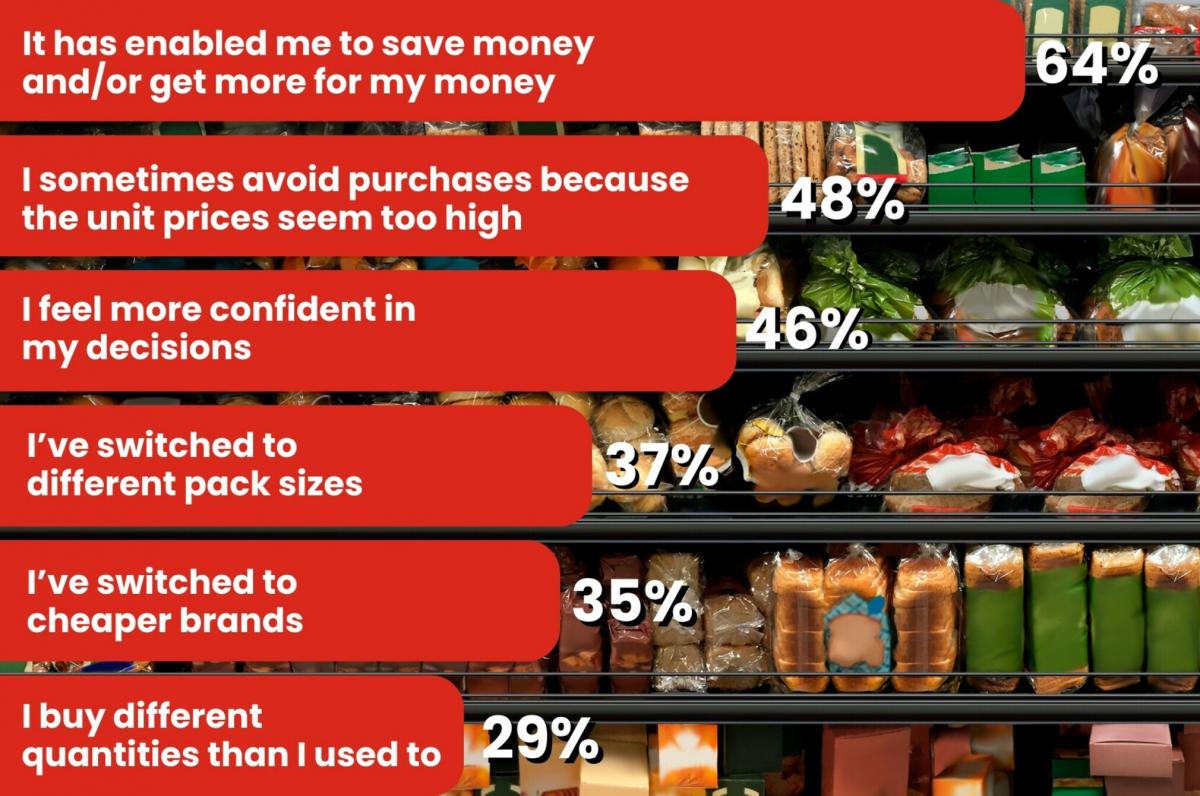
Once you learn about unit pricing, it can be really useful when you do your grocery shopping. It can help you work out which products offer the best value. From a survey we conducted on unit pricing, 64% of respondents said unit pricing helped them save money. Nearly half said they feel more confident doing their shopping because of unit pricing.
Here’s a snapshot of how people said unit pricing is helping them:
=====================================================
Unit pricing survey
Here’s what some survey respondents said about using unit pricing.
“I always use the unit price. Products on special are not necessarily the best value.”
“I use the unit price, for example, on tinned tomatoes, as the product is pretty much the same from one brand to another.”
The unit price dictates what I buy as I’m on a very strict budget.”
How to use unit pricing and save money
================================
We asked our survey respondents when they found unit pricing most helpful. Here are some of the most common scenarios people told us about.
1. When something is on special
Supermarkets have so many specials because they know it makes us more likely to add the ‘special’ item to our trolleys. Unit pricing helps you look past the promotion and find the real bargain.
2. When a product comes in different sizes
Imagine you’re trying to work out which pack of toilet paper to buy – the decision might be between a 4-pack, a 6-pack or an 8-pack. Unit pricing lets you see how much you’ll pay per 100 sheets. Of course, you might still want to take ply into account, but it’s easier to see which product gives you more bang for your buck.
3. When the packaging has changed
Shrinkflation is the word used to describe when a company downsizes its product without bringing the price down. It’s easy to keep going for the same product you’ve always bought without noticing there’s a difference in how much is inside the packaging. This is where unit pricing can help. By keeping an eye on unit pricing, we can see how the price of our favourites compares with the price of similar products.
4. When there are too many options
The supermarket can be a confusing place – think of the cheese section for example. There are blocks, slices and bags of grated cheese from various brands. Unit pricing cuts through the confusion to show you the most budget-friendly options.
5. When buying in bulk
When you’re buying in bulk, you might think it will be cheaper to get the biggest package size available. But this isn’t always the case – and a lot of people told us they discovered this when they started looking at unit prices. Bulk-buy bins, where you bag your own ingredients, can also sometimes be more expensive than buying a packet from the shelf.
Here are some other ways you could use unit pricing to help you save money.
===============================================
6. Comparing products within the supermarket
Unit pricing isn’t just for comparing the products you see in front of you on the shelf. Instead of buying a fresh vegetable, you could see how much you’d pay for the same amount frozen. Or instead of buying fresh fruit for baking, you could see if it’s cheaper buying fruit in a can.
7. Comparing the same product at different supermarkets
Unit pricing is also a good tool for comparing products between supermarkets because they don’t always stock the same size of a product. If you check out the unit prices on different supermarkets’ websites, you might decide it’s worth shopping around.
Extra tips for using unit pricing
=========================
New World, Pak’nSave and Woolworths’ websites let you sort products by unit price. This makes it easy to choose the product with the best value.
You may get tripped up both instore and online when the measure used for the same product is different. For example, the unit price for dishwasher tablets is sometimes displayed as ‘per tablet’ or ‘per 100 tablets’.
Supermarkets are actually following the unit pricing rules here. Some products have a cut-off point of 40 items – if the packet contains more than 40 of an item, it should display the unit price per 100 rather than per actual item.
======================================================

Poll: Should we ditch daylight saving? 🕰️
First introduced in New Zealand in 1927 with the passing of the Summer Time Act, it's what we know as 'Daylight Saving' and this year it ends on the first Sunday in April.
While we do get to sleep in this time around, some people would like to scrap the clock tinkering for good.
And why? Some evidence suggests the time changes are bad for our health as they mess with sleep patterns leading to short-term fatigue and affecting mood. Meanwhile the hour change is frustrating for farmers and a nightmare for getting the littlies to sleep. But what's your take?

-
40.5% Yes - get rid of the clock changes
-
57.6% No, I enjoy it
-
1.9% Other - I'll share below

Sunday Market at St Johns – Come Say Hi!
Hi Neighbours !!!!
If you’re looking for an easy, feel-good way to start your Sunday, pop down to the St Johns Market it’s on every week and always worth a visit
Expect plenty to enjoy:
Delicious Food and Drink
Seasonal fruit & veg from local growers
Handmade goodies & crafts
Clothes, toys
It’s a laid-back, welcoming spot to catch up with neighbours, support local, and soak up the community vibe.
Stay connected & get updates:
Facebook
info.sjmarket@gmail.com
0274 671 446
Bring the kids, bring the dog, or just bring yourself and make a morning of it hope to see you there!
7 Allison Ferguson Drive, Auckland Netball Courts

Poll: Are you still heading to your local for your caffeine fix, or has the $$ changed your habits? ☕
Auckland has a thriving cafe culture, but with costs climbing, that culture is under pressure. We’ve seen the headlines about recent closures across the country, and it’s a tough pill to swallow along with a $6+ coffee.
We all want our favourite spots to stay open, but we also have to balance our own budgets ⚖️
We want to know: How are you handling the "coffee math" in 2026? Are you still heading to your local for a chat and a caffeine fix, or has the cost of living changed your habits?
Keen to read more about "coffee math"? The Post has you covered.
-
42.7% I avoid spending money on coffee
-
41.1% I still indulge at my local cafe
-
16.1% Irrelevant - coffee is not for me
 Loading…