




Queenstown housing shortage leads developers to innovate
By reporter Debbie Jamieson:
Property developers are coming up with new models for much-needed worker accommodation to alleviate a chronic housing shortage in Queenstown and Wānaka.
The South Island’s scenic Queenstown Lakes District has a well-documented housing crisis largely driven by the high cost of land, a shortage of housing and the financial appeal and growth of short-term visitor accommodation options such as Airbnb in residential property.
This has led to difficulties with finding accommodation for seasonal workers and working holiday visa holders employed in tourism and hospitality, which has affected many businesses.
Chris Broadhead, a Timaru-based commercial and industrial property developer, wanted to build a commercially viable development that would help the situation in Wānaka.
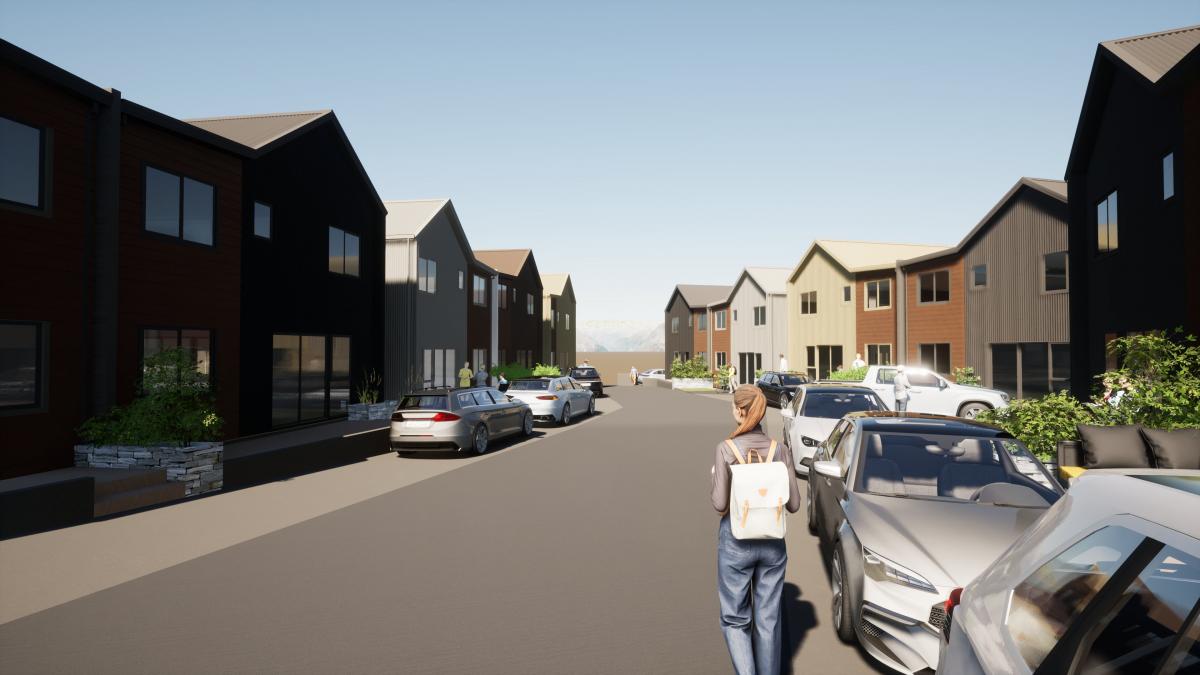
The solution he came up with was the 15-unit Reece Quarters project (artist's impression attached).
The seven-bedroom units would be based in a semi-industrial area, about 15 minutes’ walk from central Wānaka.
They would be sold separately and leased to people and businesses based exclusively in Central Otago.
They were different from traditional residential homes because they could be bought and leased as commercial entities, providing flexibility not available in traditional residential accommodation, Broadhead said.
Potential lessees included out-of-town businesses who wanted to house employees in Wānaka for short-term contracts, large seasonal employers, and local hospitality business needing homes for staff.
The apartments would each have en suites and separate heat pumps in each bedroom, dual kitchens and laundries, and communal living and dining spaces.
Some larger apartments would have configurations to cater for office space or extra bedrooms.
A covenant on the title requiring tenants to be working in Central Otago would ensure the units would remain as worker accommodation for the first 10 years, Broadhead said.
“I’m trying to support the community and make sure they don’t go to Airbnbs – it’s stuffing towns all over the world that are tourist destinations.”
The development has been on the market since the end of January with a starting price of $2 million (excluding GST), and one has sold.
Broadhead said the first stage would involve four units, and once that stage sold, he would commit to the remainder.
He anticipated investors would get a return of about 7.5% or more depending on their lease arrangement.
He had already been approached by another Wānaka investor looking to undertake a similar development in two years.
“The concept is completely new. It’s not been done in Queenstown or Wānaka at all,” he said.
The push for a new model of worker accommodation is forcing innovation in nearby Queenstown also.
Australian-based No.1 Hansen Road Ltd is seeking a fast-tracked resource consent for a 554-unit worker accommodation development known as Junction Village, in the suburb of Frankton.
Documents lodged with the Environmental Protection Authority say up to 710 people could live across eight buildings, in hostel-type rooms and one-, two- and three-bedroom units, next to the BP station.
Communal facilities would be provided within the buildings, and ground-floor commercial and retail tenancies were planned.
The ownership model for the units and buildings was unclear, but the application stated that the units were not short-term visitor accommodation and were not intended to be sold off individually.
The ongoing management of the worker accommodation was intended to be kept in-house with a management entity for the letting, supervision and operation of the complex.
The application noted that the applicant would determine whether to subdivide floors separately or retain entire buildings for sale or management by certain entities at a later date.
The company anticipated that the development would be built over four years, providing up to 540 full-time jobs.
In central Queenstown, the developers of the $2 billion Lakeview Te Taumata site have committed to a 96-apartment co-living hotel as part of the first phase of the wider development.
The apartments were small, private living units with shared lounge, dining room and workspace areas.
They would have a minimum booking requirement of seven nights, a spokesperson for Melbourne-based developer Ninety-Four Feet said.
“This will be a high-quality accommodation offering.
“We anticipate demand to stem from young professionals and corporate profiles who have regular business in the area, digital nomads – a key player in Queenstown’s burgeoning tech sector – as well as seasonal tourism workers.”
The company expected the first stage to be completed in 2027.
It would retain ownership of the co-living hotel, but it would be managed by an operator.

Poll: Does a savoury scone require cheese on top, or folded inside?
Help settle the great kiwi debate ... cheese on top, or folded inside?

-
76.7% Inside!
-
23.3% On top!
Got more greens than you know what to do with? 🥦🌱🥕
Whether it’s a courgette takeover or a feijoa frenzy, don’t let those garden gems go to waste!
Our suggestion to you: Did you know you can grate and freeze excess courgettes to use in chocolate cake later? It sounds a bit dodgy, but it makes the cake incredibly moist ... and hey, it counts as a serving of veg, right? 🍫
What’s your go-to move for a bumper harvest? Drop your best "glut" recipes or preservation hacks in the comments below! 👇


Get decorating with the Resene Sale !
20% off Resene premium paints, wood stains, primers & sealers and 20% off wallpaper and 20% off decorating accessories.
See your Resene Colorshop and bring out the best in your home.

 Loading…




