





October breast care month
OCTOBER BREAST CANCER
AWARENESS MONTH
This article is exclusively for WOMEN to appreciate the importance of regular breast care and checkup for any noticeable changes that may require further medical investigation to detect any unfortunate growth of cancer at an early stage before it is getting too late to treat.
Most women may consider BREAST SIZE, SHAPE & BEAUTY to be very important as a symbol of beauty, self-esteem, breastfeeding, sexual attraction, and arousal. Nevertheless, these factors including size have no bearing on her ability of WOMANHOOD?
Normally BREASTS may continue to develop fully only until pregnancy & lactation depending on genes, lifestyle, body weight, exercise, nutritional food, and massage. Once they fully develop then thereafter there is no likelihood of any significant change in their size and shape. Breasts are composed of fatty tissue and not muscle, chest exercises can mainly facilitate strengthening overall muscles around breasts enhancing their appearance and making them look better in shape to some extent.
THE IMPORTANCE OF SELF-EXAMINATION & AWARENESS CANNOT BE OVERLOOKED.
TODAY’S MAIN CONCERN HAPPENS TO BE BREAST CANCER THAT HAS often remained undetected in many cases till the untreatable stage due to lack of care and awareness.
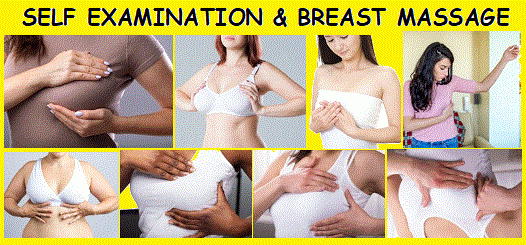
GENTLE BREAST MASSAGE AND SELF EXAMINATION
while exercising & regular breast examination can be helpful but A REGULAR GENTLE BREAST MASSAGE could also be very helpful providing multiple benefits in many ways like; alleviating muscle tension, activating energy, refreshing the breast skin; improving the inner circulatory system, flushes lymph system, increasing the lactation, observes abnormalities, boosts immunity, unblocks energy channels, reduces the risk of breast cancer and feeling more connected to the body.
Massage combined with self-examination can help to detect any lumps or abnormalities early in their development enabling immediate medical attention and timely treatment.
FLUSH LYMPH SYSTEM
AYURVEDA relies strongly on Breast massage as an effective preventive measure that allows movement of stagnant energy from vulnerable areas boosting the immune system and also helping to FLUSH LYMPH SYSTEM because that depends on movement, stretching, and light activity without having any pumping support like the heart.
EASY METHOD OF SELF MASSAGING;
1. Generally it is easy and there’s no right or wrong way excepting that you have to apply very gentle and light pressure, circular motions, and smooth strokes.
2. It’s best to use any basic heated oil like sesame or sunflower or others.
3. Cup your breast with your hand from underneath & massage gently from the outer breast to the nipple.
4. Continue in a circular motion/ slow clockwise circle, moving from the nipple toward the outside of the breasts and then to the armpits and breastbone as well.
5. Moving hands upward toward collarbone, shoulder joint and neck can help detoxify the lymph nodes and unclog any channels.
CAUTION:
It’s absolutely necessary to massage breasts carefully, softly & gently.
DISCLAIMER;
This is not a substitute for any professional advice or medical treatment. Massage can be harmful to persons having any health issues, complicated symptoms, or medical conditions & it is always advisable to consult with a physician or other healthcare professional.


Poll: Should the government levy industries that contribute to financial hardship?
As reported in the Post, there’s a $30 million funding gap in financial mentoring. This has led to services closing and mentors stepping in unpaid just to keep helping people in need 🪙💰🪙
One proposed solution? Small levies on industries that profit from financial hardship — like banks, casinos, and similar companies.
So we want to hear what you think:
Should the government ask these industries to contribute?

-
60.1% Yes, supporting people is important!
-
23.4% No, individuals should take responsibility
-
16.5% ... It is complicated

A Neighbourly Riddle! Don’t Overthink It… Or Do?😜
Do you think you know the answer? Simply 'Like' this post if you know the answer and the big reveal will be posted in the comments at 2pm on the day!
If you multiply this number by any other number, the answer will always be the same. What number is this?
Poll: As a customer, what do you think about automation?
The Press investigates the growing reliance on your unpaid labour.
Automation (or the “unpaid shift”) is often described as efficient ... but it tends to benefit employers more than consumers.
We want to know: What do you think about automation?
Are you for, or against?
-
9.7% For. Self-service is less frustrating and convenient.
-
43.2% I want to be able to choose.
-
47.1% Against. I want to deal with people.
 Loading…